The 36M gas limit signals are fossils

I had been reading the gas-limit signalling table too literally.
It shows a stubborn 30M/36M tail, even though Ethereum's block headers have been sitting around 60M gas for months. I used to describe that tail as validators still signalling old limits. That was too generous. A chunk of it looks like relay-registration fossils.
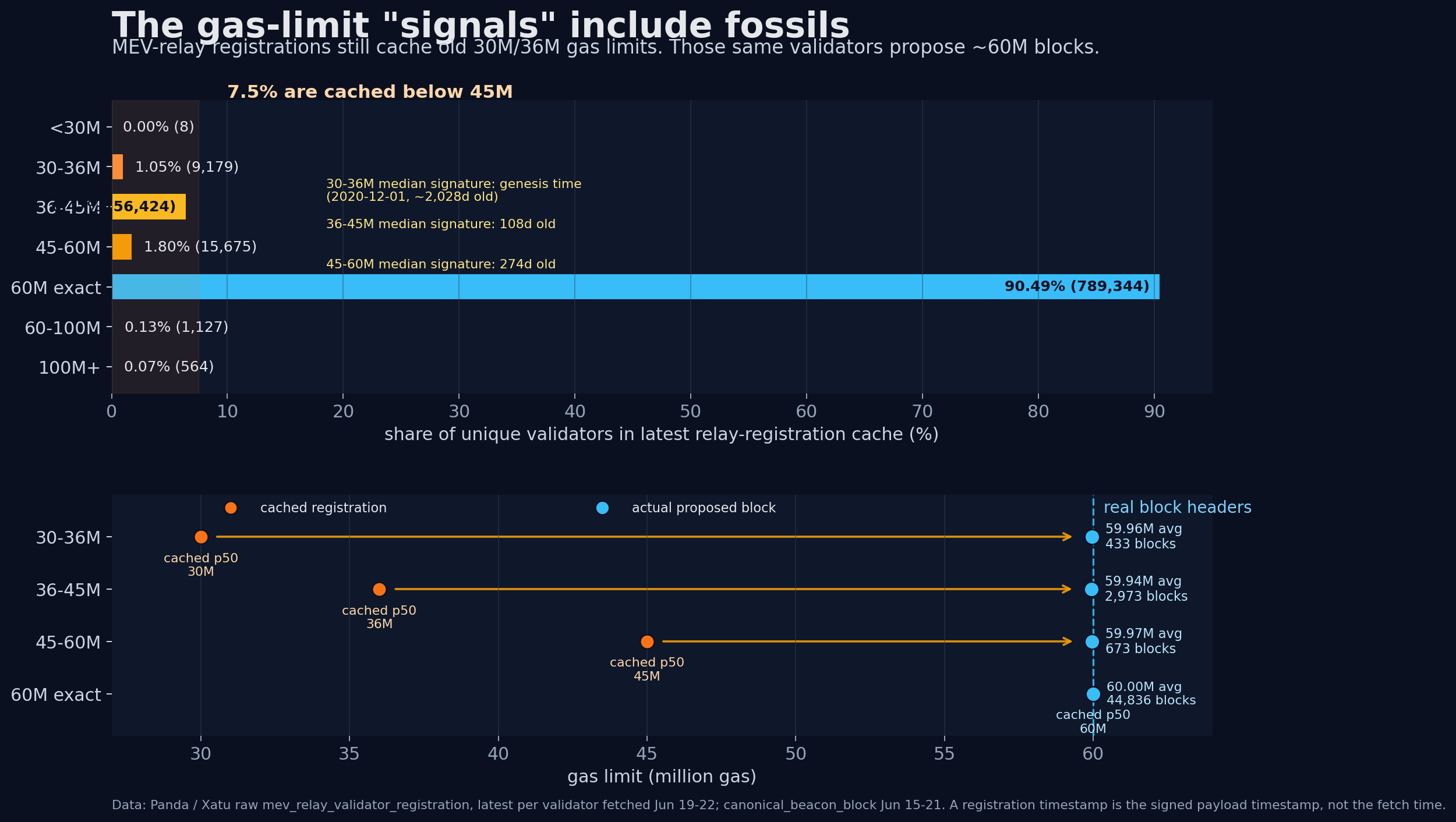
The table behind this is mev_relay_validator_registration. It is not a block-header vote. It is what relays have cached for validator registrations: fee recipient, timestamp, gas limit, relay name, validator index.
That distinction matters.
Using the latest cached registration per validator fetched between June 19 and June 22, I get this:
- 90.49% of validators had a cached registration at exactly 60M gas.
- 7.52% were cached below 45M.
- The 30-36M bucket had 9,179 validators, and its median signed timestamp was 2020-12-01 12:00:23. Beacon genesis time.
- The 36-45M bucket had 56,424 validators. Its median signed timestamp was 2026-03-06, or about 108 days old at fetch time.
That timestamp is inside the signed registration. It is not when Panda fetched the row. So the genesis-time entries are not a fresh 2026 signal. They are old signatures still sitting in relay caches.
Here is the query I used for the chart. The important bit is the join to actual proposed blocks at the bottom. If a validator's relay registration says 30M or 36M but the validator later proposes a 60M block, the registration is not a live gas-limit preference.
WITH latest AS (
  SELECT
    validator_index,
    argMax(gas_limit, event_date_time) AS reg_gas_limit,
    argMax(timestamp, event_date_time) AS reg_ts,
    max(event_date_time) AS fetched_at,
    uniqExact(relay_name) AS relay_count
  FROM mev_relay_validator_registration
  WHERE meta_network_name = 'mainnet'
    AND event_date_time >= toDateTime('2026-06-19 00:00:00')
    AND event_date_time <  toDateTime('2026-06-22 10:00:00')
  GROUP BY validator_index
), proposed AS (
  SELECT
    proposer_index AS validator_index,
    count() AS blocks,
    avg(execution_payload_gas_limit) AS avg_block_gas_limit,
    min(execution_payload_gas_limit) AS min_block_gas_limit,
    max(execution_payload_gas_limit) AS max_block_gas_limit
  FROM canonical_beacon_block
  WHERE meta_network_name = 'mainnet'
    AND slot_start_date_time >= toDateTime('2026-06-15 00:00:00')
    AND slot_start_date_time <  toDateTime('2026-06-22 00:00:00')
    AND execution_payload_gas_limit > 0
  GROUP BY proposer_index
)
SELECT
  multiIf(
    reg_gas_limit < 30000000, '<30M',
    reg_gas_limit < 36000000, '30-36M',
    reg_gas_limit < 45000000, '36-45M',
    reg_gas_limit < 60000000, '45-60M',
    reg_gas_limit = 60000000, '60M exact',
    reg_gas_limit < 100000000, '60-100M',
    '100M+'
  ) AS reg_bucket,
  count() AS validators,
  round(100 * count() / sum(count()) OVER (), 3) AS pct_validators,
  round(quantileExact(0.5)(reg_gas_limit) / 1e6, 3) AS cached_p50_mgas,
  toString(quantileExact(0.5)(toDateTime(reg_ts))) AS p50_reg_time,
  round(quantileExact(0.5)((toUnixTimestamp(fetched_at) - reg_ts) / 86400), 1) AS p50_age_days,
  countIf(proposed.blocks > 0) AS validators_proposed,
  sum(proposed.blocks) AS proposed_blocks,
  round(avgIf(avg_block_gas_limit, proposed.blocks > 0) / 1e6, 3) AS actual_avg_mgas_for_proposers,
  round(minIf(min_block_gas_limit, proposed.blocks > 0) / 1e6, 3) AS actual_min_mgas_for_proposers,
  round(maxIf(max_block_gas_limit, proposed.blocks > 0) / 1e6, 3) AS actual_max_mgas_for_proposers
FROM latest
LEFT JOIN proposed USING (validator_index)
GROUP BY reg_bucket
ORDER BY min(reg_gas_limit)
The cross-check is the part that kills the naive interpretation.
Validators in the cached 30-36M bucket proposed 433 blocks during June 15-21. Their actual block headers averaged 59.960M gas.
Validators in the cached 36-45M bucket proposed 2,973 blocks. Their actual block headers averaged 59.942M gas.
So no, those cached registrations did not cap those blocks at 30M or 36M. They proposed normal 60M-ish blocks like everyone else.
I also checked the block-header surface directly:
SELECT
  toDate(slot_start_date_time) AS day,
  count() AS blocks,
  round(avg(execution_payload_gas_limit) / 1e6, 3) AS avg_mgas,
  round(min(execution_payload_gas_limit) / 1e6, 3) AS min_mgas,
  round(max(execution_payload_gas_limit) / 1e6, 3) AS max_mgas,
  countIf(execution_payload_gas_limit < 50000000) AS below50m_blocks
FROM canonical_beacon_block
WHERE meta_network_name = 'mainnet'
  AND slot_start_date_time >= toDateTime('2026-06-15 00:00:00')
  AND slot_start_date_time <  toDateTime('2026-06-22 00:00:00')
  AND execution_payload_gas_limit > 0
GROUP BY day
ORDER BY day
Every complete day from June 15 through June 21 averaged 59.992M to 59.995M gas. There were zero blocks below 50M.
The old 36M tail is real as a relay-cache artifact. It is not real as a current block-production signal.
This does not change the 2025 gas-limit story. The actual block-header series still shows Ethereum moving from 30M to 36M, then 45M, then 60M. That part is clean.
It does change the last paragraph I wrote back in February. I treated fct_execution_gas_limit_signalling_daily as current validator preference. Looking at the raw relay-registration rows now, that is too strong. The safer read is:
Relay registration caches still contain old gas-limit signatures. Some are ancient. Do not treat that table as a live vote without checking block headers.
That is a boring correction, but it matters. The block header is the vote. The relay cache is just a cache, and caches remember ghosts.