Metadata said four. ENR still said zero.

PeerDAS now has two places where a peer can tell you how many custody groups it claims to serve. I expected the live metadata handshake to clean up the old cgc=0 ENR hole. Instead it hid it.
I wrote a couple of weeks ago that PeerDAS had a custody count trap: peers advertising ENR cgc=0 were a small bucket, but they missed custody probes at a silly rate. That post used discovery ENRs from node_record_consensus and probe results. The obvious follow-up was to stop trusting the discovery record so much and ask the newer libp2p metadata surface what the peer said during request/response.
The spec gives both surfaces. The ENR has a cgc key: a big-endian custody group count where zero is encoded as an empty byte string. The Fulu metadata object also carries custody_group_count, next to seq_number, attnets, and syncnets. Same idea, different clock: one is what discovery saw, the other is what a connected peer answered through /eth2/beacon_chain/req/metadata/3/ssz_snappy.
The metadata-only view looked almost too clean. Across the seven complete UTC days from 2026-06-30 through 2026-07-06, I took the latest successful libp2p_handle_metadata row per peer. That gave 19,185 peers. Only 4 had latest custody_group_count = 0, and none of those four showed up in the bounded custody-probe set I used for the chart.
Then I joined the same probe set back to the latest ENR cgc from node_record_consensus, parsed the hex, and the old hole came back:
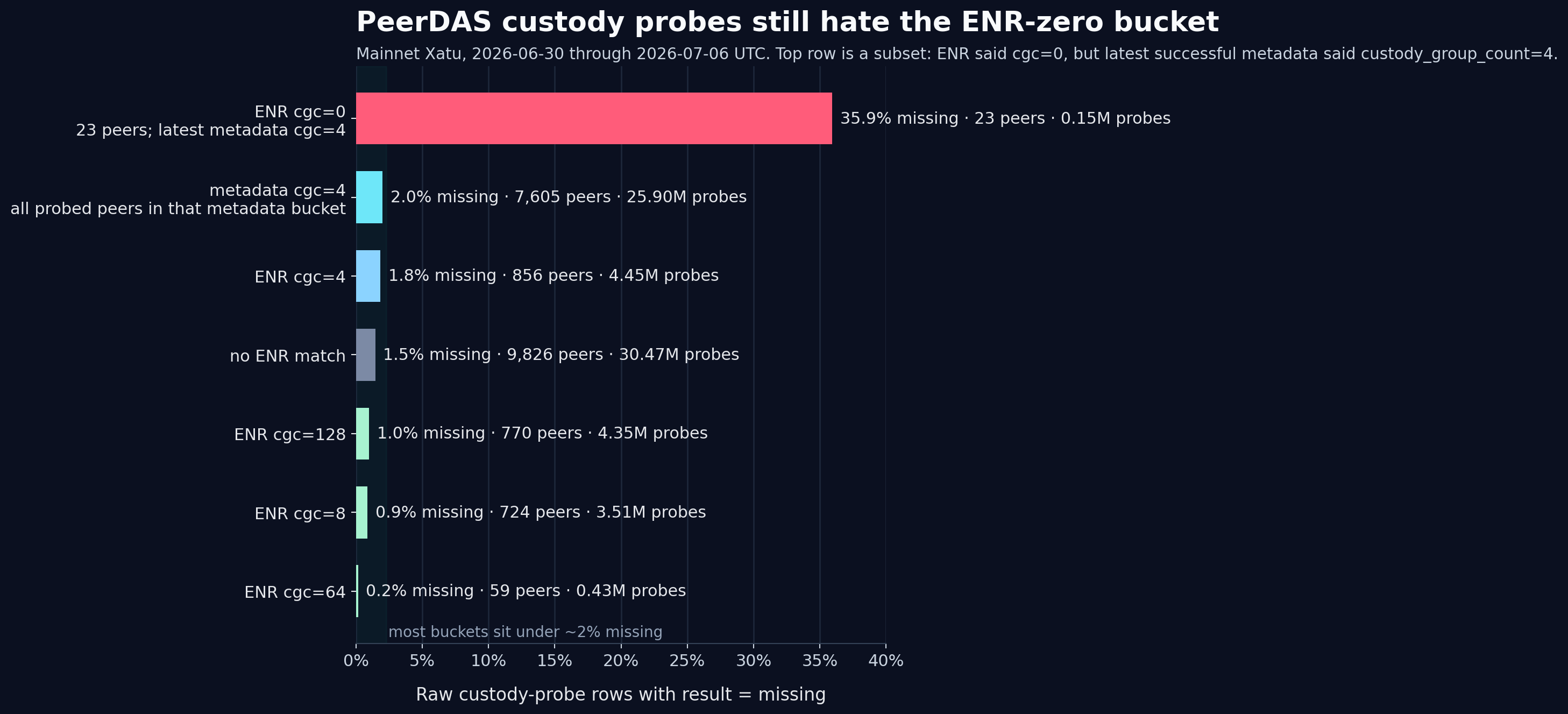
The awkward bucket is tiny but very real in this sample: 23 probed peers whose latest ENR said cgc=0. They had 146,160 raw custody-probe rows. 52,535 were missing, which is 35.94%. Every one of those 23 peers had latest successful metadata saying custody_group_count = 4.
Here is the exact shape of the query. I kept the three surfaces separate and merged locally, because raw distributed joins are a great way to accidentally turn a small semantic check into a cluster workout:
START = "2026-06-30 00:00:00"
END = "2026-07-07 00:00:00"

metadata = clickhouse.query("clickhouse-raw", f"""
SELECT
  peer_id_unique_key,
  argMax(custody_group_count, event_date_time) AS metadata_cgc,
  max(event_date_time) AS metadata_last_seen
FROM default.libp2p_handle_metadata
WHERE meta_network_name = 'mainnet'
  AND event_date_time >= toDateTime('{START}')
  AND event_date_time <  toDateTime('{END}')
  AND (error IS NULL OR error = '')
GROUP BY peer_id_unique_key
""")

enr = clickhouse.query("clickhouse-raw", f"""
SELECT
  peer_id_unique_key,
  argMax(cgc, event_date_time) AS enr_cgc_raw,
  max(event_date_time) AS enr_last_seen
FROM default.node_record_consensus
WHERE meta_network_name = 'mainnet'
  AND event_date_time >= toDateTime('{START}')
  AND event_date_time <  toDateTime('{END}')
  AND peer_id_unique_key IS NOT NULL
GROUP BY peer_id_unique_key
""")

raw_probes = clickhouse.query("clickhouse-raw", f"""
SELECT
  peer_id_unique_key,
  count() AS probe_rows,
  countIf(result = 'success') AS success_rows,
  countIf(result = 'missing') AS missing_rows,
  countIf(result = 'failure') AS failure_rows
FROM default.libp2p_rpc_data_column_custody_probe
WHERE meta_network_name = 'mainnet'
  AND event_date_time >= toDateTime('{START}')
  AND event_date_time <  toDateTime('{END}')
  AND slot_start_date_time >= toDateTime('{START}')
  AND slot_start_date_time <  toDateTime('{END}')
GROUP BY peer_id_unique_key
""")
The cross-check used the refined probe table, but counted column units rather than refined rows because mainnet.int_custody_probe batches column_indices into arrays. That gave the same answer within four raw rows: 146,156 refined column units for the ENR-zero bucket, 52,535 missing. The denominator moved by rounding dust; the hole did not.
SELECT
  peer_id_unique_key,
  sum(length(column_indices)) AS refined_column_units,
  sumIf(length(column_indices), result = 'success') AS refined_success_units,
  sumIf(length(column_indices), result = 'missing') AS refined_missing_units,
  sumIf(length(column_indices), result = 'failure') AS refined_failure_units
FROM mainnet.int_custody_probe
WHERE probe_date_time >= toDateTime('2026-06-30 00:00:00')
  AND probe_date_time <  toDateTime('2026-07-07 00:00:00')
  AND slot_start_date_time >= toDateTime('2026-06-30 00:00:00')
  AND slot_start_date_time <  toDateTime('2026-07-07 00:00:00')
GROUP BY peer_id_unique_key;
The timing makes this more annoying, not less. For 22 of the 23 ENR-zero peers, the latest successful metadata row was newer than the latest ENR row in the same window. The median gap was 23.6 hours. So the naive story is not "metadata was stale and ENR was fresh." If anything, the metadata answer looked fresher and healthier.
I do not want to oversell that as a client bug. This is an observed Xatu peer/probe surface, not a validator census, and the join uses latest rows inside a week rather than reconstructing each peer's exact state before every probe. The daily shape also improved: the same 23 peers were missing 58.3% of bounded raw probes on Jun 30 and 22.7% on Jul 6. That is still ugly, but it is not a flat line.
The safer conclusion is the useful one: do not collapse ENR cgc and metadata custody_group_count into one field just because the names rhyme. Metadata-only grouping put the bad ENR-zero peers into the huge custody_group_count = 4 bucket, where the missing rate looked normal at 2.00%. ENR grouping kept the scar visible.
That is the trap. PeerDAS custody count is not just a number; it is a number from a surface at a time. When the surfaces disagree, the probe table gets the deciding vote.