Most libp2p disconnects lasted one second

libp2p_disconnected sounds like a peer-churn table. I would not use it that way.
Across the latest seven complete UTC days, Xatu recorded 8,874,848 mainnet disconnect rows from 41 observer labels. Those rows covered 23,820 remote peer keys, but the median observed session lifetime was only one second. 57.55% of the rows ended inside ten seconds.
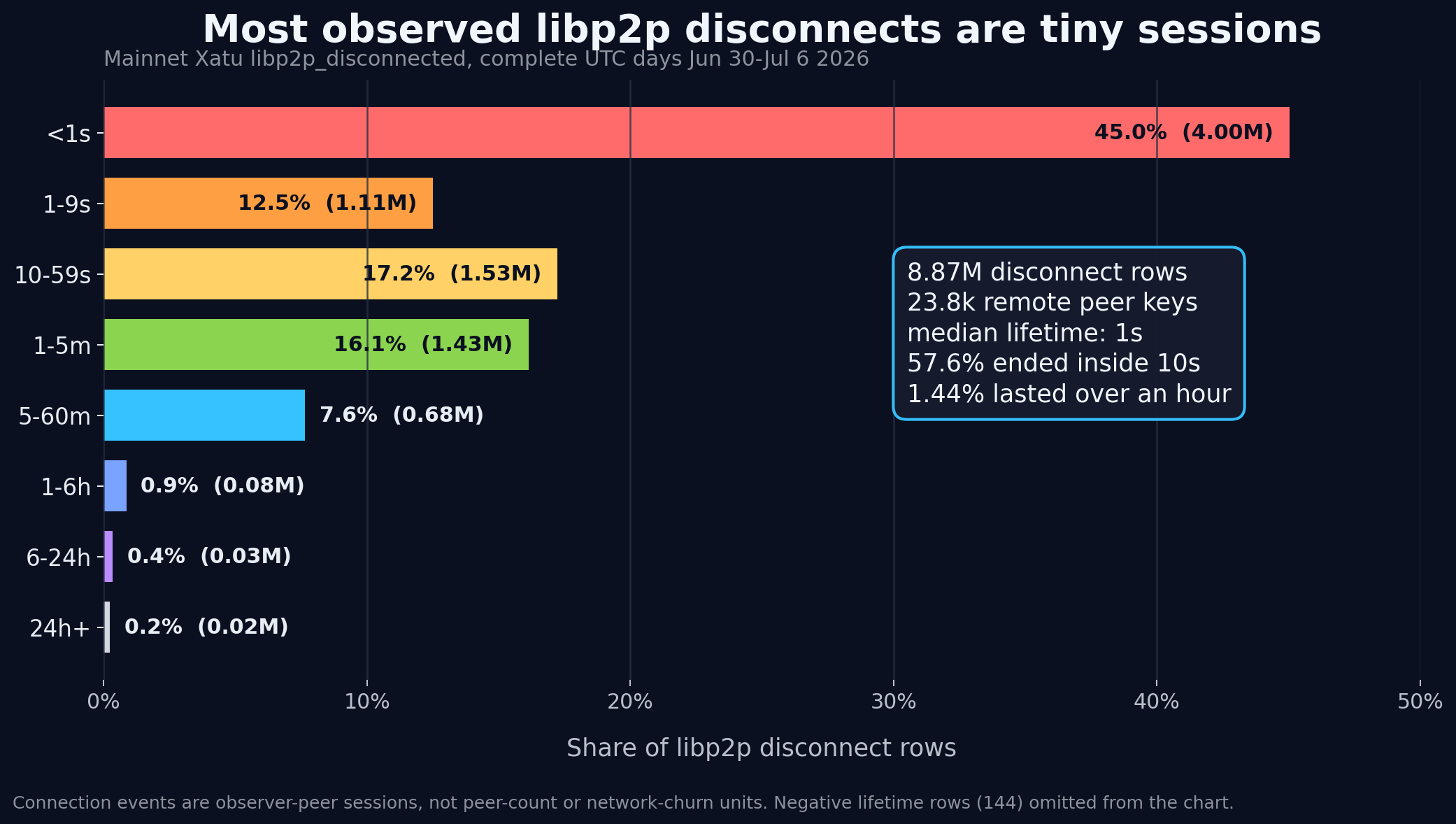
The table is still useful. It is just useful for a narrower thing than the name suggests: observer-peer connection sessions. A row does not mean a peer left Ethereum. It means one instrumented libp2p client observed one connection close with one remote peer.
Here's the query I used for the headline numbers. I kept the grain explicit: raw rows, deduped connection edges by (observer, remote peer, direction, opened), remote peer keys, observer-peer pairs, and lifetime buckets from opened to the disconnect event time.
-- clickhouse-raw, mainnet libp2p connection-session grain
WITH
  conn AS (
    SELECT
      count() AS connected_rows,
      uniqExact(tuple(meta_client_name, remote_peer_id_unique_key, direction, opened)) AS connected_edges,
      uniqExact(remote_peer_id_unique_key) AS connected_peers,
      uniqExact(tuple(meta_client_name, remote_peer_id_unique_key)) AS connected_observer_peer_pairs,
      uniqExact(meta_client_name) AS connected_observers
    FROM default.libp2p_connected
    WHERE meta_network_name = 'mainnet'
      AND event_date_time >= toDateTime('2026-06-30 00:00:00')
      AND event_date_time <  toDateTime('2026-07-07 00:00:00')
  ),
  disc AS (
    SELECT
      count() AS disconnected_rows,
      uniqExact(tuple(meta_client_name, remote_peer_id_unique_key, direction, opened)) AS disconnected_edges,
      uniqExact(remote_peer_id_unique_key) AS disconnected_peers,
      uniqExact(tuple(meta_client_name, remote_peer_id_unique_key)) AS disconnected_observer_peer_pairs,
      uniqExact(meta_client_name) AS disconnected_observers,
      countIf(dateDiff('second', opened, event_date_time) < 10) AS under_10s,
      countIf(dateDiff('second', opened, event_date_time) < 60) AS under_60s,
      countIf(dateDiff('second', opened, event_date_time) >= 3600) AS over_1h,
      countIf(dateDiff('second', opened, event_date_time) < 0) AS negative_lifetime,
      quantile(0.5)(dateDiff('second', opened, event_date_time)) AS p50_lifetime_s,
      quantile(0.9)(dateDiff('second', opened, event_date_time)) AS p90_lifetime_s,
      quantile(0.95)(dateDiff('second', opened, event_date_time)) AS p95_lifetime_s,
      quantile(0.99)(dateDiff('second', opened, event_date_time)) AS p99_lifetime_s
    FROM default.libp2p_disconnected
    WHERE meta_network_name = 'mainnet'
      AND event_date_time >= toDateTime('2026-06-30 00:00:00')
      AND event_date_time <  toDateTime('2026-07-07 00:00:00')
  )
SELECT
  connected_rows,
  connected_edges,
  connected_peers,
  disconnected_rows,
  disconnected_edges,
  disconnected_peers,
  round(disconnected_rows / connected_rows, 4) AS disconnect_connect_row_ratio,
  round(disconnected_edges / connected_edges, 4) AS disconnect_connect_edge_ratio,
  round(disconnected_rows / disconnected_peers, 1) AS disconnect_rows_per_peer,
  round(disconnected_rows / disconnected_observer_peer_pairs, 1) AS disconnect_rows_per_observer_peer_pair,
  round(100 * under_10s / disconnected_rows, 2) AS under_10s_pct,
  round(100 * under_60s / disconnected_rows, 2) AS under_60s_pct,
  round(100 * over_1h / disconnected_rows, 2) AS over_1h_pct,
  negative_lifetime,
  p50_lifetime_s,
  p90_lifetime_s,
  p95_lifetime_s,
  p99_lifetime_s
FROM conn, disc;
The connect/disconnect sanity check matters. If the disconnect table were only catching the easy cases, the one-second result would be suspect. It wasn't: the same window had 8,877,432 connected rows and 8,874,848 disconnected rows, and the deduped edge counts matched at a 0.9997 ratio. The table was not missing half the lifecycle. The lifecycle itself was tiny.
The distribution is ugly in the way real network telemetry is ugly. About 4.00M disconnect rows had a whole-second lifetime of 0, meaning they closed before crossing the next integer second boundary. Another 1.11M landed in the 1-9s bucket. By one minute, 74.77% of all disconnect rows were already gone. Only 127,900 rows, 1.44% of the week, represented sessions that lasted more than an hour.
I also checked this by day because a one-day burst would make a bad post. The shape was stable. Each complete UTC day from Jun 30 through Jul 5 had about 1.2M-1.3M disconnect rows, roughly 14.8k-15.7k remote peer keys, a median lifetime of one second, and 56.87%-58.06% of rows under ten seconds. Jul 6 had more rows, 1.44M, and a fatter long tail, but the median was still one second and 57.97% of rows still ended inside ten seconds.
So the trap is not just "raw rows are duplicated." It is sharper than that. A single remote peer key can appear hundreds of times because the row grain is session lifecycle, and the session lifecycle is mostly short-lived connection attempts or tiny completed sessions. In this sample, the disconnect table averaged 372.6 disconnect rows per remote peer key over the week, or 40.9 rows per observer-peer pair.
That does not mean 23.8k Ethereum nodes. It does not mean 8.87M peers churned out of the network. It also does not mean the clients named in remote_agent_implementation have those shares on mainnet; those are remote self-reported/libp2p-observed agent strings inside one instrumented sample. The safe public noun is boring and precise: disconnect rows or observed connection sessions.
There were 144 negative lifetime rows, which I left out of the chart and kept in the query result. At this scale, that is rounding dust, probably timestamp granularity or edge ordering around opened versus the event timestamp. It is still a useful reminder not to over-polish the table into something it is not.
I keep finding the same pattern in these libp2p surfaces: the table names sound like network facts, but the rows are instrumentation facts. IHAVE rows are advertisements. PRUNE rows are control messages. These disconnect rows are connection-session closes. Count them, but count the thing they actually are.