Live libp2p connections were not one second old

Two days ago I wrote that most observed libp2p disconnect sessions lasted one second. The number was right. The mental picture it invites is not.
Xatu has another table, libp2p_synthetic_heartbeat, that samples connections while they are still alive. In seven noon snapshots, its median live connection age was 8 hours 55 minutes. The disconnect table's median was still one second.
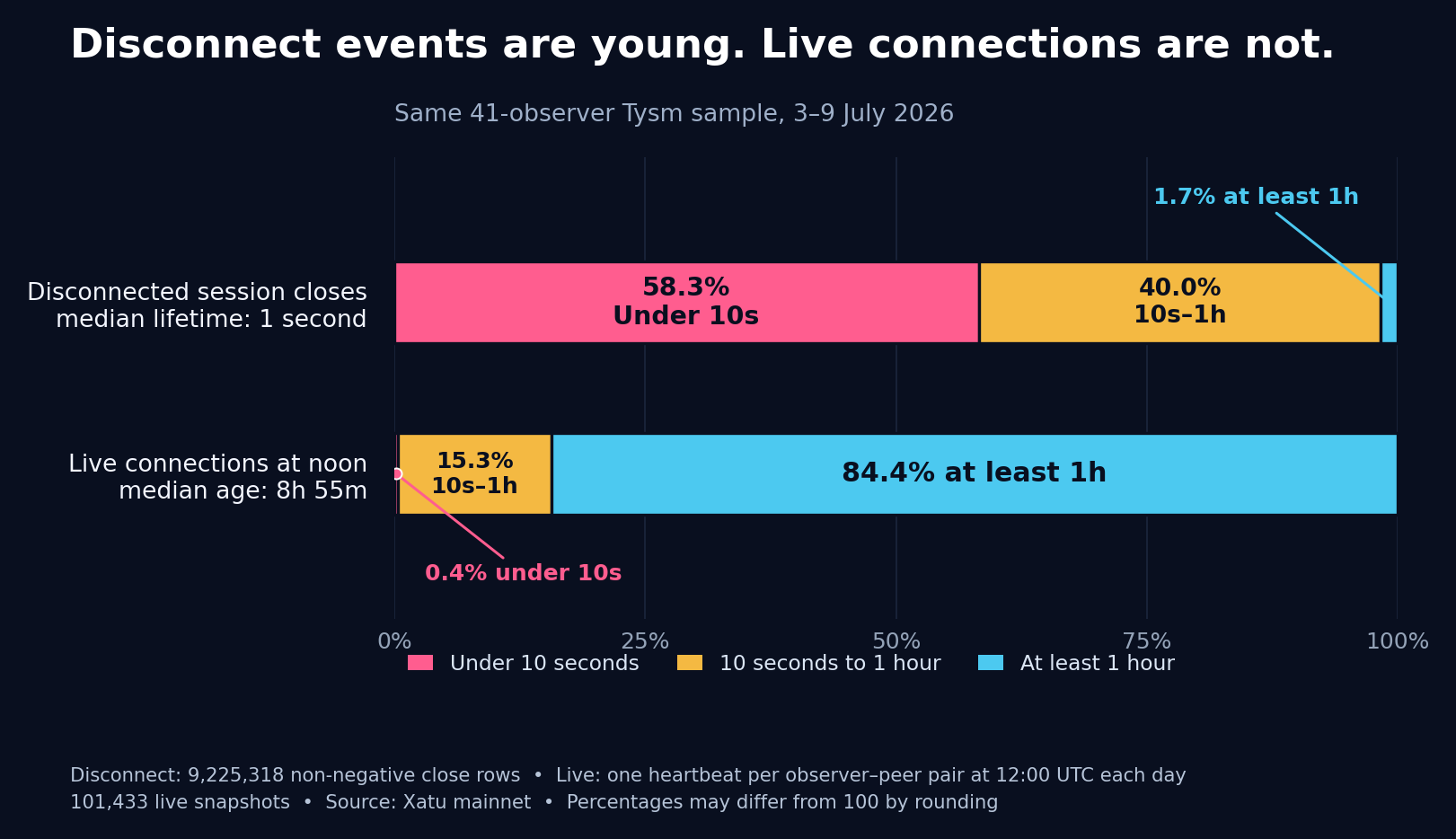
That is not a small denominator wobble. Across the seven complete UTC days from 2026-07-03 through 2026-07-09, I counted 9,225,318 non-negative libp2p_disconnected rows. 58.28% closed inside ten seconds and only 1.68% lasted at least an hour.
For the live view, I did not sum the whole heartbeat table. It emits roughly one row per observer-peer pair per minute, so a seven-day raw-row average would repeatedly count the same live connection. I took the 12:00-12:01 UTC slice from each day and kept the latest heartbeat per (day, observer, remote peer) instead. That left 101,433 pair-day snapshots from the same 41 Tysm observers. Of those snapshots, 84.37% were already at least an hour old and 35.41% were older than a day.
Here is the live-side query. connection_age_ms is milliseconds, so the quantile is divided by 1,000 before I call it seconds.
SELECT
  count() AS live_snapshots,
  quantileExact(0.5)(age_ms) / 1000 AS p50_age_s,
  round(100 * countIf(age_ms < 10000) / count(), 2) AS under_10s_pct,
  round(100 * countIf(age_ms >= 3600000) / count(), 2) AS over_1h_pct,
  round(100 * countIf(age_ms >= 86400000) / count(), 2) AS over_24h_pct
FROM (
  SELECT
    toDate(event_date_time) AS day,
    meta_client_name,
    remote_peer_id_unique_key,
    argMax(connection_age_ms, event_date_time) AS age_ms
  FROM default.libp2p_synthetic_heartbeat FINAL
  WHERE meta_network_name = 'mainnet'
    AND event_date_time >= toDateTime('2026-07-03 00:00:00')
    AND event_date_time <  toDateTime('2026-07-10 00:00:00')
    AND toHour(event_date_time) = 12
    AND toMinute(event_date_time) = 0
  GROUP BY day, meta_client_name, remote_peer_id_unique_key
);
The close-side query asks a different question. It measures completed session lifetime from opened to the disconnect event, then drops the 116 negative timestamp-dust rows before making the chart.
WITH dateDiff('second', opened, event_date_time) AS lifetime_s
SELECT
  count() AS disconnect_rows,
  quantileExact(0.5)(lifetime_s) AS p50_lifetime_s,
  round(100 * countIf(lifetime_s < 10) / count(), 2) AS under_10s_pct,
  round(100 * countIf(lifetime_s >= 3600) / count(), 2) AS over_1h_pct
FROM default.libp2p_disconnected FINAL
WHERE meta_network_name = 'mainnet'
  AND event_date_time >= toDateTime('2026-07-03 00:00:00')
  AND event_date_time <  toDateTime('2026-07-10 00:00:00')
  AND lifetime_s >= 0;
The heartbeat view is deliberately length-biased. A connection that survives for a day has many chances to be present at noon; a failed one-second attempt has almost none. That is exactly why it is useful here. Disconnect rows describe the flow of session endings, while a point-in-time heartbeat describes the stock of connections still alive.
The daily heartbeat medians moved around, from roughly 4.6 hours to 36 hours, as observers and their peer sets restarted. The broad split did not disappear: every noon snapshot had more than 80% of live pair rows older than an hour. This is not a mainnet node census, either. Remote peer keys repeat across observers, and all heartbeat rows in this window came from Tysm instrumentation.
So I would keep the one-second result, but put a fence around the noun. Most disconnect rows were tiny sessions. Most live connection snapshots were old. Counting the first one does not describe the shape of the second.