Status v2 has two retention clocks in one slot

earliest_available_slot sounds like one clean boundary. It is actually two storage policies squeezed into one integer.
At noon UTC on July 10, I found 14,598 near-head observer-peer pairs in Xatu Status v2 telemetry. 83.00% advertised at least the old five-month block-history window, while 3.96% advertised less than PeerDAS's 18.2-day sidecar window. The split was aggressively client-shaped.
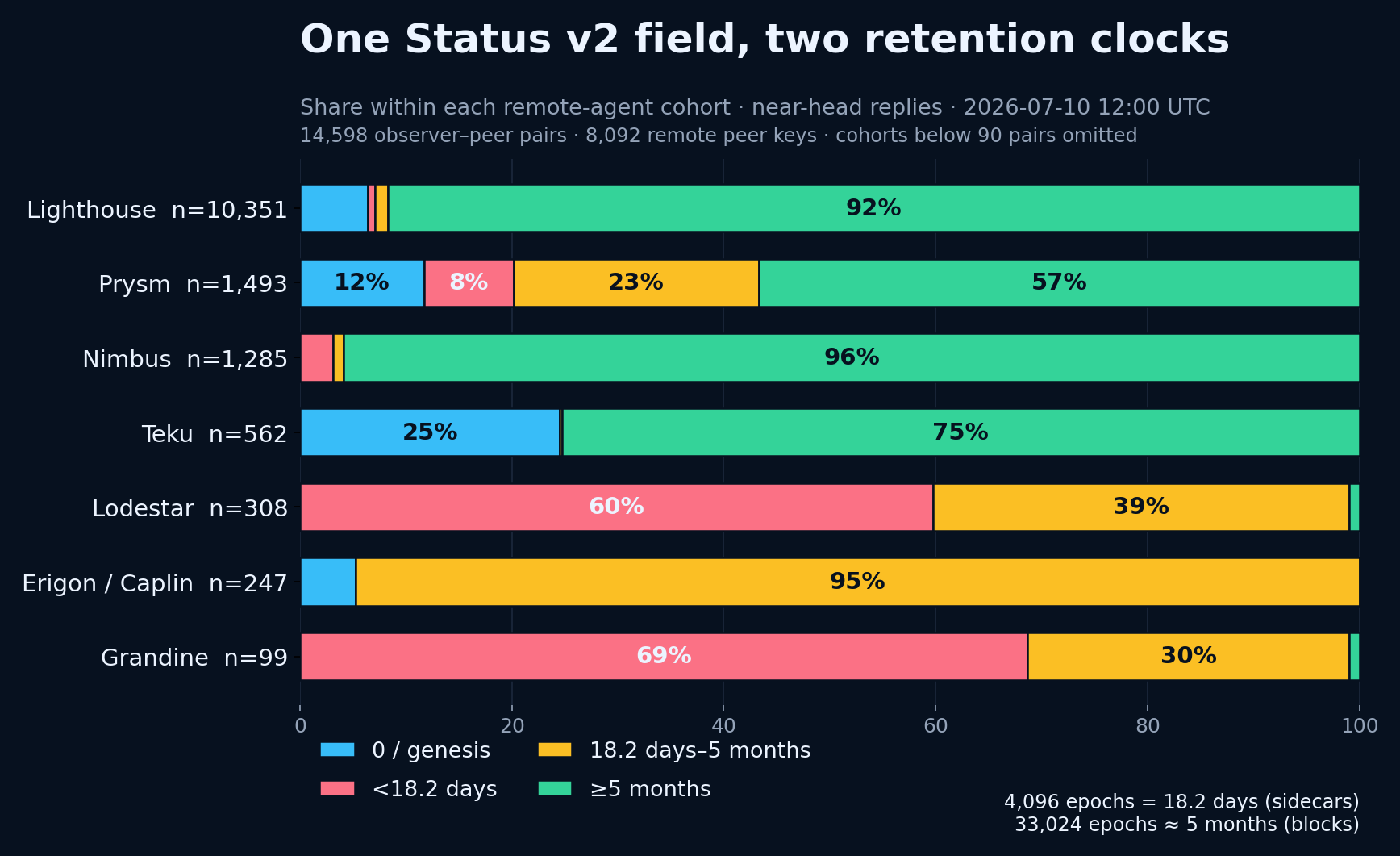
The awkward bit is in the Fulu Status v2 definition. If a node has the full required sidecar window, it should advertise the earliest block it can serve. If its sidecar history is shallower, it should advertise the earliest slot from which it can serve all sidecars instead.
That means the field tells you the shallower capability, but not which capability it was. Mainnet's blob and data-column sidecar windows are both 4,096 epochs, or 131,072 slots / 18.2 days. The long-standing block-serving floor is 33,024 epochs, about 146.8 days.
I used a one-minute noon slice, kept the latest successful outbound Status v2 reply per observer-peer pair, and threw out peers whose reported head was more than 32 slots away from the observer. The remote implementation came from the latest successful libp2p_identify exchange for the same peer key.
-- Status v2 snapshot. The request is the observer; the response is the remote peer.
SELECT
  meta_client_name,
  peer_id_unique_key,
  argMax(request_head_slot,
         tuple(event_date_time, updated_date_time)) AS local_head,
  argMax(response_head_slot,
         tuple(event_date_time, updated_date_time)) AS remote_head,
  argMax(request_earliest_available_slot,
         tuple(event_date_time, updated_date_time)) AS local_earliest,
  argMax(response_earliest_available_slot,
         tuple(event_date_time, updated_date_time)) AS remote_earliest
FROM default.libp2p_handle_status FINAL
WHERE meta_network_name = 'mainnet'
  AND protocol = '/eth2/beacon_chain/req/status/2/ssz_snappy'
  AND direction = 'outbound'
  AND error IS NULL
  AND request_head_slot IS NOT NULL
  AND response_head_slot IS NOT NULL
  AND request_earliest_available_slot IS NOT NULL
  AND response_earliest_available_slot IS NOT NULL
  AND event_date_time >= toDateTime('2026-07-10 12:00:00')
  AND event_date_time <  toDateTime('2026-07-10 12:01:00')
GROUP BY meta_client_name, peer_id_unique_key
HAVING abs(toInt64(local_head) - toInt64(remote_head)) <= 32;

-- Resolve the remote agent separately, then join locally on peer_id_unique_key.
SELECT
  remote_peer_id_unique_key AS peer_id_unique_key,
  argMax(remote_agent_implementation,
         tuple(event_date_time, updated_date_time)) AS implementation
FROM default.libp2p_identify FINAL
WHERE meta_network_name = 'mainnet'
  AND success
  AND event_date_time >= toDateTime('2026-06-10 00:00:00')
  AND event_date_time <  toDateTime('2026-07-11 00:00:00')
GROUP BY peer_id_unique_key;
The reduction left 14,598 pairs over 8,092 remote peer keys. Another 6.83% returned slot 0, an explicit genesis-history advertisement, and 6.21% landed between 18.2 days and five months. I kept observer-peer pairs as the denominator because one remote peer can appear under several observers.
The client cohorts did not merely wobble around one cutoff. Lighthouse's nonzero median was 258.8 days, Nimbus and Teku sat around 146.9 days, and Erigon/Caplin sat almost exactly on 4,096 epochs at 18.204 days. Lodestar and Grandine were the other extreme: their nonzero medians were 10.3 and 10.0 days in this snapshot. Those are advertisements, not proof that an old block or sidecar request would succeed.
This was not a lucky minute. I repeated the same latest-per-pair, near-head reduction at noon for 14 days. The share advertising at least five months stayed between 79.71% and 83.00%; the under-18.2-day share stayed between 3.96% and 4.66%. Every observer request in the final July 10 minute carried request_earliest_available_slot = 0, while the remote responses spread across the chart's buckets.
There is no client market-share claim here. The table comes from a Tysm-instrumented observer surface, and repeated pair snapshots are not unique Ethereum nodes. The useful finding is narrower: earliest_available_slot cannot be read as a typed "block history begins here" field. Sometimes it is the block clock, sometimes it is the sidecar clock, and the wire value does not tell you which one won.