One observer-peer pair logged 80,000 PRUNE‑heavy drops in a minute

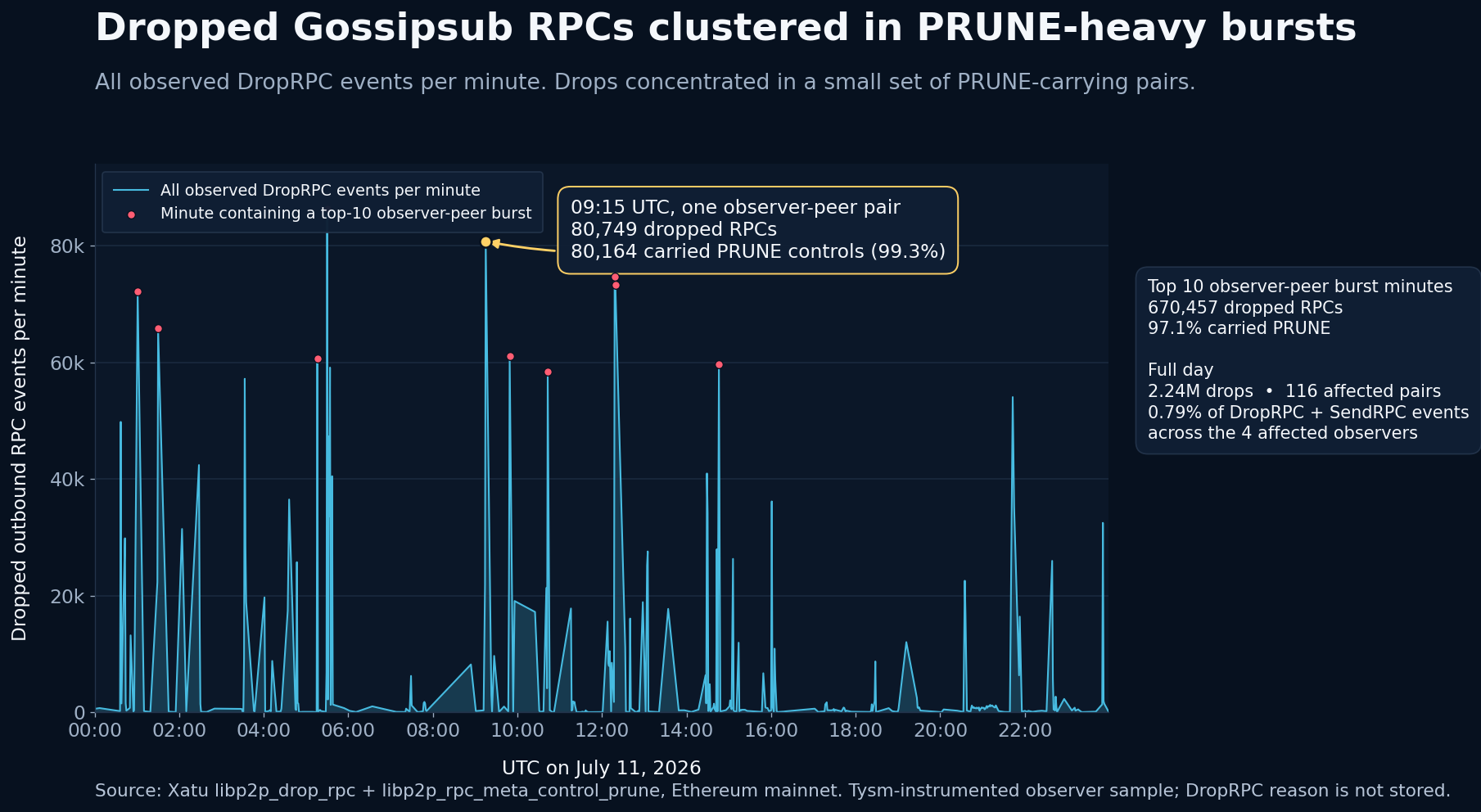
At 09:15 UTC on July 11, one Tysm observer-peer pair logged 80,749 outbound Gossipsub DropRPC events in 60 seconds. PRUNE controls appeared in 80,164 of those parent RPCs, producing 146,218 child rows across five (fork digest, topic name, encoding) tuples and no peer-exchange entries. Those child rows were not 146,218 peers leaving Ethereum.
Upstream go-libp2p-pubsub defines DropRPC as an outbound RPC that was dropped, "typically because of a queue full." The trace event does not carry the reason, and the observed Tysm build's pubsub dependency is not recorded in this table. Xatu therefore tells me which observer-peer pair emitted the event and what the parent RPC contained, but not why that send path rejected it.
peak = clickhouse.query("clickhouse-raw", """
SELECT
  meta_client_name AS observer,
  peer_id_unique_key AS peer,
  any(meta_client_implementation) AS implementation,
  count() AS drops
FROM default.libp2p_drop_rpc FINAL
WHERE meta_network_name = 'mainnet'
  AND event_date_time >= toDateTime('2026-07-11 09:15:00')
  AND event_date_time <  toDateTime('2026-07-11 09:16:00')
GROUP BY observer, peer
ORDER BY drops DESC
LIMIT 1
""").iloc[0]

prune = clickhouse.query("clickhouse-raw", """
SELECT
  count() AS prune_rows,
  uniqExact(rpc_meta_unique_key) AS parent_rpcs,
  uniqExact(tuple(
    topic_fork_digest_value,
    topic_name,
    topic_encoding
  )) AS topic_shapes,
  countIf(graft_peer_id_unique_key IS NOT NULL) AS peer_exchange_rows
FROM default.libp2p_rpc_meta_control_prune FINAL
WHERE meta_network_name = 'mainnet'
  AND event_date_time >= toDateTime('2026-07-11 09:15:00')
  AND event_date_time <  toDateTime('2026-07-11 09:16:00')
  AND meta_client_name = {observer:String}
  AND peer_id_unique_key = {peer:Int64}
  AND rpc_meta_unique_key GLOBAL IN (
    SELECT unique_key
    FROM default.libp2p_drop_rpc FINAL
    WHERE meta_network_name = 'mainnet'
      AND event_date_time >= toDateTime('2026-07-11 09:15:00')
      AND event_date_time <  toDateTime('2026-07-11 09:16:00')
      AND meta_client_name = {observer:String}
      AND peer_id_unique_key = {peer:Int64}
  )
""", parameters={
  "observer": peak.observer,
  "peer": int(peak.peer),
})
That returned 146,218 PRUNE child rows, 80,164 distinct dropped parent RPCs, five topic shapes, and zero peer-exchange rows. There were 80,749 dropped parents in the minute, so 99.3% carried PRUNE.
 Open the chart at full resolution.
I repeated that parent-key gate for the ten largest observer-peer burst minutes. Across them, 670,457 parent RPCs were dropped and 651,094, or 97.1%, carried PRUNE controls. Nine of those minutes were above 98.5% PRUNE-carrying parents; the remaining minute was 76.8%.
Current upstream code offers a mechanism that fits this shape, although it does not prove the observed rows were retries. doDropRPC passes dropped control entries back to the pending-control path with gs.pushControl(p, ctl). A later RPC can piggyback GRAFT or PRUNE controls that remain relevant. The Xatu rows have neither a drop reason nor a retry identity, so five repeated topic shapes are consistent with requeued PRUNE controls, not a reconstructed retry chain.
July 11 had 2,243,791 libp2p_drop_rpc rows and 2,243,791 unique event keys, spread across 116 observer-peer pairs and four Tysm observers. Those observers also logged 283,452,336 SendRPC events across all peers. Drops were 0.785% of the combined DropRPC + SendRPC tracer surface for those four observers; SendRPC means the local queue accepted the RPC, not that the remote peer received it.
The 116 affected pairs logged 2,243,791 drops against 307,610 SendRPC events, an 87.94% pair-cohort DropRPC share. Forty-seven pairs were above 50%, 32 were above 90%, and one pair alone contributed 832,220 drops, or 37.09% of the day's total. The top 20 pairs contributed 88.43%.
I built that denominator from separate parent tables and joined locally on (meta_client_name, peer_id_unique_key). This keeps PRUNE child rows out of the parent-event denominator and avoids a distributed join over several hundred million SendRPC rows:
-- Drop parents, one row per traced outbound failure
SELECT
  meta_client_name,
  peer_id_unique_key,
  count() AS drops,
  uniqExact(unique_key) AS unique_drop_events
FROM default.libp2p_drop_rpc FINAL
WHERE meta_network_name = 'mainnet'
  AND event_date_time >= toDateTime('2026-07-11 00:00:00')
  AND event_date_time <  toDateTime('2026-07-12 00:00:00')
GROUP BY meta_client_name, peer_id_unique_key;

-- SendRPC parent events for the 116 exact pairs, merged in Python
SELECT
  meta_client_name,
  peer_id_unique_key,
  count() AS sent
FROM default.libp2p_send_rpc FINAL
WHERE meta_network_name = 'mainnet'
  AND event_date_time >= toDateTime('2026-07-11 00:00:00')
  AND event_date_time <  toDateTime('2026-07-12 00:00:00')
  AND (meta_client_name, peer_id_unique_key) IN (<affected pairs>)
GROUP BY meta_client_name, peer_id_unique_key;

-- SendRPC events across all peers of observers that logged a drop
SELECT count() AS sent
FROM default.libp2p_send_rpc FINAL
WHERE meta_network_name = 'mainnet'
  AND event_date_time >= toDateTime('2026-07-11 00:00:00')
  AND event_date_time <  toDateTime('2026-07-12 00:00:00')
  AND meta_client_name GLOBAL IN (
    SELECT meta_client_name
    FROM default.libp2p_drop_rpc FINAL
    WHERE meta_network_name = 'mainnet'
      AND event_date_time >= toDateTime('2026-07-11 00:00:00')
      AND event_date_time <  toDateTime('2026-07-12 00:00:00')
    GROUP BY meta_client_name
  );
I widened the same parent scan to 14 complete UTC days, June 28 through July 11:
SELECT
  toDate(event_date_time) AS day,
  meta_client_name,
  peer_id_unique_key,
  count() AS drops,
  uniqExact(unique_key) AS unique_drop_events
FROM default.libp2p_drop_rpc FINAL
WHERE meta_network_name = 'mainnet'
  AND event_date_time >= toDateTime('2026-06-28 00:00:00')
  AND event_date_time <  toDateTime('2026-07-12 00:00:00')
GROUP BY day, meta_client_name, peer_id_unique_key;
The result held 36,022,114 unique DropRPC events across 739 distinct observer-peer pairs. Every day was concentrated: the top 20 pairs carried between 81.76% and 98.94% of daily drops. Observer coverage changed sharply across the window, so those raw day totals are not a trend line and should not be turned into a Tysm health score.
This is not an invalid-gossip counter or evidence that hundreds of peers left the network. DropRPC is local outbound send-path telemetry, while PRUNE is a topic-mesh control message. Across these four observers, the aggregate DropRPC share was below 1%, while the 116 affected pairs had an 87.94% DropRPC share and 32 pairs were above 90%. The five-shape concentration is consistent with requeued PRUNE controls, but it is not a measure of remote receipt, invalid gossip, disconnects, peer churn, or network-wide health.