SELFDESTRUCT is mostly not destruction now

A lot of Ethereum code still says SELFDESTRUCT.
That word is now a trap.
After EIP-6780, SELFDESTRUCT only deletes code and storage when the contract was created in the same transaction. Older contracts can still send their ETH balance to a beneficiary, but the account does not get wiped.
So I checked how often the opcode is still real deletion.
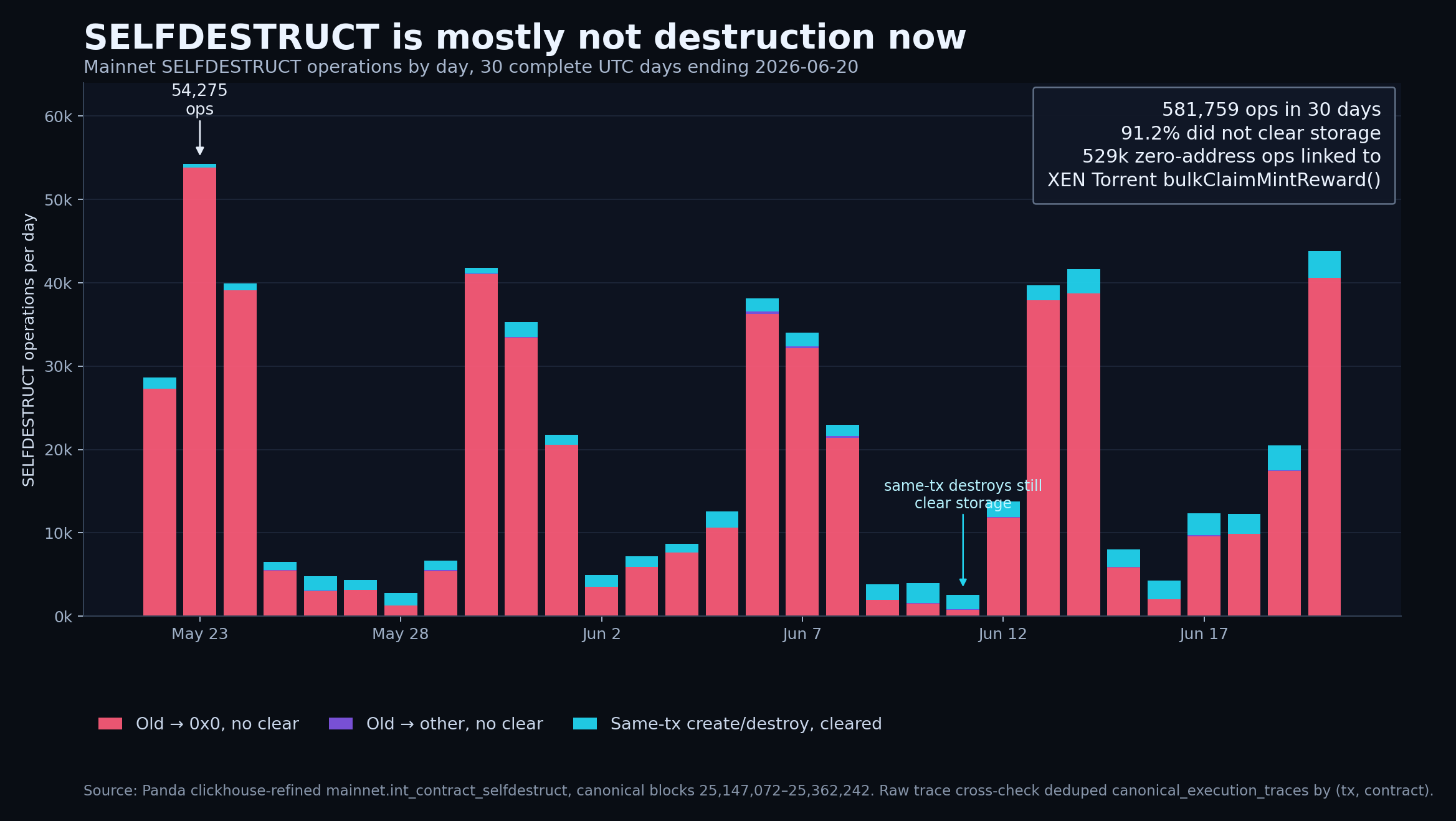
Across the 30 complete UTC days from May 22 through June 20, mainnet had 581,759 SELFDESTRUCT operations across 38,220 transactions.
Only 51,139 of them cleared storage.
The other 530,620 did not.
That is 91.2% of observed SELFDESTRUCT operations doing something other than the thing the name still promises.
Here is the query that produced the split:
from ethpandaops import clickhouse

summary = clickhouse.query("clickhouse-refined", """
SELECT
  count() AS ops,
  uniqExact(transaction_hash) AS txs,
  uniqExact(address) AS contracts,
  countIf(ephemeral) AS storage_cleared_ops,
  countIf(NOT ephemeral) AS no_clear_ops,
  countIf(
    NOT ephemeral
    AND beneficiary = '0x0000000000000000000000000000000000000000'
  ) AS old_contracts_to_zero,
  sum(if(value_transferred = 0, 1, 0)) AS zero_value_ops,
  round(toFloat64(sum(value_transferred)) / 1e18, 6) AS eth_transferred
FROM mainnet.int_contract_selfdestruct FINAL
WHERE block_number BETWEEN 25147072 AND 25362242
""")
The table's ephemeral field is the important bit. It means the contract was created and destroyed in the same transaction. Those are the cases where EIP-6780 preserves the old clearing behavior.
Everything else is an old contract. It can transfer balance. It does not clear storage.
The weird bucket was the zero address.
529,134 operations were old contracts calling SELFDESTRUCT with beneficiary 0x0000000000000000000000000000000000000000. They also transferred 0 ETH.
No storage clear. No fund recovery. Just a destroy-shaped no-op.
That was too lopsided to leave alone, so I joined the raw traces back to their transactions. Raw traces have duplicate rows here, so I deduped by (transaction_hash, action_from) first. The deduped raw count was 581,798, within 39 of the refined table's 581,759.
WITH st AS (
  SELECT
    transaction_hash,
    action_from
  FROM canonical_execution_traces
  WHERE meta_network_name = 'mainnet'
    AND block_number BETWEEN 25147072 AND 25362242
    AND action_type = 'suicide'
    AND action_to = '0x0000000000000000000000000000000000000000'
  GROUP BY transaction_hash, action_from
)
SELECT
  tx.to_address,
  substring(tx.input, 1, 10) AS selector,
  count() AS selfdestruct_ops,
  uniqExact(st.transaction_hash) AS txs,
  uniqExact(tx.from_address) AS senders,
  round(avg(tx.gas_used), 0) AS avg_gas_used
FROM st
INNER JOIN canonical_execution_transaction tx
  ON st.transaction_hash = tx.transaction_hash
WHERE tx.meta_network_name = 'mainnet'
  AND tx.block_number BETWEEN 25147072 AND 25362242
GROUP BY tx.to_address, selector
ORDER BY selfdestruct_ops DESC
LIMIT 5
That came back almost entirely as one thing:
- contract: XEN Torrent
0x0a252663dbcc0b073063d6420a40319e438cfa59 - selector:
0xf5878b9b - selfdestruct ops: 529,154
- transactions: 4,623
- senders: 263
- average gas used: 5,952,572
Panda's function-signature table maps 0xf5878b9b to bulkClaimMintReward(uint256,address). The contract label table maps the address to XEN Torrent.
So the headline is not "people still use SELFDESTRUCT." That would be boring.
The headline is that almost the entire modern SELFDESTRUCT surface, at least in this 30-day window, was XEN Torrent batch-claim traffic touching old contracts that did not clear storage and sent nothing to the zero address.
The same-tx path still exists. The cyan slivers in the chart are real. There were 51,139 storage-clearing operations, and they moved most of the ETH in the sample: total SELFDESTRUCT value transferred was 5,394.9 ETH.
But the dominant shape is not deletion anymore.
It is legacy cleanup code, still running after the protocol changed the meaning of cleanup.