Partial withdrawal queue positions are not validators

canonical_beacon_state_pending_partial_withdrawal looks like a tidy queue table. It is not a validator count, and it is very much not a daily intake table. In the latest mainnet snapshot I checked, the queue had 87 positions, 81 validators, and 1,457.9 ETH pending.
The weird part is the shape. 78 of the 87 positions were under 32 ETH, and 21 of them were under 1 ETH. At the same time, five positions between 128 and 256 ETH carried 961.3 ETH, or 65.9% of everything queued. So if you count rows, the queue looks like small partial withdrawals. If you count ETH, it is mostly a handful of much larger MaxEB-era requests.
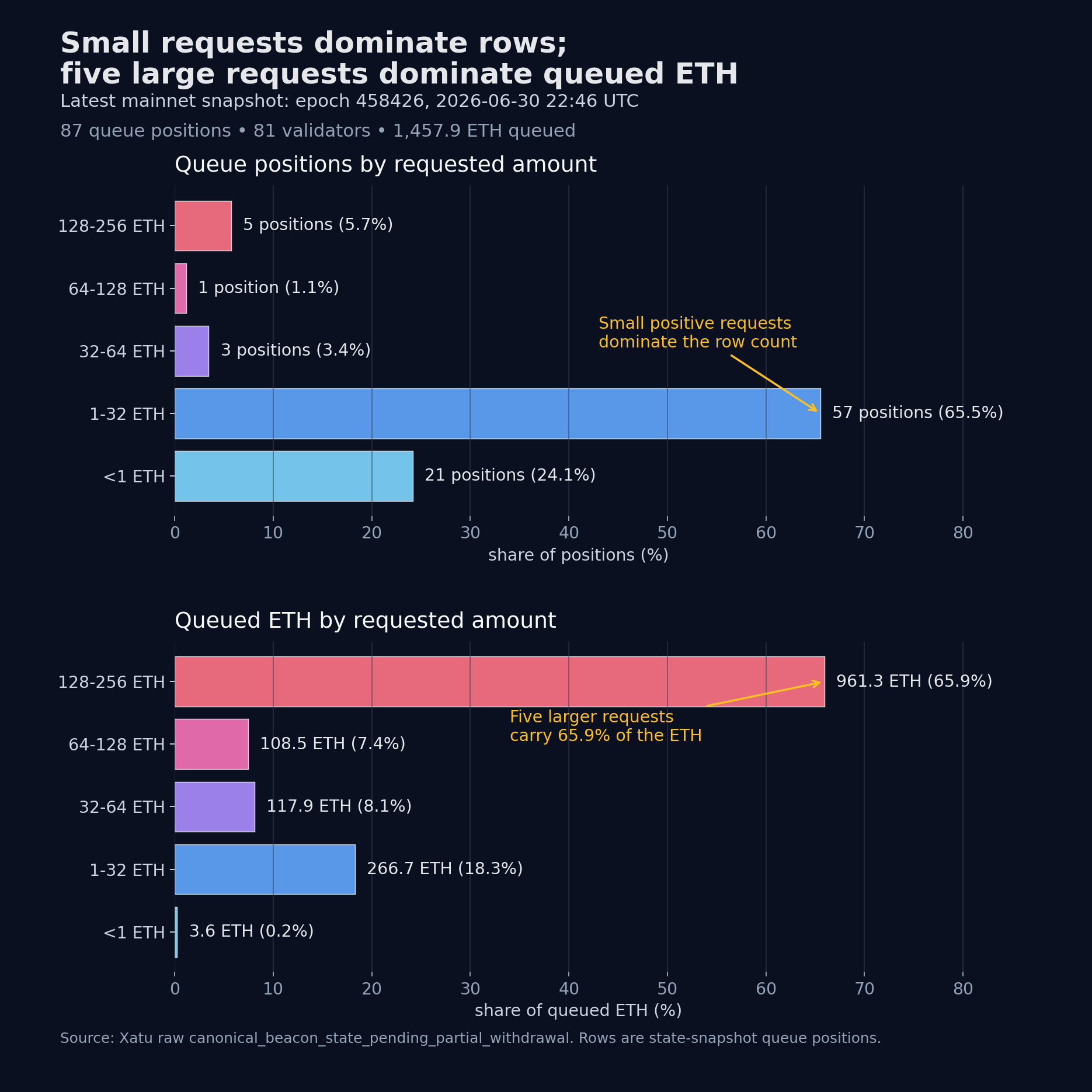
Here is the query for the snapshot. I resolved the latest epoch first and reused it as a literal, which keeps the query bounded on the distributed raw table.
-- First resolve the latest mainnet epoch in the snapshot table.
SELECT max(epoch) AS latest_epoch
FROM default.canonical_beacon_state_pending_partial_withdrawal
WHERE meta_network_name = 'mainnet';

-- latest_epoch = 458426
SELECT
  epoch,
  epoch_start_date_time,
  state_id,
  count() AS positions,
  uniqExact(validator_index) AS validators,
  sum(amount) / 1e9 AS queued_eth,
  min(amount) / 1e9 AS min_eth,
  quantile(0.5)(amount) / 1e9 AS p50_eth,
  max(amount) / 1e9 AS max_eth,
  min(withdrawable_epoch - epoch) AS min_wait_epochs,
  quantile(0.5)(withdrawable_epoch - epoch) AS p50_wait_epochs,
  max(withdrawable_epoch - epoch) AS max_wait_epochs
FROM default.canonical_beacon_state_pending_partial_withdrawal
WHERE meta_network_name = 'mainnet'
  AND epoch = 458426
GROUP BY epoch, epoch_start_date_time, state_id;
That returned epoch 458426, state 14669632, at 2026-06-30 22:46:47 UTC. The smallest queued amount was 18 gwei. The median queued amount was 3.543789 ETH. The largest was 229.455237 ETH. The median wait left was 115 epochs, about 12.3 hours, and the max was 289 epochs, about 30.8 hours.
The 18 gwei rows are not a typo. Electra's withdrawal-request path appends a pending partial withdrawal with the actual to_withdraw, not blindly with the user's requested cap. In the spec, the partial path does this:
to_withdraw = min(
    state.balances[index] - MIN_ACTIVATION_BALANCE - pending_balance_to_withdraw,
    amount,
)
state.pending_partial_withdrawals.append(
    PendingPartialWithdrawal(
        validator_index=index,
        amount=to_withdraw,
        withdrawable_epoch=withdrawable_epoch,
    )
)
That means the queue amount is already clipped by the validator's excess balance over 32 ETH and by earlier pending partials for the same validator. A big request can become a smaller queue entry. A tiny excess balance can become an 18 gwei queue entry. Ugly, but correct.
There is another easy way to lie to yourself with this table: group the snapshot rows by day and sum them. June 30 then looks like 232,075.965 ETH of pending partial withdrawals. The latest snapshot was only 1,457.921 ETH. That is a 159x inflation from treating state snapshots like event rows.
SELECT
  toDate(epoch_start_date_time) AS day,
  count() AS rows,
  uniqExact(epoch) AS epochs,
  uniqExact(position_in_queue) AS positions_seen,
  uniqExact(validator_index) AS validators_seen,
  sum(amount) / 1e9 AS snapshot_row_sum_eth
FROM default.canonical_beacon_state_pending_partial_withdrawal
WHERE meta_network_name = 'mainnet'
  AND epoch_start_date_time >= toDateTime('2026-06-30 00:00:00')
  AND epoch_start_date_time <  toDateTime('2026-07-01 00:00:00')
GROUP BY day;
That query returned 15,971 rows across 214 epoch snapshots. It saw 92 queue positions over the day, but many of those positions were the same pending entries being carried forward from one state to the next. This is a snapshot table. Use one state, or explicitly model entry and exit from the queue. Do not sum the day.
I also checked the execution request surface for the validators still in the latest queue. Mapping those 81 validator indices to pubkeys and looking back to June 17 found 197 withdrawal-request rows, all positive amount rows, with zero amount = 0 full-exit sentinel rows. The request amounts ranged from 17 gwei to 1,000 ETH, and the same validators had requested 2,630.4 ETH over that window. The current queue held less than that because some entries had already processed and because the state transition clips partial withdrawals to available excess balance.
-- Pubkey mapping was resolved with mainnet.dim_validator_pubkey FINAL,
-- then the pubkeys were used as a bounded literal IN list.
SELECT
  count() AS request_rows,
  uniqExact(validator_pubkey) AS validators,
  countIf(amount = 0) AS full_exit_zero_rows,
  countIf(amount > 0) AS positive_rows,
  sum(amount) / 1e9 AS requested_eth,
  min(amount) / 1e9 AS min_request_eth,
  max(amount) / 1e9 AS max_request_eth,
  min(slot_start_date_time) AS first_request,
  max(slot_start_date_time) AS last_request
FROM default.canonical_beacon_block_execution_request_withdrawal
WHERE meta_network_name = 'mainnet'
  AND slot_start_date_time >= toDateTime('2026-06-17 00:00:00')
  AND slot_start_date_time <  toDateTime('2026-07-01 00:00:00')
  AND validator_pubkey IN (...current queue pubkeys...);
Six validators had two pending partial-withdrawal positions in the latest state. One of them had two separate 18 gwei entries, with different withdrawable epochs. That is the part I would have missed if I had treated validator_index as the queue key.
The safe read is boring: this table is a pending partial-withdrawal queue snapshot. Its rows are positions, not validators. Its amount is gwei, not ETH. And across time, its rows are repeated state, not new requests.
Count the surface you mean.