PUBLISH_MESSAGE fires before libp2p decides not to publish

PUBLISH_MESSAGE sounds like proof that a message went onto the wire. It is not. Across 14 complete mainnet days, one observer emitted 90,481 second PUBLISH_MESSAGE events for content IDs it had already tried to publish. Every repeated ID appeared exactly twice.
Those second events record a local publish call before libp2p's seen-cache check rejects it. They are not network retransmissions.
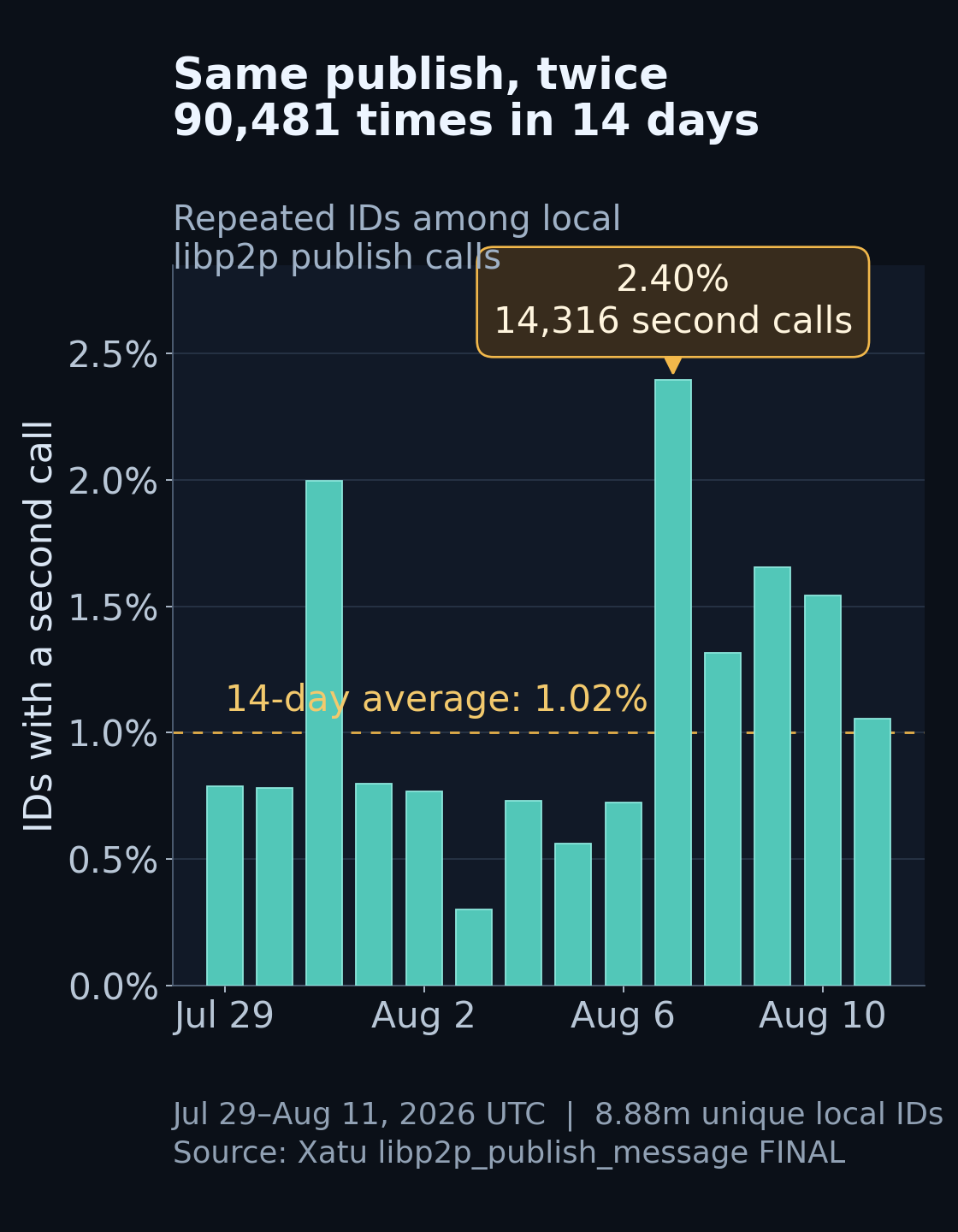
The counter increments too early
The trap is in the event name. I started with default.libp2p_publish_message, reduced it to one row per observer, topic and content-derived message ID, then counted IDs with more than one row. The window ends at midnight on August 12, so all 14 days are complete.
WITH attempts AS (
  SELECT
    meta_client_name,
    topic_fork_digest_value,
    topic_name,
    topic_encoding,
    message_id,
    count() AS copies,
    min(event_date_time) AS first_call,
    max(event_date_time) AS last_call
  FROM default.libp2p_publish_message FINAL
  WHERE meta_network_name = 'mainnet'
    AND event_date_time >= toDateTime('2026-07-29 00:00:00')
    AND event_date_time <  toDateTime('2026-08-12 00:00:00')
  GROUP BY
    meta_client_name,
    topic_fork_digest_value,
    topic_name,
    topic_encoding,
    message_id
)
SELECT
  meta_client_name,
  count() AS unique_content_ids,
  sum(copies) AS publish_event_rows,
  countIf(copies > 1) AS repeated_ids,
  sum(copies - 1) AS second_calls
FROM attempts
GROUP BY meta_client_name
ORDER BY repeated_ids DESC;
The table held 10,138,628 rows and 10,048,147 unique observer-topic-ID keys. All 90,481 extra rows belonged to the same all-subnets observer, where they affected 1.0186% of 8,882,523 unique IDs. No key appeared three times. The daily share ranged from 0.30% to 2.40%, with 14,316 second calls on August 7.
The topic split was almost comically lopsided: 90,143 beacon attestations and 338 aggregate-and-proof messages. There were no repeated beacon-block IDs. This is an observer-specific capture result, not a rate for Ethereum's validator population or for every gossip node.
The library trace hook explains why the table looks this way. In go-libp2p-pubsub v0.15.0, ValidateLocal calls tracer.PublishMessage(msg) before the validator checks whether the content ID is already in its seen cache. A few lines later, a failed markSeen(id) emits DuplicateMessage and returns dupeErr. Topic.Publish treats that duplicate error as success and returns before sendMsgBlocking.
So the sequence is:
- application calls
Topic.Publish; - tracer emits
PUBLISH_MESSAGE; - seen-cache check finds the content ID;
- libp2p suppresses the duplicate and returns
nilto the caller.
The Xatu path preserves that trace event. Its Group A sharder keys PUBLISH_MESSAGE on topic and message ID, so repeated calls for the same key face the same sampling decision. That makes the duplicate share internally consistent for captured IDs, but the sampled table is still not a census of all mainnet nodes.
One attestation, three clocks
I checked an exact ID rather than trusting the aggregate alone. Attestation message e208d507e62c0f258c6488ae1ccf667249512e67 was first parsed by the affected observer at 14:30:01.393 UTC on July 30. The same observer then emitted PUBLISH_MESSAGE for it at 14:30:23.520 and again at 14:31:11.234.
Other observers decoded that exact ID as validator 2,178,194 attesting in slot 14,883,148 to block root 0x946de4e54a97d8cbd65663d9e7a6f249790f232b1f16c96d586f23396c94b1f8. It was real content, already present in the local seen cache before either publish trace. Across the full window, every database row was unique at (event_date_time, observer, topic, message_id), which rules out a simple duplicate-row artifact.
I cannot tell from this public surface which higher-level observer path made the second call. That part would need the exact application code and runtime context. The narrower conclusion is enough: libp2p_publish_message counts local publish attempts at a pre-deduplication hook. Treating it as a wire-send table overcounted this observer by 1.02% over the window and by 2.40% on its worst day.