0x54dd returned with almost-empty blobs

The weird June 18 blob record was not a one-off. On June 29, the same unlabeled address came back with an even cleaner signature: 11,784 type-3 transactions, one blob each, 0.49% filled on average. It produced 31.8% of Ethereum's blobs that day while carrying only 7.5 MB of payload.
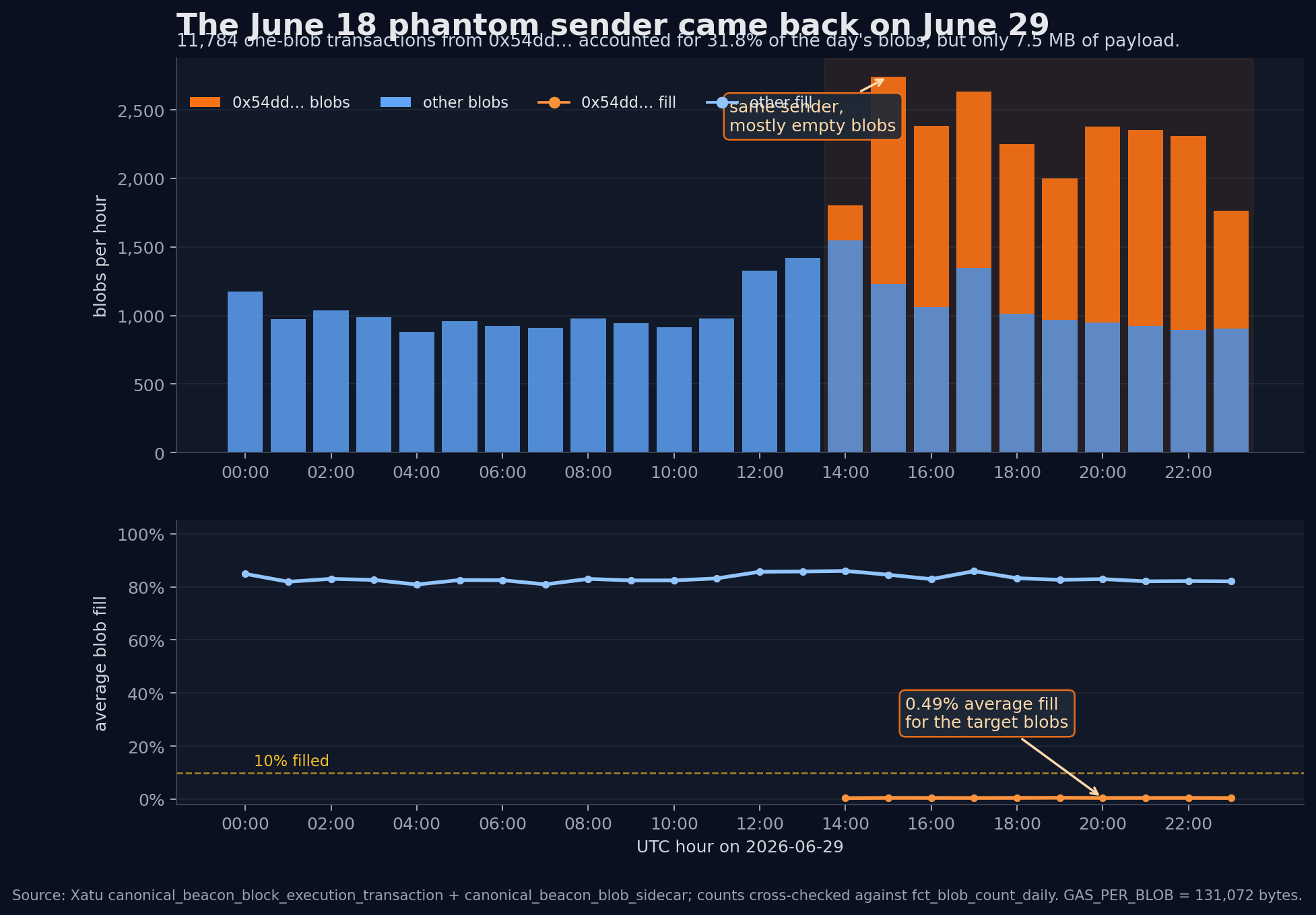
I called the June 18 burst "phantom blobs" because the blob count was real but the payload mostly was not. The old post had enough evidence to point at 0x54dd1659c232dec31386c52507982a4983d9bcb8, but it leaned on timing: type-3 transactions from that address lined up almost perfectly with the low-fill sidecar spike.
This time there is a better table for the job. canonical_beacon_block_execution_transaction carries the blob hashes and sidecar byte totals on the same transaction row, so the sender-to-blob path is direct instead of inferred from an hourly correlation.
WITH blob_txs AS (
  SELECT
    slot_start_date_time,
    lower(`from`) AS sender,
    lower(ifNull(`to`, '')) AS receiver,
    hash AS transaction_hash,
    length(blob_hashes) AS blobs,
    ifNull(blob_sidecars_size, 0) - ifNull(blob_sidecars_empty_size, 0) AS payload_bytes
  FROM canonical_beacon_block_execution_transaction
  WHERE meta_network_name = 'mainnet'
    AND slot_start_date_time >= toDateTime('2026-06-29 00:00:00')
    AND slot_start_date_time <  toDateTime('2026-06-30 00:00:00')
    AND type = 3
)
SELECT
  sender,
  count() AS txs,
  sum(blobs) AS blobs,
  sum(payload_bytes) AS payload_bytes,
  round(sum(payload_bytes) / sum(blobs) / 131072 * 100, 4) AS avg_fill_pct,
  min(slot_start_date_time) AS first_seen,
  max(slot_start_date_time) AS last_seen
FROM blob_txs
GROUP BY sender
ORDER BY blobs DESC
LIMIT 10
The top row was 0x54dd...bcb8: 11,784 transactions, 11,784 blobs, 7,499,217 payload bytes, 0.4855% average fill. That is about 636 bytes of non-empty data in a 131,072-byte blob. It started at 14:49:35 UTC, stopped at 23:35:35 UTC, and every transaction went to the same receiver with one blob and 164 bytes of calldata.
The contrast with normal rollup traffic is blunt. The next-largest submitter by blobs was Base's labelled L1 submitter 0x5050...76c9: 9,092 blobs at 97.87% fill, carrying about 1.09 GiB of payload. Same blob lane, completely different shape.
I also re-ran the same direct table path on June 18. The address had 11,356 one-blob transactions that day, carrying 7,134,639 bytes at 0.4793% fill. So the June 29 event was not just a vaguely similar sparse day. It was the same sender, the same one-blob shape, the same tiny payload density, and the same unknown label problem.
The daily totals cross-check cleanly. The transaction table had 20,774 type-3 transactions and 37,035 blob hashes for June 29. Raw canonical_beacon_blob_sidecar counted the same 37,035 sidecars and the same 2,767,658,061 non-empty payload bytes. mainnet.fct_blob_count_daily FINAL and mainnet.fct_block_blob_count FINAL also both returned 37,035 blobs for the day.
SELECT
  count() AS blobs,
  sum(blob_size - ifNull(blob_empty_size, 0)) AS payload_bytes,
  countIf((blob_size - ifNull(blob_empty_size, 0)) < 13108) AS under_10pct,
  round(avg((blob_size - ifNull(blob_empty_size, 0)) / 131072) * 100, 4) AS avg_fill_pct
FROM canonical_beacon_blob_sidecar
WHERE meta_network_name = 'mainnet'
  AND slot_start_date_time >= toDateTime('2026-06-29 00:00:00')
  AND slot_start_date_time <  toDateTime('2026-06-30 00:00:00')
That sidecar query returned 15,077 blobs under 10% filled for the day. The 0x54dd... sender accounted for 11,784 of them, or 78.2% of the low-fill bucket. It was 31.8% of blobs, but only 0.27% of payload bytes.
One caveat matters here: a low-fill blob is not automatically suspicious. Multi-blob rollup batches often have a trailing partial blob, and that is fine. The strange part is thousands of one-blob transactions where the only blob is roughly half a percent full. That is not "we filled six blobs and the last one had a tail." It is one nearly empty blob, over and over.
I still do not have a useful public label for the sender, and I am not going to invent one from vibes. The receiver was 0x12ad349e5d72b582856290736e0f13fe5fa57aa4, the calldata selector was 0x3e5aa082, and the raw execution table showed all 11,784 target transactions succeeded. That is enough to describe the mechanism without pretending to know the actor.
The mental model is the same as June 18, just less fuzzy now. Blob count is capacity consumed. Payload bytes are data carried. On June 29, a single unlabeled sender bought a lot of blob slots and put almost nothing in them.
If you are looking at fee pressure, gossip load, or DAS sampling work, the slots still count. If you are looking at rollup data throughput, they basically don't.