EIP-8148's threshold bytes are backwards

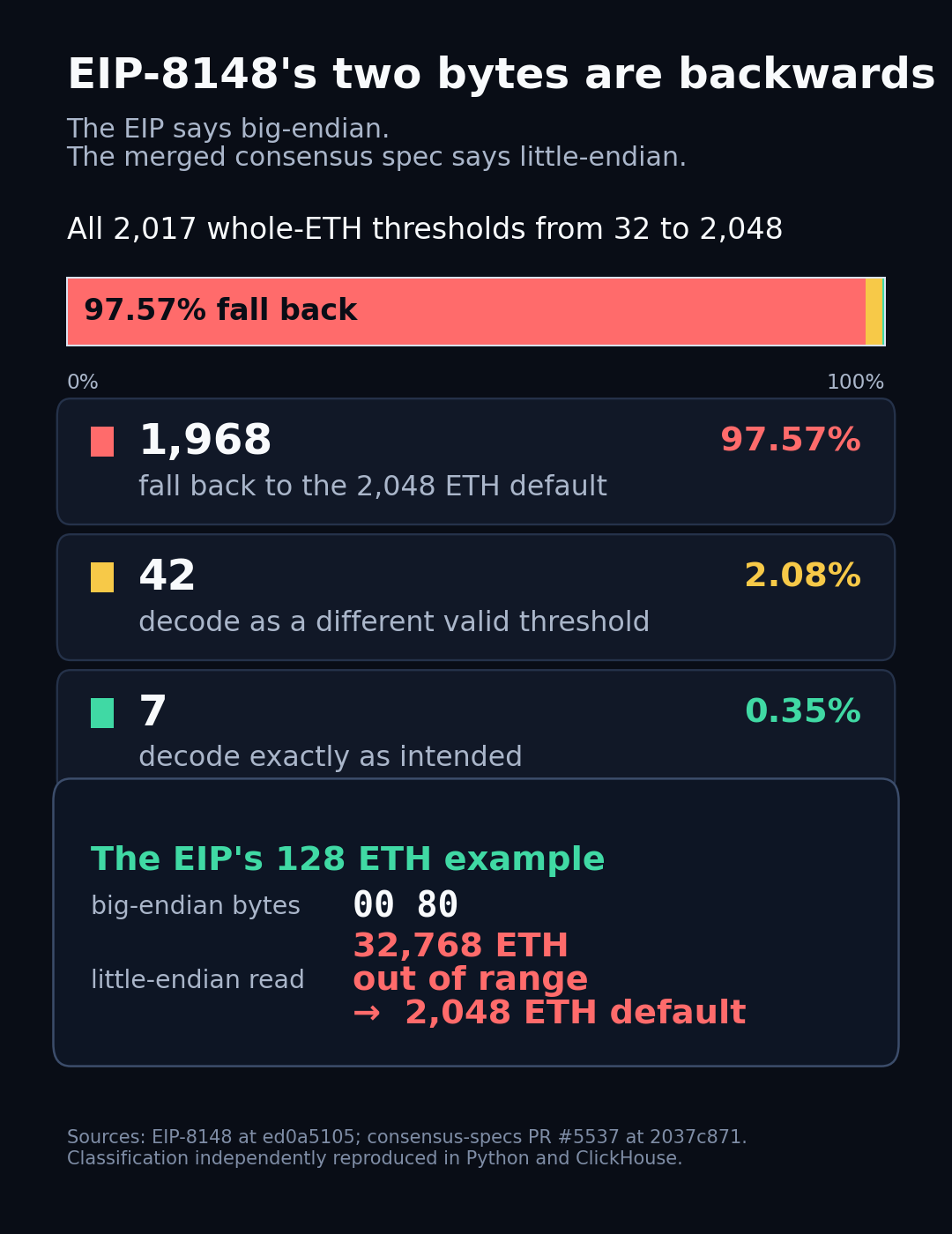
EIP-8148's worked 128 ETH threshold currently has two answers. The EIP tells deposit tooling to write bytes 00 80; the consensus spec merged yesterday reads those bytes as little-endian, gets 32,768, rejects it as out of range, and silently restores the 2,048 ETH default.
This is not live on Mainnet. EIP-8148 is Draft and only Proposed for Inclusion in Hegotá, which is exactly why this is the cheap moment to find it. The disagreement landed after my earlier look at the proposal's validator denominator: the EIP edit merged on August 20, while the matching consensus-specs PR #5537 merged on August 24.
Two bytes, opposite directions
The EIP text at the merge commit assigns credential bytes 10 and 11 to a whole-ETH threshold. It says the two-byte integer is big-endian and implements the read as byte_10 * 256 + byte_11.
The merged consensus spec says little-endian and calls int.from_bytes(data, ENDIANNESS). The inherited Phase 0 constant sets ENDIANNESS = 'little', so this is not an ambiguous helper name. The two documents really do reverse the bytes.
For the EIP's 128 ETH example, big-endian encoding produces 00 80. Reading that as little-endian gives 0x8000, or 32,768 ETH. The consensus helper rejects anything above 2,048 ETH and returns MAX_EFFECTIVE_BALANCE_ELECTRA, so the requested 128 ETH threshold becomes the existing 2,048 ETH default.
The full threshold space
I enumerated every whole-ETH value the proposal allows, from 32 through 2,048 inclusive. This is the exact ClickHouse query behind the chart:
WITH
    number + 32 AS intended_eth,
    intDiv(intended_eth, 256) AS high_byte,
    modulo(intended_eth, 256) AS low_byte,
    low_byte * 256 + high_byte AS decoded_eth
SELECT
    count() AS total_thresholds,
    countIf(decoded_eth < 32 OR decoded_eth > 2048)
        AS falls_back_to_2048,
    countIf(decoded_eth BETWEEN 32 AND 2048
            AND decoded_eth != intended_eth)
        AS accepted_wrong_threshold,
    countIf(decoded_eth = intended_eth)
        AS decoded_as_intended,
    round(100 * falls_back_to_2048 / total_thresholds, 6)
        AS fallback_pct,
    round(100 * accepted_wrong_threshold / total_thresholds, 6)
        AS wrong_valid_pct,
    round(100 * decoded_as_intended / total_thresholds, 6)
        AS correct_pct
FROM numbers(2017);
The result is ugly. 1,968 thresholds, or 97.57%, fall out of range and become 2,048 ETH. Another 42, or 2.08%, remain in range but turn into a different valid threshold. Those are the nastier cases because the range check accepts them: 258 ETH is bytes 01 02, which the little-endian path reads as 513 ETH; 513 ETH is 02 01, which comes back as 258 ETH.
Only seven thresholds, or 0.35%, survive unchanged: 257, 514, 771, 1,028, 1,285, 1,542 and 1,799 ETH. Their two bytes are identical, so reversing them does nothing. The round numbers somebody would actually put in a worked example, including 32, 64, 128, 256, 512, 1,024 and 2,048 ETH, all hit the default path. I reproduced the same 1,968 / 42 / 7 split with a separate Python byte conversion rather than trusting one arithmetic expression.
There is a second disagreement in the same deposit path. The EIP says a threshold below the creating deposit's amount must be ignored, preventing the new validator from using this field as an immediate withdrawal shortcut. The merged consensus spec stores get_initial_sweep_threshold(withdrawal_credentials) without comparing it with amount at all. That case is not part of the chart, but an endian-only patch would still leave the two repositories describing different state transitions.
No validator has been affected because the feature is inactive; today's credentials are not interpreted this way. Right now the failure is two fresh pieces of draft text disagreeing in a way that exhaustive enumeration makes painfully obvious. Pick one byte order, add a cross-repository vector for 128 ETH -> 00 80 -> 128 ETH, and make the amount guard match before this gets anywhere near a fork.