Ethereum just scheduled a fivefold exit lane

Ethereum has scheduled a fivefold expansion of the validator exit lane for Glamsterdam. At mainnet's current active stake, EIP-8061 would let 1,279 ETH exit per epoch instead of 256 ETH. Deposits do not get the same treatment.
This is an easy change to flatten into "the churn limit goes up." That misses the interesting bit. The proposal splits one shared balance budget into three lanes: activation stays capped, exit becomes uncapped and stake-proportional, and consolidation gets its own parameter. Using mainnet's current validator state makes the asymmetry hard to miss.
The current stake, not the proposal's example
The EIP's security section uses 36 million ETH as a round example. Mainnet has moved on. I used the latest complete raw validator snapshot available during this run, epoch 468105 at 2026-08-12 23:12:23 UTC:
SELECT
  epoch,
  max(epoch_start_date_time) AS snapshot_time,
  countIf(status = 'active_ongoing') AS active_validator_indices,
  sumIf(
    toUInt128(ifNull(effective_balance, 0)),
    status = 'active_ongoing'
  ) / 1e9 AS active_effective_eth,
  countIf(
    status = 'active_ongoing'
    AND effective_balance > 32000000000
  ) AS maxeb_validator_indices,
  sumIf(
    toUInt128(ifNull(effective_balance, 0)),
    status = 'active_ongoing'
    AND effective_balance > 32000000000
  ) / 1e9 AS maxeb_effective_eth
FROM default.canonical_beacon_validators FINAL
WHERE meta_network_name = 'mainnet'
  AND epoch_start_date_time >= toDateTime('2026-08-12 23:00:00')
  AND epoch_start_date_time < toDateTime('2026-08-12 23:20:00')
  AND epoch = 468105
GROUP BY epoch
That snapshot contains 897,359 active validator indices and 41,938,587 ETH of active effective balance. Of that, 13,637,370 ETH sits behind 12,927 active validators with effective balances above 32 ETH. This matters because Electra churn is already balance-denominated: a 2,048 ETH validator consumes 2,048 ETH of exit capacity, not one old-style validator slot.
I cross-checked the raw result against mainnet.fct_validator_balance_daily FINAL. Its August 12 snapshot, updated at 22:52 UTC, contained 897,324 active indices and 41,937,435 ETH. The 1,152 ETH difference is consistent with the refined daily row ending about 20 minutes earlier than the raw epoch snapshot; I used the later raw state for the calculations below.
One cap stays, one cap disappears
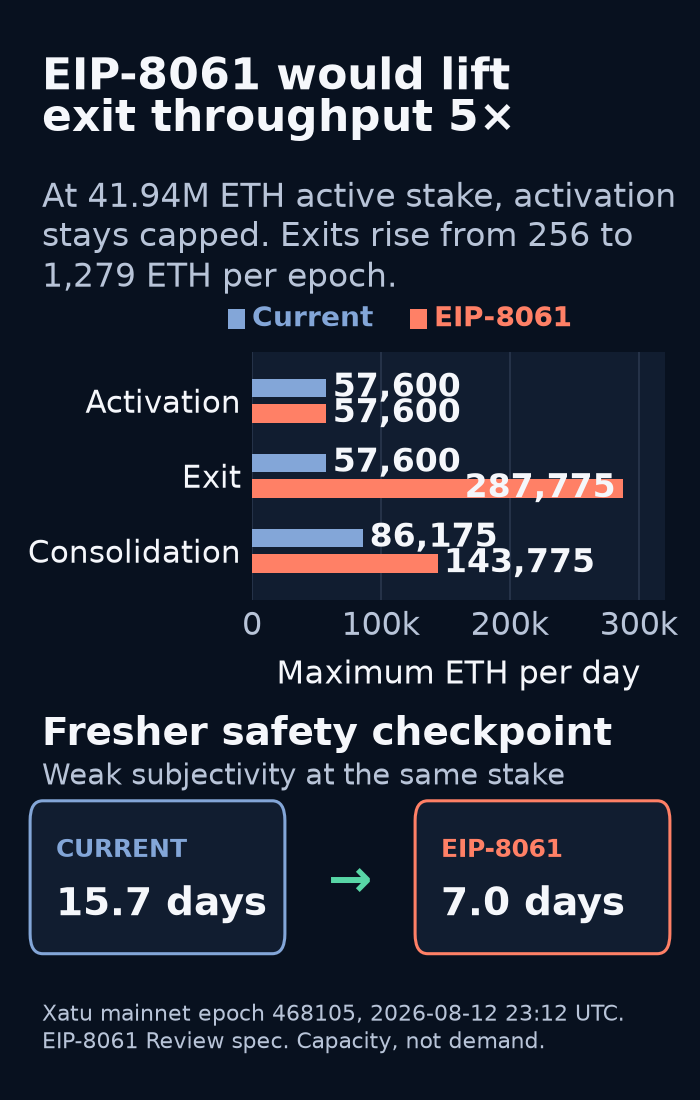
Today's Electra formula starts with total active balance divided by 65,536, rounded down to whole ETH. At this snapshot that is 639 ETH per epoch. Activations and exits share a capped 256 ETH lane, leaving 383 ETH for consolidations.
EIP-8061 changes the plumbing. It halves the activation-and-exit quotient to 32,768, but applies the 256 ETH cap only to activations. It also gives consolidations an independent quotient of 65,536. At the same mainnet stake, the proposed limits are therefore:
- activation: 256 ETH per epoch, unchanged;
- exit: 1,279 ETH per epoch, up 5.0x;
- consolidation: 639 ETH per epoch, up 1.67x.
There are 225 epochs in an Ethereum day. If each lane stayed full, exit capacity would rise from 57,600 ETH/day to 287,775 ETH/day. Consolidation capacity would rise from 86,175 to 143,775 ETH/day. These are protocol ceilings, not forecasts of how much stake will actually move.
Faster exits spend checkpoint shelf life
The trade is not hidden. Ethereum's weak-subjectivity period is the window during which a recent trusted checkpoint remains safe under the spec's 10% safety-decay assumption. More churn lets the validator set change faster, so checkpoint users need a fresher anchor.
With the current Electra formula and 41,938,587 ETH active, I get 3,542 epochs, or 15.7 days. Applying EIP-8061's weighted activation, exit, and consolidation terms gives 1,586 epochs, or 7.0 days. That reproduces the direction and roughly seven-day target in the EIP, but uses today's stake rather than its older 36 million ETH example.
Seven days is still a decent operational window, but it is less forgiving. A node restored from an old snapshot, an air-gapped signer workflow, or infrastructure that pins checkpoints manually has about half as much calendar slack before it should fetch a newer checkpoint. The liquidity improvement is real because the security maintenance interval gets shorter too.
Why I think this change is overdue
The existing 256 ETH exit cap is awkward in a post-MaxEB validator set. Active stake is now 41.94 million ETH, yet the protocol can only drain 57,600 ETH per day through the normal exit lane when it is saturated. Put differently, replacing one third of today's active stake through exits alone would take roughly 243 days at the current ceiling. Under EIP-8061 it falls to about 49 days.
That does not make a one-third exit harmless. It makes the throttle proportional to the thing being protected again. Meanwhile, the activation cap stays exactly where it is, so this is not a fivefold increase in how fast new stake can enter or how fast the validator registry can grow. It is a deliberate one-way asymmetry: easier out, not easier in.
The proposal is now listed as Scheduled for Inclusion in EIP-7773, the Glamsterdam meta EIP. It has been implemented and tested on Glamsterdam devnets, but mainnet activation details are still blank. The numbers here describe what its current Review specification would do if activated against the August 12 mainnet stake, not a live rule today.