Beacon API block/head events have a catch-up tail

block and head sound even cleaner than block_gossip. A block event says the beacon node saw a block. A head event says fork choice moved to it. If those rows show up hours after the slot started, the first question should not be "did Ethereum propagate blocks hours late?" It should be "what denominator did I just use?"
The denominator was the row.
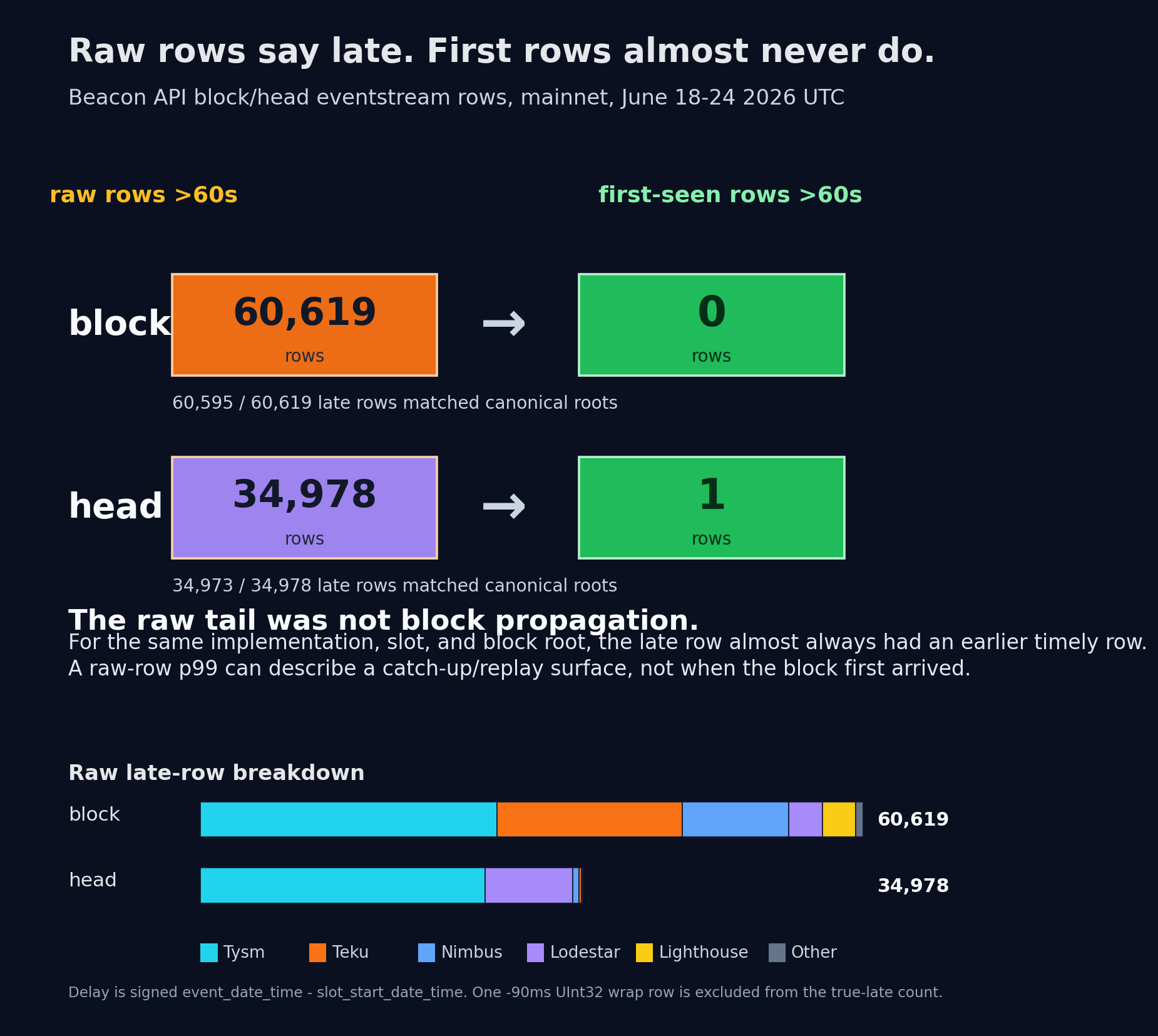
beacon_api_eth_v1_events_block and beacon_api_eth_v1_events_head, mainnet, June 18-24 2026 UTC. First-seen means grouped by implementation, slot, and block root.I checked the raw Beacon API block and head eventstream tables after the block_gossip tail turned out to be haunted. The naive query looked ugly in a different way. Across seven complete UTC days, raw block rows had 60,619 observations more than 60 seconds after slot start. Raw head rows had 34,978.
There is one annoying footgun before the real finding: I did not use propagation_slot_start_diff directly. The stored field is unsigned, and there was one Teku row where the event timestamp was 90 ms before the slot start. Stored as UInt32, that becomes 4,294,967,207 ms, which is nonsense unless you enjoy debugging fake 49-day delays. So the query below recomputes a signed delay from the timestamps and then does the reduction that matters:
WITH raw AS (
  SELECT
    meta_consensus_implementation AS impl,
    slot,
    block,
    dateDiff('millisecond', slot_start_date_time, event_date_time) AS signed_ms
  FROM beacon_api_eth_v1_events_block
  WHERE meta_network_name = 'mainnet'
    AND slot_start_date_time >= toDateTime('2026-06-18 00:00:00')
    AND slot_start_date_time <  toDateTime('2026-06-25 00:00:00')
), firsts AS (
  SELECT
    impl,
    slot,
    block,
    min(signed_ms) AS first_ms,
    max(signed_ms) AS last_ms,
    count() AS rows
  FROM raw
  GROUP BY impl, slot, block
)
SELECT
  countIf(signed_ms > 60000) AS raw_rows_after_60s,
  (SELECT countIf(first_ms > 60000) FROM firsts) AS first_rows_after_60s,
  round(quantileExact(0.99)(greatest(signed_ms, 0)) / 1000, 3) AS raw_p99_s,
  (SELECT round(quantileExact(0.99)(greatest(first_ms, 0)) / 1000, 3) FROM firsts) AS first_p99_s
FROM raw;
Run against block, that pattern returns 60,619 raw rows after 60 seconds and 0 first rows after 60 seconds. Run the same pattern against head, it returns 34,978 raw rows after 60 seconds and 1 first row after 60 seconds. That is the whole trick. The scary rows were late observations of things the same implementation had already observed on time.
The implementation split is noisy but useful as a smell test. Tysm had 27,105 late raw block rows and 26,034 late raw head rows. Teku had 16,954 late raw block rows, and its raw block p99 was 269,172 seconds, or 74.8 hours. Nimbus had 9,759 late raw block rows. Lodestar showed up harder on head, with 7,997 late raw rows.
If you stop there, you get a stupid story. Teku did not see normal blocks three days late. Tysm was not moving its head 18 hours after the slot. For the same implementation, slot, and block root, the first row was already timely. In the late-row groups, the first-row p50 was around 1.6-1.8s for every implementation I checked. The per-implementation first-seen p99 for the block event sat between 3.53s and 3.88s.
I also joined the late rows back to canonical_beacon_block by (slot, block_root), because the other easy mistake is to blame orphans. That did not work either. For block, 60,595 of 60,619 late rows matched the canonical root, with 0 conflicting noncanonical joins and 24 no-join rows. For head, 34,973 of 34,978 late rows matched the canonical root, again with no conflicting noncanonical joins. These were mostly canonical roots coming back through the eventstream later, not a giant orphan tail.
So the safe query shape is the boring one. If the question is "when did this implementation first surface this block/head?", group by (meta_consensus_implementation, slot, block) and take min(event_date_time - slot_start_date_time). If the question is global first seen, drop the implementation from the grouping. If the question is eventstream replay, keep the raw rows and stare at the tail directly.
This is an observed Xatu Beacon API eventstream surface. It is not a client market-share claim, and it is not proof about why a particular client emitted catch-up rows. It just says raw block and head rows are not unique block/head timing events.
The block was not late. The row was.