EIP-7702's spammiest bucket was sitting in the mempool

The previous type-4 post left one obvious loose end. The labelled Poisoner target was the gas-heavy part of EIP-7702's type-4 surface, so I half-expected it to be private orderflow or at least hard to see before inclusion.
It was the opposite. From Jun 30 through Jul 6 UTC, Xatu saw every one of the 31,565 canonical type-4 transactions sent to that target in its mempool table. The barely visible bucket was the much smaller executeBatch tail.
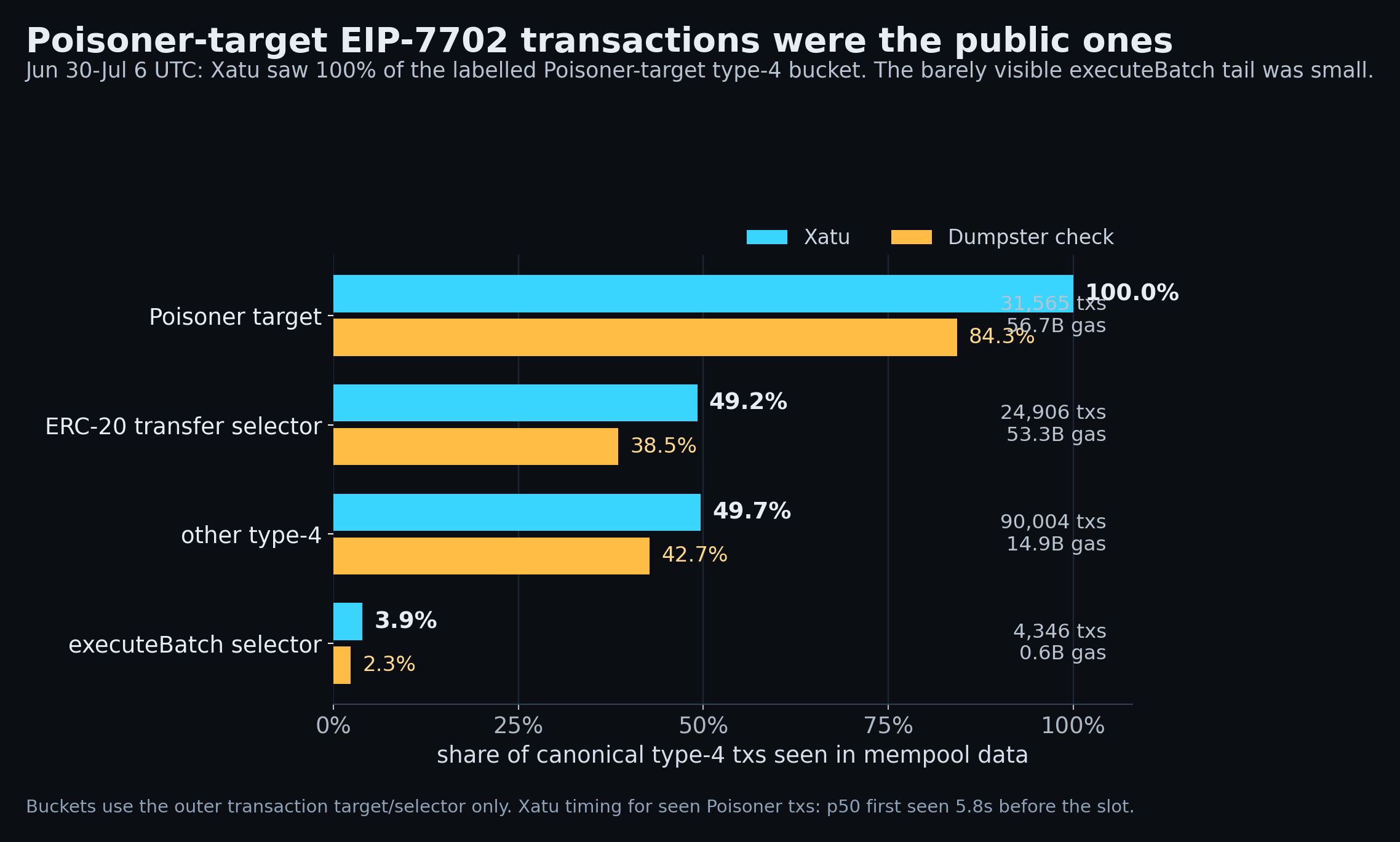
This is still a type-4 envelope story, not an authorization-list decoder. Xatu's canonical execution transaction table exposes the outer transaction type, target, calldata selector, gas, and success bit. It does not expose the individual EIP-7702 authorization entries, so I kept the buckets deliberately ugly: one labelled target, one ERC-20 transfer selector, one executeBatch selector, and everything else.
The canonical slice came from the same kind of dedupe as the earlier post, just narrowed to the latest seven complete UTC days. I resolved Jun 30 through Jul 6 to execution blocks 25426767 through 25476942, reduced raw transaction rows to transaction_hash, and split the outer call shape:
-- clickhouse-raw, canonical type-4 outer-call buckets
WITH tx AS (
  SELECT DISTINCT
    transaction_hash,
    success,
    gas_used,
    lower(ifNull(to_address, '')) AS to_address,
    ifNull(substring(input, 1, 10), '') AS selector
  FROM default.canonical_execution_transaction
  WHERE meta_network_name = 'mainnet'
    AND transaction_type = 4
    AND block_number BETWEEN 25426767 AND 25476942
)
SELECT
  if(
    to_address = '0x00fe78205f5f0e63b8ad2b2ae5337f538a610e04', 'Poisoner target',
    if(selector = '0xa9059cbb', 'ERC-20 transfer selector',
      if(selector = '0x34fcd5be', 'executeBatch selector', 'other type-4')
    )
  ) AS bucket,
  count() AS txs,
  sum(gas_used) AS gas_used,
  countIf(success = 0) AS reverts
FROM tx
GROUP BY bucket
ORDER BY gas_used DESC;
That produced 150,821 canonical type-4 transactions in the week. The two big gas buckets were familiar: 31,565 transactions to the labelled Poisoner target used 56.7B gas, and 24,906 ERC-20 transfer(address,uint256)-selector envelopes used 53.3B gas. The much larger "other type-4" bucket had 90,004 transactions, but only 14.9B gas because a lot of it was cheap and revert-heavy. The executeBatch selector was only 4,346 transactions and 0.6B gas.
Then I stopped asking "how many type-4 transactions landed?" and asked a narrower mempool question: which of those canonical hashes appeared before or around inclusion in the raw mempool surfaces? For Xatu's own mempool_transaction table, the match was exact by hash and transaction type:
-- clickhouse-raw, one bucket shown; repeat the canonical subquery per bucket
SELECT
  uniqExact(hash) AS seen_hashes,
  count() AS mempool_rows
FROM default.mempool_transaction
WHERE meta_network_name = 'mainnet'
  AND event_date_time >= toDateTime('2026-06-30 00:00:00') - INTERVAL 1 DAY
  AND event_date_time <  toDateTime('2026-07-07 00:00:00') + INTERVAL 1 DAY
  AND type = 4
  AND hash GLOBAL IN (
    SELECT transaction_hash
    FROM default.canonical_execution_transaction
    WHERE meta_network_name = 'mainnet'
      AND transaction_type = 4
      AND block_number BETWEEN 25426767 AND 25476942
      AND lower(ifNull(to_address, '')) = '0x00fe78205f5f0e63b8ad2b2ae5337f538a610e04'
    GROUP BY transaction_hash
  );
The result was not subtle. Xatu saw 31,565 of 31,565 Poisoner-target transactions, with two mempool observer labels and a median first-seen time 5.8 seconds before the slot. An independent mempool_dumpster_transaction cross-check, which has no type column so I matched by canonical hash, saw 26,606 of the same 31,565 hashes (84.3%). That is not a universal public-mempool census, but it is enough to kill the easy story that the gas-heavy type-4 spam was mostly hidden before inclusion.
The low-visibility shape was elsewhere. Xatu saw about half of the ERC-20 transfer-selector bucket (12,250 of 24,906) and about half of the "other type-4" bucket (44,707 of 90,004). The executeBatch selector was the outlier: 170 of 4,346 hashes in Xatu and 101 of 4,346 in the Dumpster cross-check. It was barely visible in both surfaces, but it was also tiny by gas. If you were looking only at mempool visibility, that bucket would look interesting. If you were looking at type-4 gas, it barely moved the chart.
There is a useful measurement warning here. "Seen in a mempool table" means a monitored mempool source saw the hash; it does not mean every public node had it, and "not seen" does not prove a private route. The Xatu mempool sample for this type-4 slice was only two observer labels. Still, the contrast inside the same sample is hard to wave away: the gas-heavy labelled target was completely visible there, while the executeBatch tail was almost absent.
So the safer update to the type-4 mental model is this: the noisy Poisoner bucket was not just an on-chain artifact discovered after the fact. In this seven-day slice it was public enough for Xatu to catch every canonical hash before or around inclusion. The actually low-visibility type-4 traffic was much smaller, and calling either one "wallet adoption" would still be nonsense without decoding the authorization list and the surrounding contract behavior.