newPayload ERROR rows are not invalid payloads

engine_newPayload has a scary-looking ERROR bucket. I went looking for bad payloads there and found 18,762 raw rows in seven complete UTC days. That sounds like an execution incident until you dedupe the rows by the payload they were trying to validate.
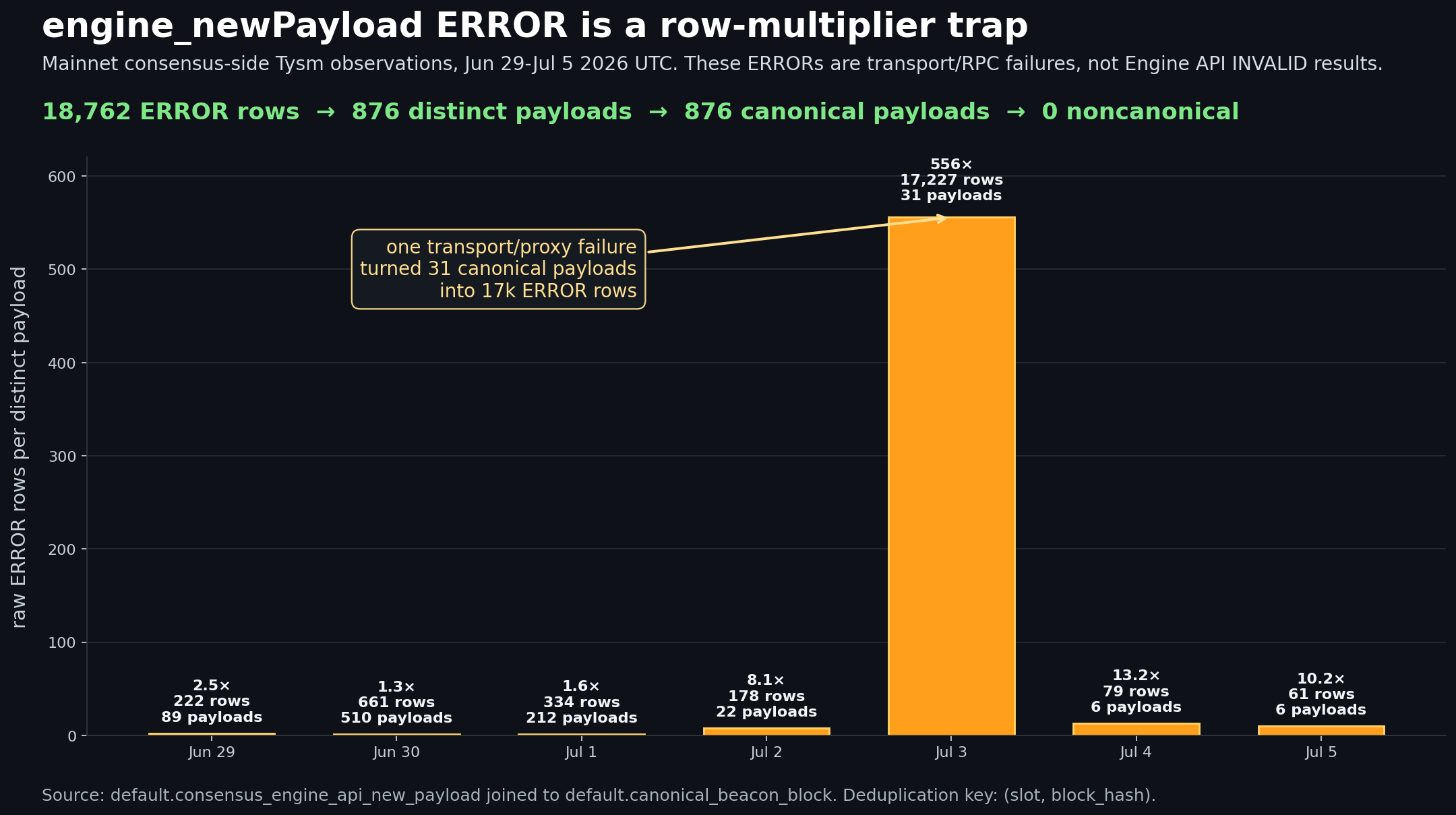
Those rows were only 876 distinct (slot, block_hash) payloads. All 876 joined back to canonical beacon blocks. The important thing hiding in the status name is that ERROR is not the Engine API saying INVALID; in this slice it was transport and RPC failure telemetry around payloads that still landed on chain.
The table I used for the first pass was default.consensus_engine_api_new_payload. It is useful because it sits on the consensus-to-execution boundary, but it is still an observation table. One payload can appear once per observing label, and the same payload can be VALID on most labels while another label says SYNCING or ERROR. So the first denominator is not raw rows. It is the semantic payload key.
Here is the check that made the scary number boring:
WITH per AS (
  SELECT
    slot,
    block_hash,
    any(block_number) AS block_number,
    status,
    count() AS raw_rows
  FROM default.consensus_engine_api_new_payload
  WHERE meta_network_name = 'mainnet'
    AND slot_start_date_time >= toDateTime('2026-06-29 00:00:00')
    AND slot_start_date_time <  toDateTime('2026-07-06 00:00:00')
  GROUP BY slot, block_hash, status
)
SELECT
  p.status,
  sum(p.raw_rows) AS raw_rows,
  uniqExact(tuple(p.slot, p.block_hash)) AS distinct_payloads,
  countIf(c.execution_payload_block_hash = p.block_hash) AS canonical_payloads,
  countIf(c.execution_payload_block_hash != p.block_hash OR c.execution_payload_block_hash IS NULL)
    AS noncanonical_or_missing
FROM per p
LEFT JOIN default.canonical_beacon_block c
  ON c.meta_network_name = 'mainnet'
 AND c.slot = p.slot
 AND c.slot_start_date_time >= toDateTime('2026-06-29 00:00:00')
 AND c.slot_start_date_time <  toDateTime('2026-07-06 00:00:00')
GROUP BY p.status
ORDER BY raw_rows DESC;
| status | raw rows | distinct payloads | canonical payloads | noncanonical or missing |
|---|---|---|---|---|
VALID | 1,026,567 | 50,230 | 50,166 | 64 |
SYNCING | 59,882 | 32,371 | 32,359 | 12 |
ERROR | 18,762 | 876 | 876 | 0 |
That table is also a reminder that status buckets are not exclusive block categories. The same canonical payload can have a clean VALID observation from one node and a SYNCING or ERROR observation from another. Counting the ERROR rows as failed blocks would be the same kind of mistake as counting every Beacon API observer row as a new block.
The weirdest day was Jul 3. It had 17,227 ERROR rows, but only 31 distinct payloads. That is a 556x row multiplier from one day of repeated failed observations. The error text itself is not something I want in a public post because it carries endpoint-shaped operational noise, so I bucketed it before looking at counts:
SELECT
  multiIf(
    positionCaseInsensitive(ifNull(validation_error, ''), 'timeout') > 0,
      'client timeout',
    positionCaseInsensitive(ifNull(validation_error, ''), 'connect') > 0,
      'proxy connect failed',
    positionCaseInsensitive(ifNull(validation_error, ''), '503') > 0,
      '503 service unavailable',
    positionCaseInsensitive(ifNull(validation_error, ''), 'EOF') > 0,
      'proxy EOF',
    ifNull(validation_error, '') = '',
      'empty/unknown',
    'other'
  ) AS error_bucket,
  count() AS raw_rows,
  uniqExact(tuple(slot, block_hash)) AS distinct_payloads,
  round(quantileExact(0.5)(duration_ms), 1) AS p50_ms,
  round(quantileExact(0.95)(duration_ms), 1) AS p95_ms
FROM default.consensus_engine_api_new_payload
WHERE meta_network_name = 'mainnet'
  AND slot_start_date_time >= toDateTime('2026-06-29 00:00:00')
  AND slot_start_date_time <  toDateTime('2026-07-06 00:00:00')
  AND status = 'ERROR'
GROUP BY error_bucket
ORDER BY raw_rows DESC;
| error bucket | raw rows | distinct payloads | p50 | p95 |
|---|---|---|---|---|
| proxy connect failed | 17,945 | 108 | 14 ms | 17 ms |
| client timeout | 815 | 776 | 8,002 ms | 8,012 ms |
| 503 service unavailable | 1 | 1 | 2 ms | 2 ms |
| proxy EOF | 1 | 1 | 845 ms | 845 ms |
That split is the whole story. The big row count was not a pile of invalid execution payloads. It was mostly fast connect failures, plus a smaller set of timeouts. The connect-failure bucket is especially row-shaped: 17,945 rows but only 108 payloads. The timeout bucket went the other way, 815 rows over 776 payloads, which is much closer to one failed observation per payload.
I wanted one more sanity check from the execution-side table, because otherwise this would still be one raw surface explaining itself. For the same block-number span, default.execution_engine_new_payload did not have an ERROR bucket at all:
SELECT
  status,
  source,
  count() AS raw_rows,
  uniqExact(tuple(block_number, block_hash)) AS distinct_payloads,
  round(quantileExact(0.5)(duration_ms), 1) AS p50_ms,
  round(quantileExact(0.95)(duration_ms), 1) AS p95_ms
FROM default.execution_engine_new_payload
WHERE meta_network_name = 'mainnet'
  AND block_number >= 25419598
  AND block_number <= 25469763
  AND event_date_time >= toDateTime('2026-06-29 00:00:00')
  AND event_date_time <  toDateTime('2026-07-07 00:00:00')
GROUP BY status, source
ORDER BY raw_rows DESC;
| status | source | raw rows | distinct payloads | p50 | p95 |
|---|---|---|---|---|---|
VALID | ENGINE_SOURCE_SNOOPER | 1,420,711 | 50,230 | 72 ms | 228 ms |
SYNCING | ENGINE_SOURCE_SNOOPER | 61,634 | 32,870 | 4 ms | 577 ms |
UNKNOWN | ENGINE_SOURCE_SNOOPER | 1 | 1 | 0 ms | 0 ms |
That does not mean every execution node was happy. It means the word ERROR in the consensus-side raw table was not the same thing as an execution client returning INVALID. If the question is "did mainnet receive bad payloads?", the answer is not in raw ERROR row counts. Start by deduping to (slot, block_hash), join to canonical blocks, and split transport failures from actual Engine API payload statuses.
The boring conclusion is the useful one: ERROR rows are failed observations. INVALID payloads would be a different story.