The "6-hour" MEV reward average forgot five hours

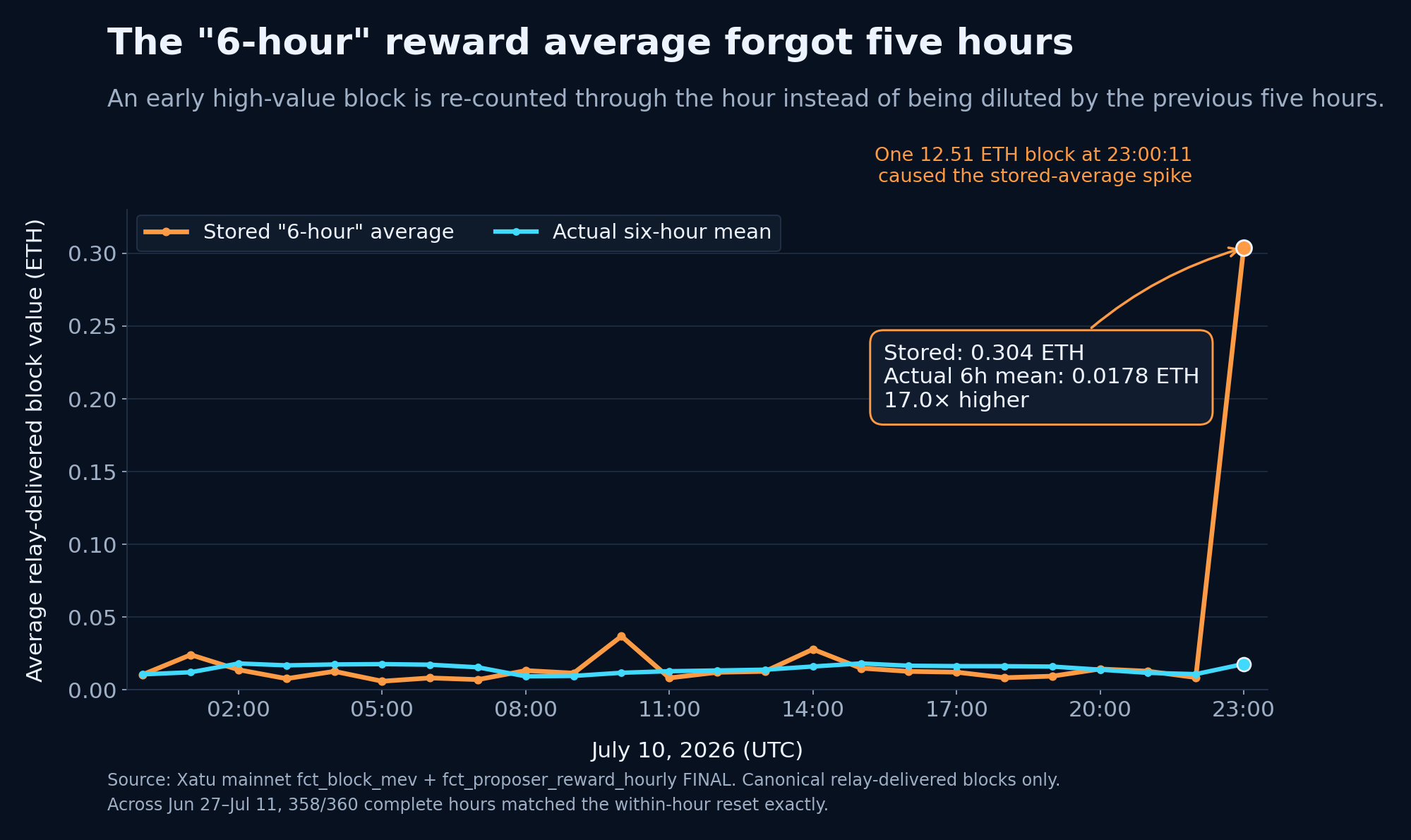
A six-hour moving average that only sees one hour is not smoothing much. At 23:00 UTC on July 10, Xatu's fct_proposer_reward_hourly stored 0.303736 ETH in its moving_avg_reward_eth field. The actual six-hour mean was 0.017821 ETH.
The 17x gap came from one 12.506337 ETH relay-delivered block, included eleven seconds after the hour began. Because it landed first, the stored calculation kept re-counting it through almost every cumulative average in that hour. The previous five hours never entered the window.
This table covers positive-value, canonical blocks delivered through MEV relays. It does not include locally built blocks, and it is not the consensus-layer block reward. The ordinary hourly fields are straightforward aggregates over mainnet.fct_block_mev: count the blocks, convert the relay value from wei to ETH, then take the average and percentiles.
The moving average takes a stranger route. The transformation source first limits slots_in_hours to the hours inside the current transformation task. Only then does it ask ClickHouse for a six-hour window:
slots_in_hours AS (
  SELECT
    slot,
    slot_start_date_time,
    toUnixTimestamp(slot_start_date_time) AS slot_timestamp,
    toFloat64(value) / 1e18 AS reward_eth
  FROM mainnet.fct_block_mev FINAL
  WHERE slot_start_date_time >= min_hour
    AND slot_start_date_time <  max_hour + INTERVAL 1 HOUR
    AND status = 'canonical'
    AND value IS NOT NULL
    AND value > 0
),
slots_with_ma AS (
  SELECT
    *,
    avg(reward_eth) OVER (
      ORDER BY slot_timestamp
      RANGE BETWEEN 21600 PRECEDING AND CURRENT ROW
    ) AS ma_reward_eth
  FROM slots_in_hours
)
SELECT
  toStartOfHour(slot_start_date_time) AS hour,
  avg(ma_reward_eth) AS moving_avg_reward_eth
FROM slots_with_ma
GROUP BY hour
A window function cannot reach rows that its input query never loaded. On the usual one-hour forward-fill task, RANGE BETWEEN 21600 PRECEDING sounds six hours back but stops at the start of the current hour. The result is the average of a within-hour cumulative average. An early large block gets enormous leverage; a late one barely moves the field.
I reproduced both paths from the same block rows. reset_each_hour deliberately partitions the input at the hour boundary. full_history_6h leaves the preceding hours available to the window:
WITH slots AS (
  SELECT
    slot_start_date_time,
    toStartOfHour(slot_start_date_time) AS hour,
    toUnixTimestamp(slot_start_date_time) AS ts,
    toFloat64(value) / 1e18 AS reward_eth
  FROM mainnet.fct_block_mev FINAL
  WHERE slot_start_date_time >= toDateTime('2026-06-26 18:00:00')
    AND slot_start_date_time <  toDateTime('2026-07-12 00:00:00')
    AND status = 'canonical'
    AND value IS NOT NULL
    AND value > 0
), windowed AS (
  SELECT
    *,
    avg(reward_eth) OVER (
      PARTITION BY hour ORDER BY ts
      RANGE BETWEEN 21600 PRECEDING AND CURRENT ROW
    ) AS reset_each_hour,
    avg(reward_eth) OVER (
      ORDER BY ts
      RANGE BETWEEN 21600 PRECEDING AND CURRENT ROW
    ) AS full_history_6h
  FROM slots
), recomputed AS (
  SELECT
    hour,
    round(avg(reset_each_hour), 6) AS reset_value,
    round(avg(full_history_6h), 6) AS actual_6h_value
  FROM windowed
  GROUP BY hour
)
SELECT
  r.hour,
  t.moving_avg_reward_eth AS stored_value,
  r.reset_value,
  r.actual_6h_value,
  round(stored_value / actual_6h_value, 3) AS ratio
FROM recomputed r
GLOBAL INNER JOIN (
  SELECT hour_start_date_time, moving_avg_reward_eth
  FROM mainnet.fct_proposer_reward_hourly FINAL
  WHERE hour_start_date_time >= toDateTime('2026-06-27 00:00:00')
    AND hour_start_date_time <  toDateTime('2026-07-12 00:00:00')
) t ON r.hour = t.hour_start_date_time
ORDER BY r.hour;
Across 360 complete hours from June 27 through July 11, the stored value matched the within-hour reset exactly in 358. The two exceptions were July 3 hours, consistent with a wider backfill task supplying more history. Against the real six-hour series, the stored value ran above 2x in 31 hours, above 5x twice, and below half in 34 hours. This is not a simple upward bias. It depends on where the expensive blocks sit inside each processing batch.
July 10 at 23:00 is the cleanest failure. The hour contained 268 relay-delivered canonical blocks with an ordinary average value of 0.058321 ETH. The first block paid 12.506337 ETH, so averaging the hour's cumulative averages produced 0.303736 ETH, more than five times the ordinary hourly average and 17.044x the six-hour mean.
I checked that block and the six-hour denominator against the raw relay surface rather than trusting the refined table twice. I fetched mev_relay_proposer_payload_delivered and canonical_beacon_block separately, deduped relay observations by block hash, and joined them locally. The seven-hour slice had 1,931 matched relay-delivered canonical payloads. It reproduced the same 12.506337 ETH maximum, 0.058321 ETH hourly average, and 0.017821 ETH six-hour value.
This is a window-frame bug, not an MEV market event. The table's count, total, ordinary average, min, max, and percentile fields still answer their hourly questions. I would not use moving_avg_reward_eth as a six-hour trend line until the transformation loads the preceding six hours before applying the window. The daily sibling uses the same bounded-input pattern for its advertised seven-day average, so that field needs the same treatment.