LayerZero kept 52,161 storage slots for one block

I expected Ethereum's shortest-lived storage to be token-account churn: balances created, spent, and gone. USDC and USDT do show up, but neither contract was first. LayerZero's ReceiveUln302 created 52,161 storage slots and deleted them in the next execution block.
Its EndpointV2 added another 24,163. Together, those two contracts made 76,324 of Ethereum's 212,618 adjacent-block storage lifecycles, or 35.90%, across 14 complete days. This was not random garbage. It was a cross-chain message waiting room being filled, checked, moved, and cleared.
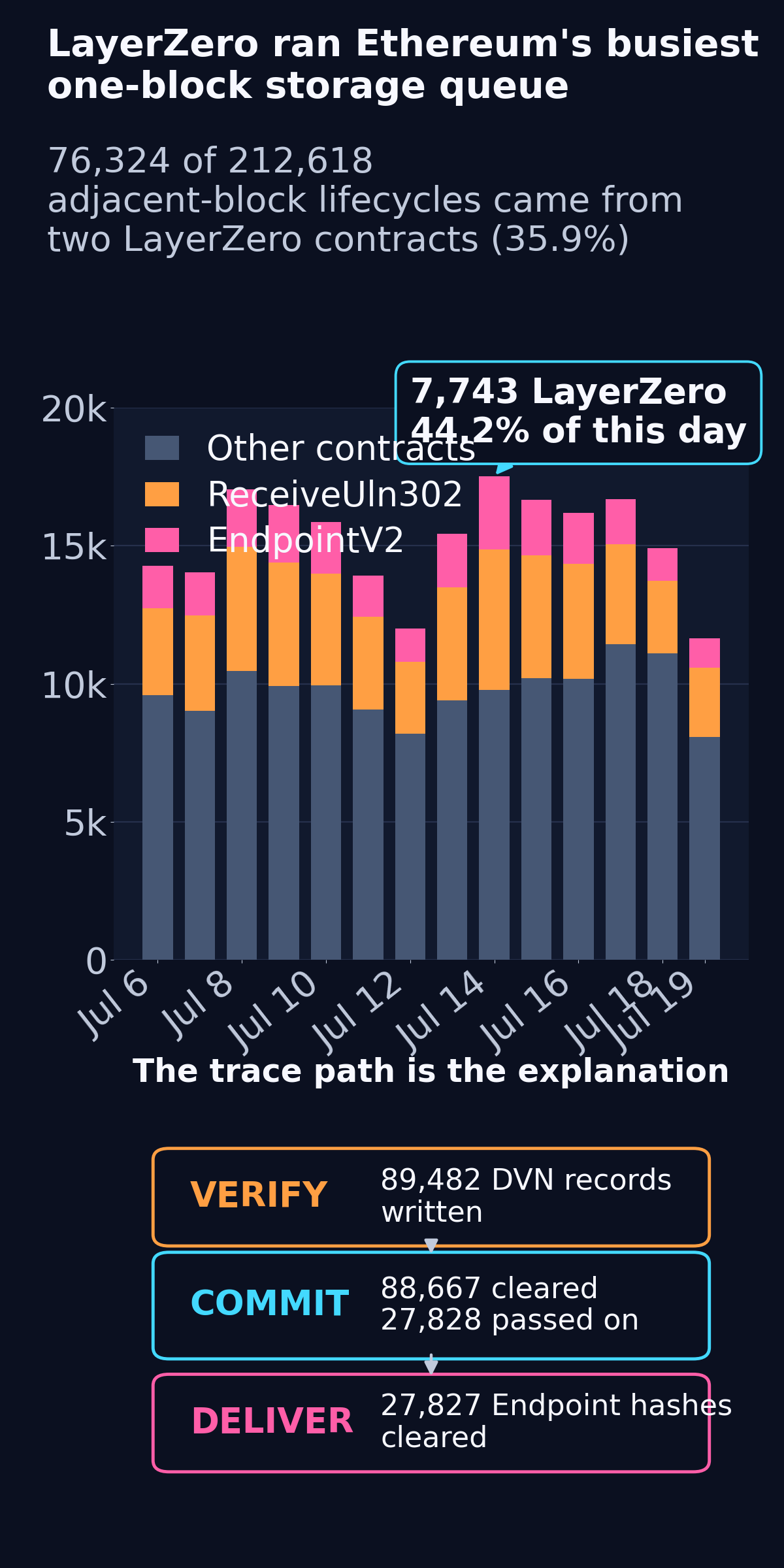
The lifecycle table is unusually literal. birth_block is the block where a slot moves from zero to nonzero; death_block is the reverse. lifespan_blocks = 1 therefore means adjacent execution blocks, not one transaction and not one write. Of the 76,324 LayerZero pairs, 76,115 were 12 seconds apart and the other 209 crossed a missed slot at 24 seconds.
I resolved the window through finalized canonical blocks before touching the block-partitioned storage model. Refined mainnet.fct_block FINAL and raw canonical_execution_block FINAL independently returned the same 100,437 blocks and hashes, from 25,469,764 through 25,570,200, for July 6-19 UTC.
Here is the query behind the headline. The lifecycle table is ordered by address and slot rather than birth block, so the primary-key guard is deliberately disabled only after pinning the query to one known partition and the literal 14-day block range.
SELECT
  countIf(lifespan_blocks = 1) AS all_one_block,
  countIf(
    lifespan_blocks = 1
    AND address = '0xc02ab410f0734efa3f14628780e6e695156024c2'
  ) AS receive_uln_one_block,
  countIf(
    lifespan_blocks = 1
    AND address = '0x1a44076050125825900e736c501f859c50fe728c'
  ) AS endpoint_one_block,
  countIf(
    lifespan_blocks = 1
    AND address IN (
      '0xc02ab410f0734efa3f14628780e6e695156024c2',
      '0x1a44076050125825900e736c501f859c50fe728c'
    )
  ) AS layerzero_one_block
FROM mainnet.int_storage_slot_lifecycle FINAL
WHERE intDiv(birth_block, 5000000) = 5
  AND birth_block BETWEEN 25469764 AND 25570200
SETTINGS force_primary_key = 0;

-- all_one_block:        212,618
-- receive_uln_one_block: 52,161
-- endpoint_one_block:    24,163
-- layerzero_one_block:   76,324
The first address is a verified ReceiveUln302. The second is LayerZero's verified EndpointV2. Their lifecycle shapes are different but both are aggressively temporary. Of 88,502 closed ReceiveUln302 lifecycles born in the window, 58.94% died one block later. For EndpointV2, it was 24,163 of 27,819 closed lifecycles, or 86.86%.
The source code explains the first contract cleanly. ReceiveUlnBase._verify stores a Verification record under (headerHash, payloadHash, DVN). Once the configured required and optional DVNs have signed, _verifyAndReclaimStorage loops over them and deletes those records. The method name is unusually honest.
The traces reproduce that path without needing to guess from storage keys. The selector 0x0223536e is verify(bytes,bytes32,uint64): 89,482 successful trace calls wrote exactly 89,482 nonzero storage records in the receive library. Several calls can share a transaction, which is why those calls covered 89,421 transaction hashes.
Then commitVerification(bytes,bytes32) takes over. The deployed ReceiveUln302 reclaims the DVN records and calls EndpointV2.verify for the same packet. Across 27,828 successful commit calls, every transaction contained both sides of that handoff: 88,667 receive-library records were cleared and 27,828 Endpoint payload hashes were written. That is 3.19 verification records cleared per successful commit, on average.
SELECT
  action_to,
  substring(action_input, 1, 10) AS selector,
  count() AS trace_rows,
  uniqExact((block_number, transaction_hash, internal_index)) AS exact_trace_rows,
  uniqExact(transaction_hash) AS transactions,
  countIf(error IS NULL OR error = '') AS successful_rows,
  countIf(error IS NOT NULL AND error != '') AS error_rows
FROM default.canonical_execution_traces FINAL
WHERE meta_network_name = 'mainnet'
  AND block_number BETWEEN 25469764 AND 25570201
  AND action_to IN (
    '0xc02ab410f0734efa3f14628780e6e695156024c2',
    '0x1a44076050125825900e736c501f859c50fe728c'
  )
  AND substring(action_input, 1, 10) IN (
    '0x0223536e', -- ReceiveUln302.verify
    '0x0894edf1', -- ReceiveUln302.commitVerification
    '0xa825d747', -- EndpointV2.verify
    '0x0c0c389e'  -- EndpointV2.lzReceive
  )
GROUP BY action_to, selector
ORDER BY action_to, selector;
I fetched the bounded raw storage diffs separately and joined them to those trace transaction hashes locally. That avoids pretending two large distributed raw tables will always give a stable publication join. The result was exact: all 27,828 successful commit transactions cleared at least one ReceiveUln302 record and created one Endpoint hash in the same transaction.
EndpointV2 keeps that payload hash until delivery. Its verify path writes the hash through _inbound. Its lzReceive path calls _clearPayload before the external application call, specifically to prevent reentrancy. The data shows 27,827 successful lzReceive traces and 27,827 Endpoint storage deaths on those same transaction hashes.
I also ran the headline backward from raw diffs rather than only checking that each model row had some plausible source. For each LayerZero address and slot key, I looked for a raw zero-to-nonzero transition in block n and a nonzero-to-zero transition in block n + 1. That raw path produced 76,324 pairs. The lifecycle model produced 76,324, with a 76,324-row intersection and nothing left over on either side.
There is one important blind spot. The lifecycle model first reduces a slot to its opening and closing value inside each block. A slot created and cleared within the same block can finish zero-to-zero and disappear from this particular denominator. These counts describe state that survived across an execution-block boundary; they are not every bit of temporary EVM storage activity. They also do not count cross-chain messages. One committed packet can clear several DVN verification records, which is exactly what happened here.
Still, the ranking changes the mental picture. Short-lived state is not only token balances and AMM locks. In this window, the busiest one-block storage contract was a verifier deliberately writing proof-of-approval records, deleting them, moving one hash into the endpoint, then deleting that hash at delivery. The state churn was real. It just had excellent cleanup discipline.