Gossipsub PRUNE rows are not peer churn

The libp2p control tables had one of those numbers that looks fake enough to be interesting: 3.23 billion PRUNE rows on June 25, from the mainnet Gossipsub sample. If you read that as "three billion peers got pruned", the table is lying to you.
It is not a peer count. It is not a rejected-message count. It is a control-plane row surface, and on that day it expanded much faster than the observed peer set did.
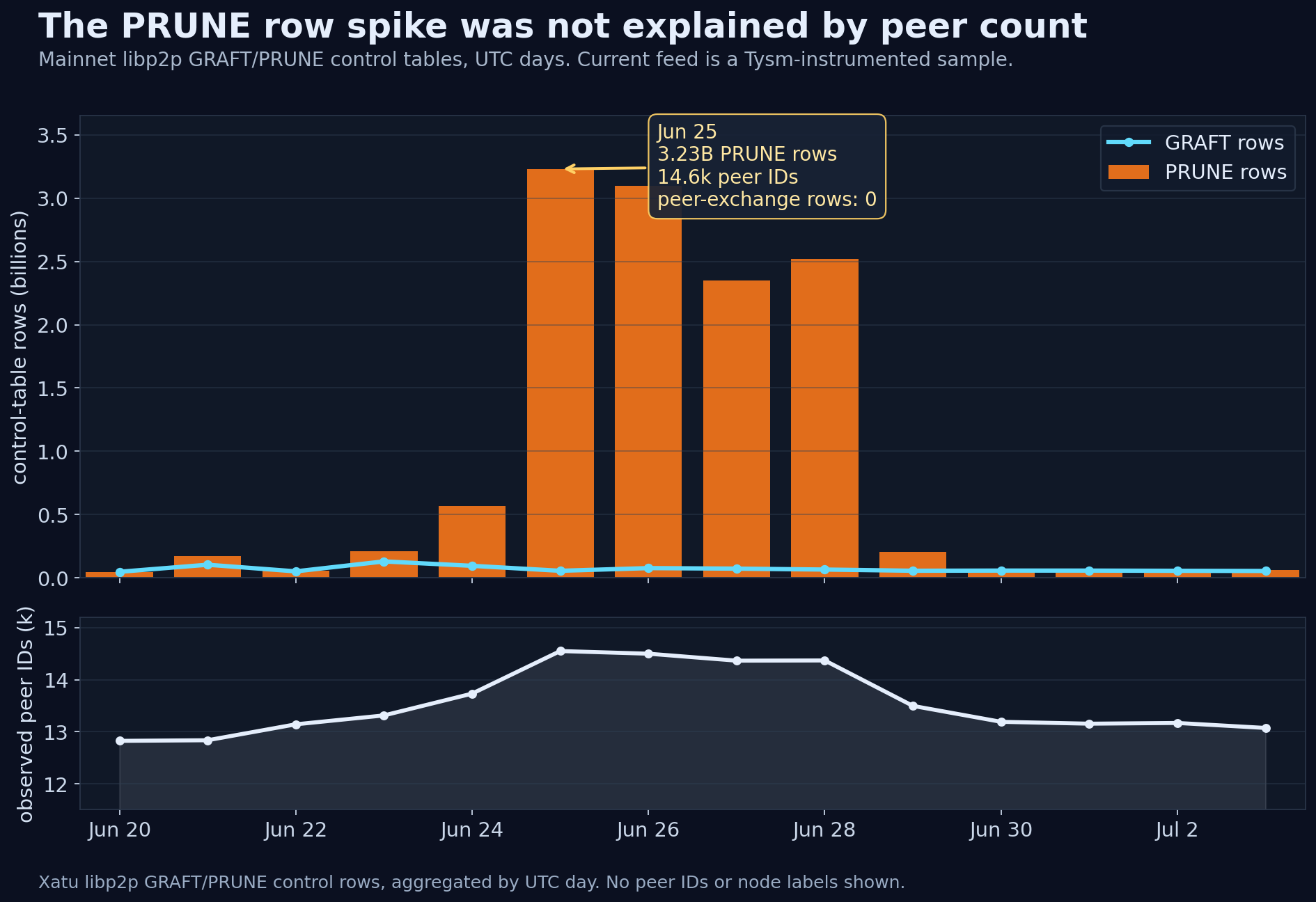
Here is the daily query shape. The chart keeps June 20-24 as context, while the headline totals below use the complete June 25-July 3 spike window. I kept the public post aggregated and did not publish peer IDs or observer labels.
WITH g AS (
  SELECT
    toDate(event_date_time) AS day,
    count() AS graft_rows,
    uniqExact(peer_id_unique_key) AS graft_peers,
    uniqExact(meta_client_name) AS graft_nodes,
    uniqExact(meta_client_implementation) AS graft_impls,
    any(meta_client_implementation) AS graft_impl_sample,
    uniqExact(topic_name) AS graft_topics
  FROM default.libp2p_rpc_meta_control_graft
  WHERE meta_network_name = 'mainnet'
    AND event_date_time >= toDateTime('2026-06-20 00:00:00')
    AND event_date_time <  toDateTime('2026-07-04 00:00:00')
  GROUP BY day
), p AS (
  SELECT
    toDate(event_date_time) AS day,
    count() AS prune_rows,
    uniqExact(peer_id_unique_key) AS prune_peers,
    uniqExact(meta_client_name) AS prune_nodes,
    uniqExact(meta_client_implementation) AS prune_impls,
    any(meta_client_implementation) AS prune_impl_sample,
    uniqExact(topic_name) AS prune_topics,
    countIf(graft_peer_id_unique_key IS NOT NULL) AS peer_exchange_rows
  FROM default.libp2p_rpc_meta_control_prune
  WHERE meta_network_name = 'mainnet'
    AND event_date_time >= toDateTime('2026-06-20 00:00:00')
    AND event_date_time <  toDateTime('2026-07-04 00:00:00')
  GROUP BY day
)
SELECT
  coalesce(g.day, p.day) AS day,
  graft_rows,
  prune_rows,
  graft_peers,
  prune_peers,
  graft_nodes,
  prune_nodes,
  graft_impls,
  prune_impls,
  graft_impl_sample,
  prune_impl_sample,
  graft_topics,
  prune_topics,
  peer_exchange_rows,
  round(prune_rows / greatest(prune_peers, 1), 0) AS prune_rows_per_peer,
  round(graft_rows / greatest(prune_rows, 1), 4) AS graft_prune_ratio
FROM g
FULL OUTER JOIN p ON g.day = p.day
ORDER BY day;
The shape is ugly. From June 25 through July 3, default.libp2p_rpc_meta_control_prune had 11.65 billion PRUNE rows. The matching GRAFT table had 557.76 million rows. Both surfaces came from the same current sample shape: one observing implementation, Tysm, with up to 46 observing nodes in the window. That matters. This is not a full-network peer census, and I would not use it as one.
But even inside that sample, the naive read breaks. The peak day had 3,230,084,267 PRUNE rows, 14,550 observed peer IDs, and zero rows with the peer-exchange field populated. The row count was about 222,000 PRUNE rows per observed peer ID that day. The peer set rose a bit, but not by anything close to the same factor.
That last peer_exchange_rows = 0 check is boring in the useful way. The table has a field for PRUNE peer-exchange entries, and it was empty for this whole June 25 to July 3 window. So the spike was not a hidden giant peer-exchange list showing up in the rows. It was ordinary control-row multiplication across topics, peers, and observer events.
The sanity check was to compare PRUNE rows to actual Gossipsub attestation messages. If PRUNE rows were a proxy for attestation volume, the message surface should move with it. It did not.
WITH selected AS (
  SELECT arrayJoin([
    'beacon_attestation_20',
    'beacon_attestation_38',
    'beacon_attestation_40',
    'beacon_attestation_44'
  ]) AS topic_name
), msg AS (
  SELECT
    toDate(slot_start_date_time) AS day,
    topic_name,
    count() AS attestation_msg_rows,
    uniqExact(message_id) AS attestation_msg_ids,
    uniqExact(meta_client_name) AS msg_nodes
  FROM default.libp2p_gossipsub_beacon_attestation
  WHERE meta_network_name = 'mainnet'
    AND slot_start_date_time >= toDateTime('2026-06-25 00:00:00')
    AND slot_start_date_time <  toDateTime('2026-07-04 00:00:00')
    AND topic_name IN selected
  GROUP BY day, topic_name
), p AS (
  SELECT
    toDate(event_date_time) AS day,
    topic_name,
    count() AS prune_rows,
    uniqExact(meta_client_name) AS prune_nodes
  FROM default.libp2p_rpc_meta_control_prune
  WHERE meta_network_name = 'mainnet'
    AND event_date_time >= toDateTime('2026-06-25 00:00:00')
    AND event_date_time <  toDateTime('2026-07-04 00:00:00')
    AND topic_name IN selected
  GROUP BY day, topic_name
)
SELECT
  msg.day,
  msg.topic_name,
  attestation_msg_rows,
  attestation_msg_ids,
  prune_rows,
  round(prune_rows / greatest(attestation_msg_rows, 1), 3) AS prune_per_message_row
FROM msg
LEFT JOIN p ON msg.day = p.day AND msg.topic_name = p.topic_name
ORDER BY msg.day, msg.topic_name;
beacon_attestation_20 is a nice example because it is not subtle. On June 25 it had 3.11 million unique attestation message IDs and 4.74 million PRUNE rows. On June 30 it still had 3.11 million unique attestation message IDs, but only 134,672 PRUNE rows. The message count was basically in the same band. The control table moved by roughly 35x.
That is the trap. A Gossipsub PRUNE row is a mesh-control observation for a topic and peer entry in this instrumented surface. It is not a data object. It is not a peer leaving the network. It is not a clean bandwidth counter. Counting it raw gives you a control-plane row multiplier and then dares you to name it something more exciting.
I would still use these tables. They are useful for debugging mesh behavior, especially when you keep topic_name, observer implementation, and the row semantics in the denominator. I would just keep the nouns ugly: PRUNE rows, observed peer IDs, Tysm-instrumented sample.
Anything cleaner is probably wrong.