The finalized checkpoint event is not one shape

I expected finalized_checkpoint to be boring.
It has four useful fields: block, state, epoch, and execution_optimistic. The obvious read is that block is the finalized checkpoint block root and state is the finalized checkpoint state root.
For six clients, that is exactly what shows up.
For Lodestar and Grandine, it is not.
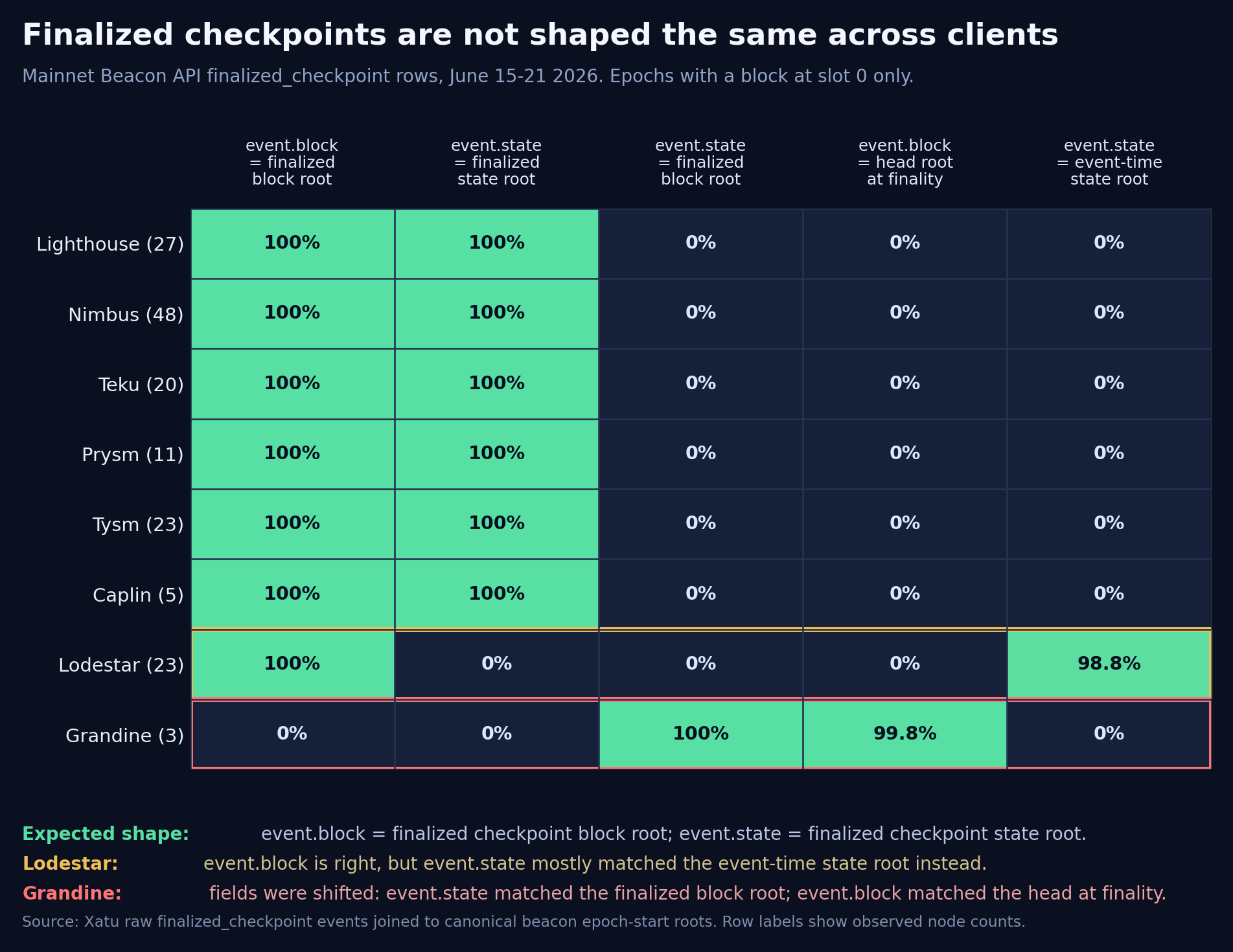
I used the seven complete UTC days from June 15 through June 21. That gave 207,821 raw finalized_checkpoint eventstream rows across 1,575 finalized epochs.
Then I threw away the annoying cases first.
There were 34 epochs where slot 0 did not have a canonical block. The finalized block root is still derivable in those cases, but the checkpoint state root after empty-slot processing is not sitting directly in canonical_beacon_block as a nice row. I did not want to fake that part, so the chart only uses the 1,541 epochs with a canonical block at slot 0.
That leaves 203,332 event rows.
The strict slot-0-present check looked like this:
WITH checkpoints AS (
  SELECT
    epoch,
    block_root AS canonical_block,
    state_root AS canonical_state
  FROM canonical_beacon_block
  WHERE meta_network_name = 'mainnet'
    AND slot_start_date_time >= toDateTime('2026-06-15 00:00:00')
    AND slot_start_date_time <  toDateTime('2026-06-22 00:00:00')
    AND slot % 32 = 0
), events AS (
  SELECT
    epoch,
    block,
    state,
    meta_consensus_implementation AS impl,
    meta_client_name
  FROM beacon_api_eth_v1_events_finalized_checkpoint
  WHERE meta_network_name = 'mainnet'
    AND epoch_start_date_time >= toDateTime('2026-06-15 00:00:00')
    AND epoch_start_date_time <  toDateTime('2026-06-22 00:00:00')
)
SELECT
  impl,
  uniqExact(meta_client_name) AS nodes,
  count() AS rows,
  uniqExact(epoch) AS epochs,
  round(100 * countIf(block = canonical_block) / count(), 2) AS block_is_finalized_block_pct,
  round(100 * countIf(state = canonical_state) / count(), 2) AS state_is_finalized_state_pct,
  round(100 * countIf(state = canonical_block) / count(), 2) AS state_is_finalized_block_pct
FROM events
INNER JOIN checkpoints USING epoch
GROUP BY impl
ORDER BY rows DESC
The normal clients were boring in the best possible way:
- Lighthouse:
blockmatched the finalized block root 100%,statematched the finalized state root 100%. - Nimbus: 100% / 100%.
- Teku: 100% / 100%.
- Prysm: 100% / 100%.
- Tysm: 100% / 100%.
- Caplin: 100% / 100%.
Lodestar split the event in half. Its block field matched the finalized block root 100% of the time, but its state field matched the finalized checkpoint state root 0% of the time.
It was not random junk. In 98.8% of Lodestar rows, state matched the state root at the event-time epoch, roughly two epochs after the finalized checkpoint. So the event still has a useful root in it. It is just not the finalized checkpoint state root.
For that chart column, I joined the same event rows to the canonical block at slot = epoch * 32 + 64, the start of the epoch when the finalized-checkpoint event normally arrives.
Grandine was weirder.
In this sample, Grandine's state field matched the finalized checkpoint block root 100% of the time. Its block field matched the head root around the time finality was processed, not the finalized checkpoint block root, in 99.8% of rows. That head-root check used slot = epoch * 32 + 63, the block immediately before the event-time epoch boundary.
So if you read Grandine's block field as "the finalized block", you get the wrong root every time in this window.
That is the trap.
The Beacon API example for finalized_checkpoint shows this shape:
{
  "block": "0x...",
  "state": "0x...",
  "epoch": "2",
  "execution_optimistic": false
}
It does not give you much semantic padding. In practice, if you are building a cross-client finality monitor, you cannot just group by (epoch, block, state) and call disagreements a chain problem.
You will manufacture fake disagreements.
For epoch-start blocks in this one-week window, the safe rule was:
- use
blockfrom Lighthouse, Nimbus, Teku, Prysm, Tysm, Caplin, and Lodestar as the finalized checkpoint block root; - use
statefrom Lighthouse, Nimbus, Teku, Prysm, Tysm, and Caplin as the finalized checkpoint state root; - do not treat Lodestar
stateas the finalized checkpoint state root; - do not treat Grandine
blockas the finalized checkpoint block root.
Small-sample caveat: Grandine had only 3 observed nodes and Caplin had 5. This is Xatu's observed eventstream surface, not a client-market-share census.
Still, the shape is too clean to ignore. Lodestar was not a noisy 93%. Grandine was not a handful of odd rows. These were deterministic-looking field semantics across a full week of mainnet events.
Finality was fine.
The event shape was not.