Ethereum's execution peer set has a zombie wing

A stale execution peer is not always a node that forgot the latest fork.
Sometimes it is a modern client binary sitting at the mainnet genesis block and politely telling the world it is ready for Homestead.
Across seven complete UTC days, 201 of 1,444 discovered mainnet execution node IDs advertised old fork IDs. 164 of those had the old Frontier fork ID, 0xfc64ec04, with next = 1150000.
That is not "slightly behind."
That is genesis.
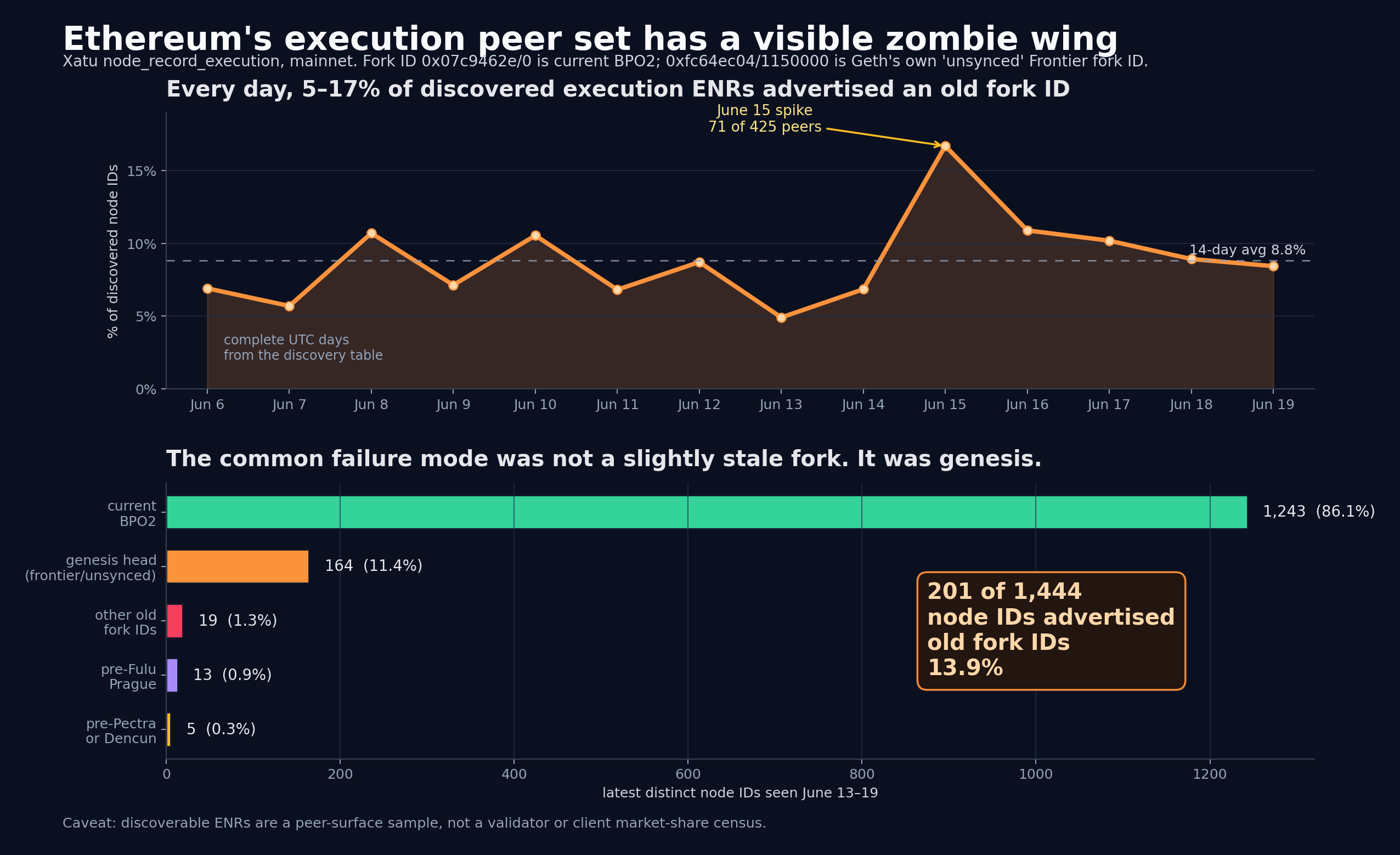
The fork-ID part matters because this is not me inventing a label. Geth's own fork-ID test calls this pair unsynced:
{0, 0, ID{Hash: checksumToBytes(0xfc64ec04), Next: 1150000}}, // Unsynced
{50000000, 2000000000, ID{Hash: checksumToBytes(0x07c9462e), Next: 0}}, // Future BPO2 block
0x07c9462e / 0 is the current mainnet fork ID after the January BPO2 change. 0xfc64ec04 / 1150000 is the fork ID you get at block zero, before Homestead.
So I asked a dumb question: how much of the discoverable execution peer surface is actually advertising the current chain?
This is the query. It takes the latest record per node_id seen from June 13 through June 19, then buckets the advertised fork ID.
WITH latest AS (
  SELECT
    node_id,
    argMax(implementation, event_date_time) AS impl,
    argMax(version, event_date_time) AS version,
    argMax(fork_id_hash, event_date_time) AS fork_hash,
    argMax(fork_id_next, event_date_time) AS fork_next,
    argMax(head, event_date_time) AS head,
    argMax(ip, event_date_time) AS ip,
    argMax(geo_autonomous_system_organization, event_date_time) AS asn_org
  FROM node_record_execution
  WHERE meta_network_name = 'mainnet'
    AND event_date_time >= toDateTime('2026-06-13 00:00:00')
    AND event_date_time < toDateTime('2026-06-20 00:00:00')
  GROUP BY node_id
), labeled AS (
  SELECT
    *,
    multiIf(
      fork_hash = '0x07c9462e' AND fork_next = '0', 'current/BPO2',
      fork_hash = '0xfc64ec04' AND fork_next = '1150000', 'frontier-or-unsynced',
      fork_hash = '0xc376cf8b' AND fork_next = '1764798551', 'pre-Fulu/Prague',
      fork_next IN ('1681338455', '1710338135')
        OR fork_hash IN ('0xf0afd0e3', '0xdce96c2d'), 'pre-Pectra-or-Dencun',
      'other-old'
    ) AS state
  FROM latest
)
SELECT
  state,
  count() AS nodes,
  round(100 * nodes / sum(nodes) OVER (), 2) AS pct,
  uniqExact(ip) AS ips,
  uniqExact(asn_org) AS asns
FROM labeled
GROUP BY state
ORDER BY nodes DESC
Result:
| fork state | node IDs | share | distinct IPs | ASNs |
|---|---|---|---|---|
| current/BPO2 | 1,243 | 86.08% | 1,165 | 255 |
| frontier-or-unsynced | 164 | 11.36% | 149 | 29 |
| other old fork IDs | 19 | 1.32% | 17 | 13 |
| pre-Fulu/Prague | 13 | 0.90% | 7 | 5 |
| pre-Pectra-or-Dencun | 5 | 0.35% | 5 | 5 |
The ugly bit is the head field.
For the 164 frontier-or-unsynced peers, the latest advertised head was the mainnet genesis hash:
0xd4e56740f876aef8c010b86a40d5f56745a118d0906a34e69aec8c0db1cb8fa3
Not a Prague head. Not a Dencun head. Not a node that missed BPO2.
Genesis.
That group was not just ancient software either. The biggest cluster was Geth v1.16.7, but the same genesis-head bucket also had Reth v2.2.0, Reth v2.3.0, Erigon v3.4.x, and a couple of Ethrex nodes. Fresh binary, dead chain state.
Split by implementation:
| implementation | total node IDs | current | old | old share |
|---|---|---|---|---|
| Nimbus EL | 16 | 8 | 8 | 50.0% |
| Erigon | 121 | 91 | 30 | 24.8% |
| Geth | 941 | 809 | 132 | 14.0% |
| Reth | 172 | 148 | 24 | 14.0% |
| Besu | 30 | 27 | 3 | 10.0% |
| Nethermind | 150 | 150 | 0 | 0.0% |
Do not read that as client market share. This table is a discoverability surface, not a validator census, and the sample is shaped by what the discovery crawler can reach.
But that caveat cuts both ways. These are exactly the peers a node-discovery system can find. If a peer table says "I found 1,400 execution nodes," somewhere around one in seven of those advertised a fork ID that a current mainnet node should not use for useful peering.
The daily view was not a one-hour scrape artifact either. The old-fork share bounced around, but it never went away:
| day | discovered node IDs | old or unsynced | share |
|---|---|---|---|
| Jun 6 | 405 | 28 | 6.91% |
| Jun 7 | 386 | 22 | 5.70% |
| Jun 8 | 448 | 48 | 10.71% |
| Jun 9 | 448 | 32 | 7.14% |
| Jun 10 | 474 | 50 | 10.55% |
| Jun 11 | 440 | 30 | 6.82% |
| Jun 12 | 413 | 36 | 8.72% |
| Jun 13 | 346 | 17 | 4.91% |
| Jun 14 | 365 | 25 | 6.85% |
| Jun 15 | 425 | 71 | 16.71% |
| Jun 16 | 376 | 41 | 10.90% |
| Jun 17 | 412 | 42 | 10.19% |
| Jun 18 | 448 | 40 | 8.93% |
| Jun 19 | 391 | 33 | 8.44% |
My guess is boring and annoying: lots of short-lived or misconfigured execution clients start up, bind P2P, advertise an ENR, and sit at genesis long enough to be crawled. Some may be abandoned nodes. Some may be cloud images caught mid-sync. Some may be test rigs pointed at mainnet discovery by accident.
The important part is not whether they hurt consensus. They probably do not. A synced node should reject stale peers through fork-ID checks.
The important part is counting.
Raw peer counts include ghosts. Fork ID and head hash are the cheap sanity check. Without them, a peer table can look healthier than the network it actually represents.