8,980 code deployments landed on addresses that already held ETH

A contract address can hold ETH before it has bytecode. That sounds like EVM trivia until a gas proposal has to decide whether deploying the code creates a new account or updates one that is already there.
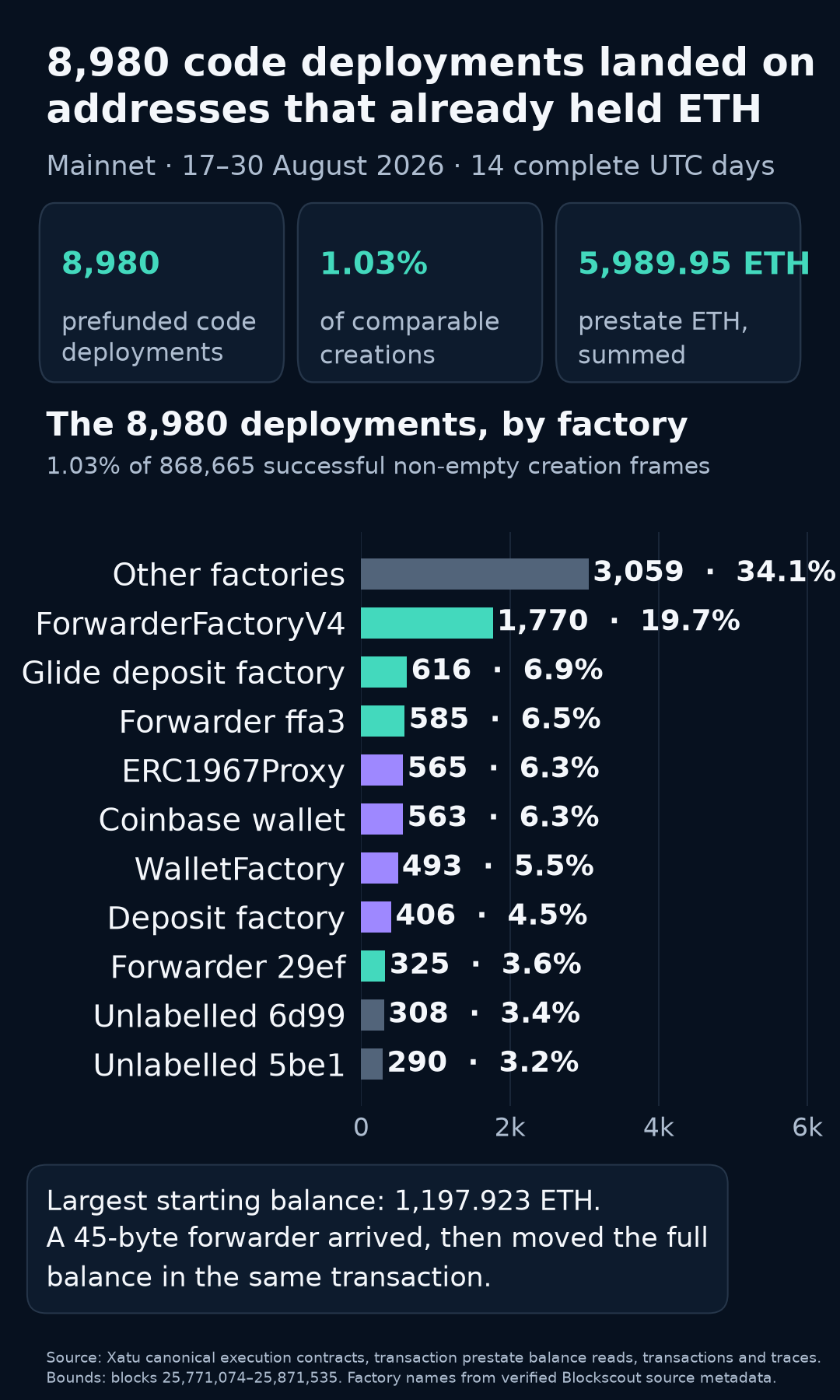
Across 14 complete August days, 8,980 successful code deployments landed on addresses with a positive prestate balance. That was 1.03% of comparable creation frames, and the addresses held 5,989.950758 ETH in total before their deployment transactions began.
The immediate trigger was a tiny edit. EIPs PR #12246, merged on August 31, added "or a non-zero balance" to EIP-8037's description of an existing account. The edit is one clause long. Mainnet makes the clause look much less academic.
EIP-684 rejects contract creation when the destination already has a nonzero nonce or nonempty code. Balance is not part of that collision test. A deterministic address can receive ETH first, then accept code later while the balance sits on the same account leaf.
The account came first
I looked at blocks 25,771,074 through 25,871,535, the 100,462 canonical blocks from August 17 through 30 UTC. canonical_execution_balance_reads is transaction-prestate account data, not a count of BALANCE opcodes, so a positive row at the created address means the ETH was present before that transaction executed.
The creation table is a frame surface, which is an easy place to overcount. I joined every candidate back to its root transaction, required success, and required a nonempty runtime for the headline. This is the executed headline query:
SELECT
  countIf(p.n_code_bytes > 0) AS prefunded_code_deployments,
  uniqExactIf(lower(p.contract_address), p.n_code_bytes > 0) AS deployed_addresses,
  uniqExactIf(p.transaction_hash, p.n_code_bytes > 0) AS deployment_transactions,
  sumIf(toUInt256(p.prebalance), p.n_code_bytes > 0) AS prestate_balance_wei,
  maxIf(toUInt256(p.prebalance), p.n_code_bytes > 0) AS largest_prestate_balance_wei,
  countIf(p.n_code_bytes = 0) AS zero_runtime_create_frames
FROM default.canonical_execution_transaction AS t FINAL
GLOBAL INNER JOIN
(
  SELECT
    c.block_number AS creation_block,
    c.transaction_hash AS transaction_hash,
    c.internal_index AS creation_internal_index,
    c.contract_address AS contract_address,
    c.factory AS factory,
    c.n_code_bytes AS n_code_bytes,
    b.balance AS prebalance
  FROM default.canonical_execution_balance_reads AS b FINAL
  GLOBAL INNER JOIN
  (
    SELECT
      meta_network_name,
      block_number,
      transaction_hash,
      internal_index,
      contract_address,
      factory,
      n_code_bytes
    FROM default.canonical_execution_contracts FINAL
    WHERE meta_network_name = 'mainnet'
      AND block_number BETWEEN 25771074 AND 25871535
  ) AS c
    ON b.meta_network_name = c.meta_network_name
   AND b.block_number = c.block_number
   AND b.transaction_hash = c.transaction_hash
   AND lower(b.address) = lower(c.contract_address)
  WHERE b.meta_network_name = 'mainnet'
    AND b.block_number BETWEEN 25771074 AND 25871535
    AND b.balance > 0
) AS p
  ON t.block_number = p.creation_block
 AND t.transaction_hash = p.transaction_hash
WHERE t.meta_network_name = 'mainnet'
  AND t.block_number BETWEEN 25771074 AND 25871535
  AND t.success;
That returned 8,980 frames, 8,979 distinct addresses, and 8,385 transactions. The one-address difference is why I am calling these deployments rather than unique contracts. Another 2,461 successful prefunded creation frames produced zero runtime bytes and stay outside the headline.
The denominator used the same transaction-success gate without the balance join:
SELECT
  countIf(c.n_code_bytes > 0) AS successful_nonempty_create_frames,
  countIf(c.n_code_bytes = 0) AS successful_zero_runtime_create_frames
FROM default.canonical_execution_transaction AS t FINAL
GLOBAL INNER JOIN
(
  SELECT meta_network_name, block_number, transaction_hash, n_code_bytes
  FROM default.canonical_execution_contracts FINAL
  WHERE meta_network_name = 'mainnet'
    AND block_number BETWEEN 25771074 AND 25871535
) AS c
  ON t.meta_network_name = c.meta_network_name
 AND t.block_number = c.block_number
 AND t.transaction_hash = c.transaction_hash
WHERE t.meta_network_name = 'mainnet'
  AND t.block_number BETWEEN 25771074 AND 25871535
  AND t.success;
It returned 868,665 successful nonempty creation frames, putting the prefunded share at 1.033770%. Raw and refined creation tables differed by five rows in the full window, but all five belonged to one failed out-of-gas root transaction. The success gate removed the discrepancy instead of averaging it away.
The second check was at trace grain. Every one of the 8,980 candidates matched exactly one create trace at the same (block, transaction, result_address). All 8,980 had a null error and zero create endowment. For the 7,078 candidates with a transaction-final balance diff, from_value matched the prestate balance exactly; the other 1,902 had no diff row rather than a conflicting value.
Mostly factories doing factory things
The shape is not a random sample of contract deployment. Verified Blockscout source names identify ForwarderFactoryV4 at 1,770 deployments, GlideDepositFactory at 616, another ForwarderFactory at 585, ERC1967Proxy at 565, and CoinbaseSmartWalletFactory at 563. The named and two largest unlabelled groups in the chart account for 5,921 deployments; the remaining 3,059 are folded into "other factories."
The largest balance makes the ordering obvious. In transaction 0x569b...c493, ForwarderFactory created a 45-byte proxy at 0xe560...d0e3 with zero endowment. The address already held 1,197.923 ETH. Its balance diff went from 1,197.923 ETH to zero, and Blockscout's independent internal-call view shows the new forwarder sending that exact amount later in the same successful transaction.
The charge moved, it did not vanish
EIP-8037 is in Review and Scheduled for Inclusion in Glamsterdam. Its current constants charge 120 state bytes × 1,530 gas/byte = 183,600 state gas when an operation creates a new account leaf. The proposal now says a balance-only destination already has that leaf, so these deployments pay code-byte state gas but skip the account-creation component at deployment time.
A naive backcast that charged every one of the 8,980 deployments as a fresh account would add 1,648,728,000 state gas in the wrong place. That is not a loophole or free state. Under EIP-2780, a positive-value transfer to a previously nonexistent address pays the same new-account state charge when the funding transaction runs after activation.
The account arrived first. The code arrived later. EIP-8037's one-line clarification makes the meter follow that order.