The removed validator-reuse rule had 1.1 million holes ready

Yesterday, consensus-specs deleted its implementation of EIP-6914. The proposal is Stagnant and nobody expects it in an upcoming fork, so removing dead code is sensible. What surprised me was how much work that dead code was already ready to do.
At finalized epoch 471,117, the old rule marked 1,125,125 validator indices as reusable. That is 47.94% of Ethereum's entire 2,347,182-entry validator registry and 78.18% of its zero-balance withdrawal_done rows. If the deleted code had activated against that state, the first new pubkey would have received validator index 41.
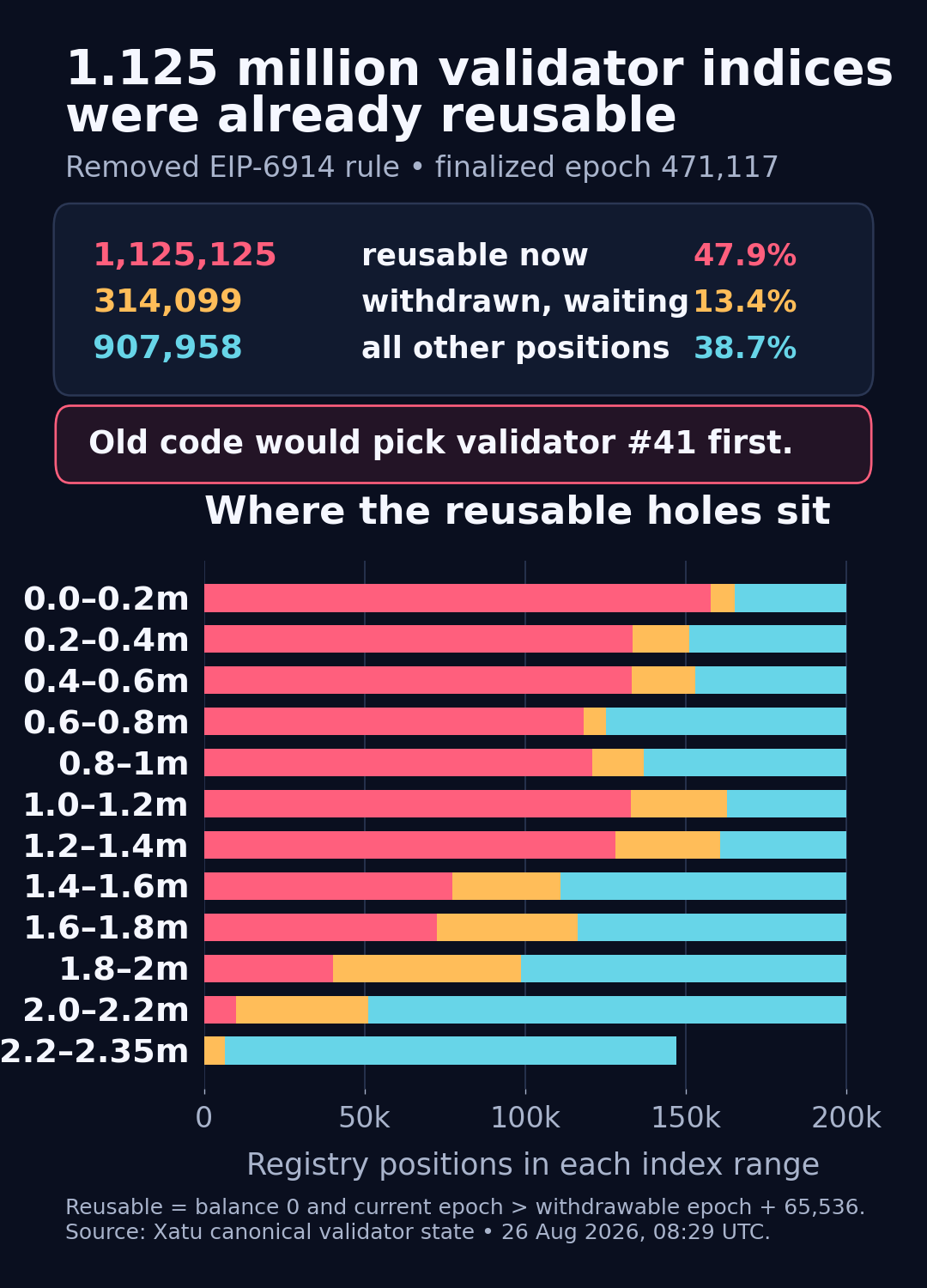
The rule was blunt. A validator became reusable once its balance was zero and more than 65,536 epochs had passed since withdrawable_epoch. That wait is about 291.27 days on mainnet. The deleted get_index_for_new_validator helper then scanned the registry from index zero and returned the first match, which is why index 41 matters rather than merely being a fun old number.
I froze the latest finalized Xatu state and applied that predicate literally. The extra timestamp filter is deliberate: canonical_beacon_validators is an epoch-snapshot table, and filtering only on epoch throws away its useful partition clock.
SELECT
  count() AS registry_rows,
  uniqExact(index) AS unique_indices,
  max(index) AS max_index,
  countIf(status = 'withdrawal_done') AS withdrawal_done,
  countIf(
    balance = 0
    AND withdrawable_epoch IS NOT NULL
    AND toUInt128(epoch) > toUInt128(withdrawable_epoch) + 65536
  ) AS reusable_indices,
  minIf(
    index,
    balance = 0
    AND withdrawable_epoch IS NOT NULL
    AND toUInt128(epoch) > toUInt128(withdrawable_epoch) + 65536
  ) AS first_reusable_index,
  maxIf(
    withdrawable_epoch,
    balance = 0
    AND withdrawable_epoch IS NOT NULL
    AND toUInt128(epoch) > toUInt128(withdrawable_epoch) + 65536
  ) AS latest_safe_withdrawable_epoch
FROM default.canonical_beacon_validators FINAL
WHERE meta_network_name = 'mainnet'
  AND epoch = 471117
  AND epoch_start_date_time = toDateTime('2026-08-26 08:29:11');
The snapshot was clean: count(), uniqExact(index), and max(index) + 1 all returned 2,347,182. Every zero-balance row was already withdrawal_done. Of those 1,439,224 dead positions, 1,125,125 passed the old safety clock and 314,099 were still waiting. The newest eligible rows had withdrawable_epoch = 405580; because the comparison was strict, a row at 405581 had to wait one more epoch.
The holes are not spread evenly. There were 75,342 reusable positions in the first 100,000 indices, and the old loop would have reached the first one after checking only 42 entries. At the other end, the 2.1m-2.2m range had five eligible positions and the registry above 2.2m had none. This was a hole-filling scheme, not a compaction scheme: the list would stay the same length while old indices acquired new pubkeys.
I also checked how that stock compares with current append traffic. Across 15 complete day-to-day steps from August 10 through August 25, the refined daily state grew by 13,261 indices, or a mean of 884 per day. At that short recent rate, the already-safe pool equals about 3.48 years of new indices, before counting any of the waiting cohort that becomes safe later.
SELECT
  day_start_date,
  max(validator_index) + 1 AS registry_length,
  count() AS snapshot_rows,
  countIf(status = 'withdrawal_done') AS withdrawal_done_count
FROM mainnet.fct_validator_balance_daily FINAL
WHERE day_start_date >= toDate('2026-08-10')
  AND day_start_date <= toDate('2026-08-25')
GROUP BY day_start_date
ORDER BY day_start_date;
That is not a forecast. Validator intake changes, exits keep moving, and the old rule would add another 32,414 safe holes within 30 days, 71,508 over the following 60 days, and 210,177 more within a year if the state otherwise stood still. The point is simpler: the reusable cohort was not theoretical or tiny.
The cross-checks were reassuringly boring. The refined dim_validator_status FINAL path lagged two fresh withdrawal_done transitions, but it reproduced the exact 1,125,125 reusable count and the same index bounds. A public finalized Beacon API independently reported epoch 471,117 and returned indices 41, 42, and 2,109,884 as zero-balance withdrawal_done validators with the same lifecycle epochs.
EIP-6914 remains Stagnant, and consensus-specs PR #5568 removed the implementation on August 25 because it is not expected in an upcoming upgrade. Nothing changed on mainnet, and no validator index is being recycled today. The removal just makes the trade-off hard to miss: Ethereum keeps appending validator records while nearly half of the current registry already passes the abandoned reuse rule.
The first hole is 41.