Token transfer address appearances duplicate the sender

Some table names quietly lie to you. canonical_execution_address_appearances has relationship rows called erc20_transfer_from and erc20_transfer_from_to, which sounds like it should cover both sides of a token transfer. On July 1, it did something simpler and uglier: it pointed at the sender twice.
I started with this table because it looked like the broad "who appeared in this transaction?" index that dashboard people always want. That is a useful surface, but only if the relationship names mean what they look like they mean. For token transfers, they do not.
First I resolved the complete July 1 UTC execution-block range, because these raw execution tables are block-number partitioned:
SELECT
  min(block_number) AS min_block,
  max(block_number) AS max_block,
  count() AS blocks
FROM default.canonical_execution_block
WHERE meta_network_name = 'mainnet'
  AND block_date_time >= toDateTime('2026-07-01 00:00:00')
  AND block_date_time <  toDateTime('2026-07-02 00:00:00');
That gave blocks 25,433,939 through 25,441,105, covering 7,167 canonical execution blocks and 2,238,720 transactions. Then I compared the transfer-shaped relationship rows against the canonical ERC transfer tables for the same block range:
SELECT
  'address_appearances' AS surface,
  relationship AS name,
  count() AS rows,
  uniqExact(transaction_hash) AS txs
FROM default.canonical_execution_address_appearances
WHERE meta_network_name = 'mainnet'
  AND block_number BETWEEN 25433939 AND 25441105
  AND relationship IN (
    'erc20_transfer_from', 'erc20_transfer_from_to',
    'erc721_transfer_from', 'erc721_transfer_from_to'
  )
GROUP BY relationship

UNION ALL

SELECT
  'transfer_table' AS surface,
  'erc20_transfers' AS name,
  count() AS rows,
  uniqExact(transaction_hash) AS txs
FROM default.canonical_execution_erc20_transfers
WHERE meta_network_name = 'mainnet'
  AND block_number BETWEEN 25433939 AND 25441105

UNION ALL

SELECT
  'transfer_table' AS surface,
  'erc721_transfers' AS name,
  count() AS rows,
  uniqExact(transaction_hash) AS txs
FROM default.canonical_execution_erc721_transfers
WHERE meta_network_name = 'mainnet'
  AND block_number BETWEEN 25433939 AND 25441105;
The row counts lined up too neatly to ignore. July 1 had 2,780,877 ERC-20 transfer rows, and address_appearances had 2,780,877 erc20_transfer_from rows plus 2,780,877 erc20_transfer_from_to rows. ERC-721 had the same shape at smaller scale: 172,599 transfer rows, 172,599 erc721_transfer_from rows, and 172,599 erc721_transfer_from_to rows.
At that point the charitable guess was that _from_to meant the recipient side. It does not. I narrowed the test to transactions with exactly one ERC-20 or ERC-721 Transfer event, so there was no multi-transfer ambiguity inside the transaction, then joined the address-appearance rows back to the canonical transfer row:
WITH single AS (
  SELECT
    transaction_hash,
    any(erc20) AS token,
    any(from_address) AS from_address,
    any(to_address) AS to_address
  FROM default.canonical_execution_erc20_transfers
  WHERE meta_network_name = 'mainnet'
    AND block_number BETWEEN 25433939 AND 25441105
  GROUP BY transaction_hash
  HAVING count() = 1
)
SELECT
  relationship,
  count() AS rows,
  uniqExact(a.transaction_hash) AS txs,
  countIf(a.address = from_address) AS matches_from,
  countIf(a.address = to_address AND from_address != to_address) AS matches_nonself_to,
  round(100 * matches_from / rows, 4) AS pct_from,
  round(100 * matches_nonself_to / rows, 4) AS pct_nonself_to
FROM default.canonical_execution_address_appearances AS a
GLOBAL INNER JOIN single USING (transaction_hash)
WHERE a.meta_network_name = 'mainnet'
  AND a.block_number BETWEEN 25433939 AND 25441105
  AND a.relationship IN ('erc20_transfer_from', 'erc20_transfer_from_to')
GROUP BY relationship
ORDER BY relationship;
For the 653,129 single-transfer ERC-20 transactions, both relationship names matched Transfer.from 100% of the time. They matched non-self Transfer.to 0% of the time. Running the same query against canonical_execution_erc721_transfers returned the same pattern across 50,774 single-transfer ERC-721 transactions.
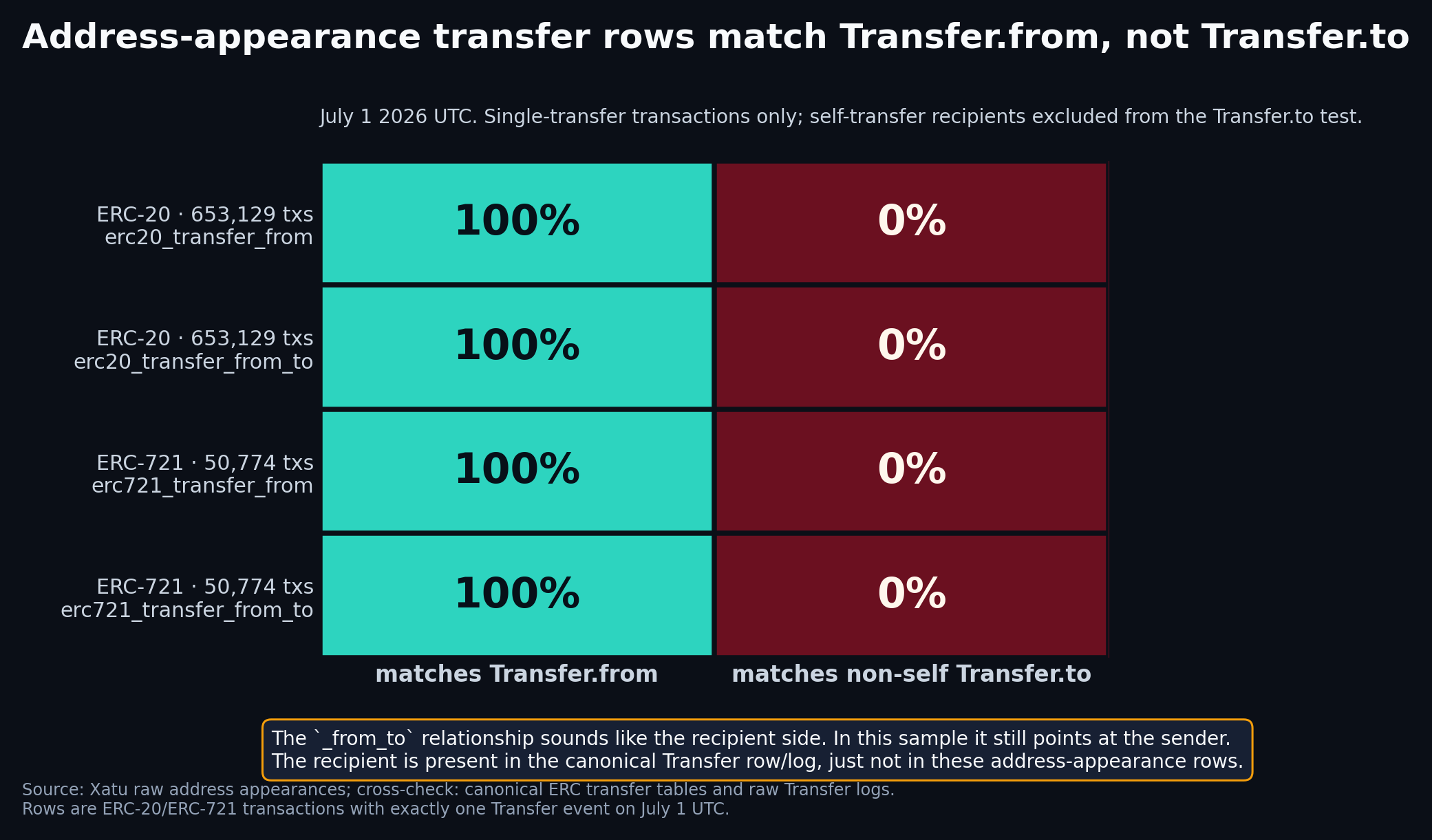
A single transaction makes the bug-shaped part easier to see. In 0x0b33ba5384aa9457a8897fa1781ee2963b1d2d0703f00cf2c47411d31d0d5d01, the canonical ERC-20 transfer row says token 0xa12c...f4f3, from 0x91d4...debe, to 0xcc49...0f52. The raw log agrees: topic1 is the sender and topic2 is the recipient.
The address-appearance rows for that same transaction do not include the recipient under the transfer relationship. They include erc20_transfer_from = 0x91d4...debe and erc20_transfer_from_to = 0x91d4...debe. The recipient can still appear elsewhere in the transaction through some other call or event, but this transfer relationship row is not how you find it.
This is exactly the kind of table that can poison a dashboard without looking broken. If you count erc20_transfer_from_to as recipient activity, you are really counting senders again. If you use the table as a general address-touch index, keep the role caveat attached to it and cross-check token movement with canonical_execution_erc20_transfers, canonical_execution_erc721_transfers, or raw Transfer logs.
The safe rule is boring but useful: canonical_execution_address_appearances is a relationship-row surface, not a canonical token-transfer participant table. For ERC-20 and ERC-721 recipients on July 1, the transfer tables had the recipient. The address-appearance transfer rows did not.