The state-size total I used was not the total

I owe this one a correction. In February I wrote that Ethereum was carrying 296 GB of state. That was the value of mainnet.fct_execution_state_size_daily.total_bytes, but it was not the component total I described in the post.
On the same Feb 26 row, the exposed account, account-trie, contract-code, storage, and storage-trie byte columns add up to 430.9 GB. Storage trie bytes alone were 220.8 GB, so my old sentence saying "296 GB total" while also talking about trie bytes as part of that total was internally broken.
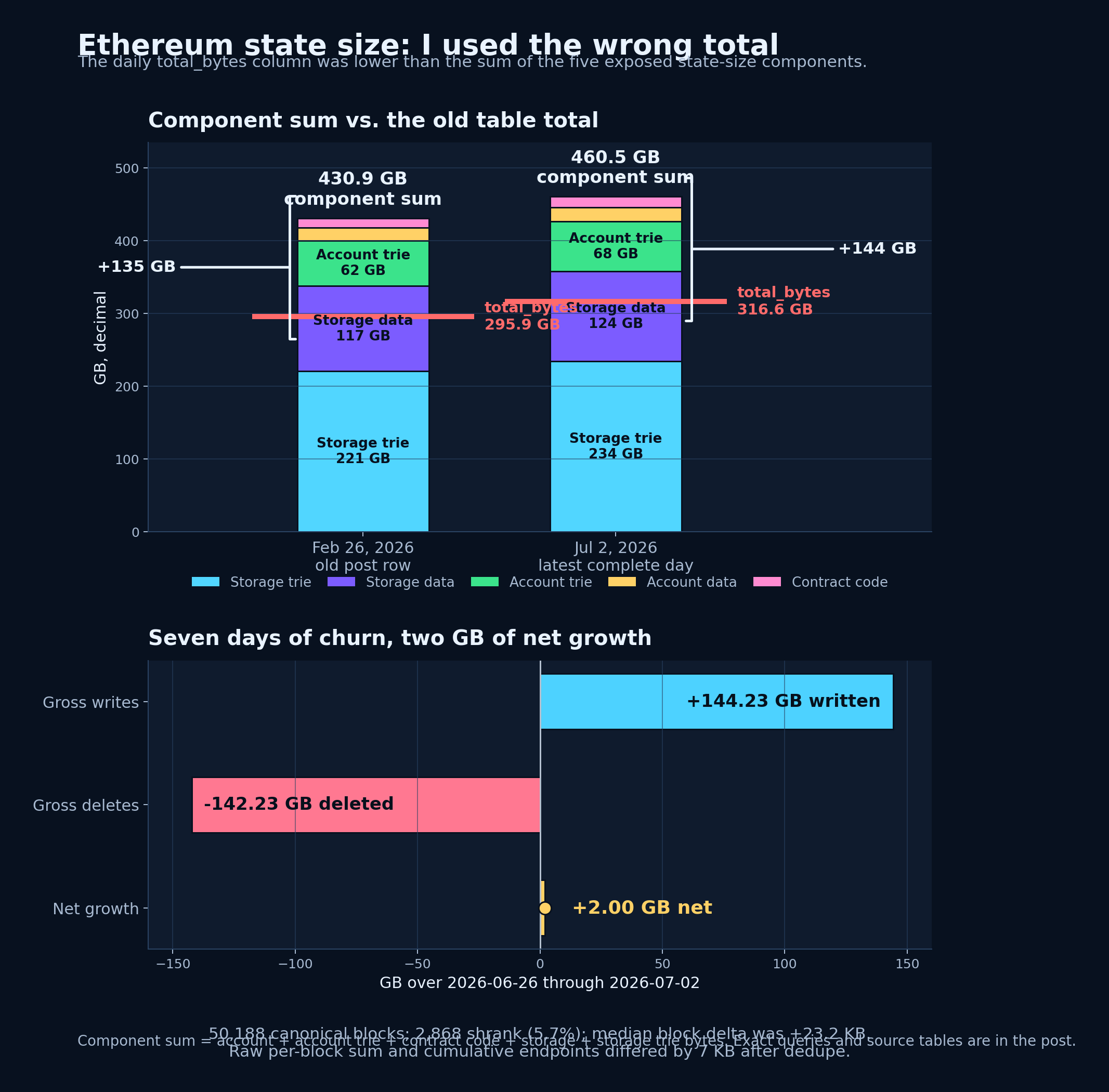
Here is the exact check that caught it. I am not doing anything clever here, just putting the table's total_bytes column next to the sum of the five byte components exposed in the same row.
SELECT
  day_start_date AS day,
  total_bytes,
  account_bytes,
  account_trienode_bytes,
  contract_code_bytes,
  storage_bytes,
  storage_trienode_bytes,
  account_bytes
    + account_trienode_bytes
    + contract_code_bytes
    + storage_bytes
    + storage_trienode_bytes AS component_sum_bytes,
  account_bytes
    + account_trienode_bytes
    + contract_code_bytes
    + storage_bytes
    + storage_trienode_bytes
    - total_bytes AS gap_bytes
FROM mainnet.fct_execution_state_size_daily FINAL
WHERE day_start_date IN (toDate('2026-02-26'), toDate('2026-07-02'))
ORDER BY day;
| day | total_bytes | component sum | gap |
|---|---|---|---|
| 2026-02-26 | 295.912 GB | 430.932 GB | 135.021 GB |
| 2026-07-02 | 316.606 GB | 460.532 GB | 143.925 GB |
That is the correction: the February byte total in the old post should have been 430.9 GB if the sentence means "sum the state-size components this table exposes." The current equivalent is 460.5 GB as of the end of Jul 2. The dormant-storage-slot finding from that post still uses separate storage-slot tables and still survives, but the headline byte count and the "storage trie is part of this 296 GB" wording do not.
I cross-checked the component sum against the newer cumulative by-block table. First I resolved the canonical end-of-day execution blocks, then read the same five components at those block heights.
-- End-of-day block numbers from canonical_execution_block:
-- 2026-02-26 -> 24544538
-- 2026-07-02 -> 25448270

SELECT
  block_number,
  account_bytes
    + account_trienode_bytes
    + contract_code_bytes
    + storage_bytes
    + storage_trienode_bytes AS component_sum_bytes,
  account_bytes,
  account_trienode_bytes,
  contract_code_bytes,
  storage_bytes,
  storage_trienode_bytes
FROM mainnet.int_execution_state_size_by_block FINAL
WHERE block_number IN (24544538, 25448270)
ORDER BY block_number;
That returned the same component sums: 430,932,424,434 bytes at block 24544538 and 460,531,564,066 bytes at block 25448270. This matters because int_execution_state_size_by_block is reconstructed from execution_state_size_delta, not just another view of the daily row I originally used.
The raw delta table also gives a nicer mental model for state growth. Over the seven complete UTC days from Jun 26 through Jul 2, mainnet did not simply "add two GB" in a quiet way. It wrote 144.23 GB of state-size components and deleted 142.23 GB, ending up about 2.00 GB larger.
WITH per_block AS (
  SELECT
    block_number,
    argMax(
      account_bytes_delta
        + account_trienode_bytes_delta
        + contract_code_bytes_delta
        + storage_bytes_delta
        + storage_trienode_bytes_delta,
      updated_date_time
    ) AS total_bytes_delta,
    argMax(
      account_write_bytes
        + account_trienode_write_bytes
        + contract_code_write_bytes
        + storage_write_bytes
        + storage_trienode_write_bytes,
      updated_date_time
    ) AS gross_write_bytes,
    argMax(
      account_delete_bytes
        + account_trienode_delete_bytes
        + contract_code_delete_bytes
        + storage_delete_bytes
        + storage_trienode_delete_bytes,
      updated_date_time
    ) AS gross_delete_bytes,
    count() AS raw_rows,
    uniqExact(tuple(
      account_bytes_delta,
      account_trienode_bytes_delta,
      contract_code_bytes_delta,
      storage_bytes_delta,
      storage_trienode_bytes_delta
    )) AS metric_shapes
  FROM execution_state_size_delta
  WHERE meta_network_name = 'mainnet'
    AND block_number >= 25398083
    AND block_number <= 25448270
  GROUP BY block_number
)
SELECT
  count() AS blocks,
  sum(raw_rows) AS raw_rows,
  countIf(metric_shapes > 1) AS disagreement_blocks,
  sum(total_bytes_delta) AS raw_net_bytes,
  sum(gross_write_bytes) AS gross_write_bytes,
  sum(gross_delete_bytes) AS gross_delete_bytes,
  quantileExact(0.5)(total_bytes_delta) AS median_delta_bytes,
  countIf(total_bytes_delta < 0) AS shrinking_blocks
FROM per_block;
That query covered 50,188 canonical blocks and 200,956 raw rows, roughly four instrumented rows per block. Only 51 blocks had component-shape disagreement across raw rows. Summing the deduped raw deltas gave 2,000,031,561 bytes of net growth; the cumulative by-block endpoints gave 2,000,038,747 bytes, a 7,186-byte difference over the whole week. Close enough to trust the shape, but I use the endpoint number when I need the final net.
The more useful point is the cancellation. 2,868 blocks in that week actually shrank the component sum, about 5.7% of canonical blocks. The median block added only 23.2 KB, while the gross write/delete streams moved two orders of magnitude more data than the net line suggests.
So the corrected story is messier, but better. Ethereum's exposed state-size components were about 431 GB on the day of the old post and 461 GB at the end of Jul 2. Recent growth is still a few hundred MB per day, but underneath that smooth net line is a churn machine writing and deleting roughly twenty GB of state components per day.
This is the kind of table footgun I like least: every column name sounds obvious until you add the columns.