Plataberget's 16,306-deposit fork boundary

Plataberget's Gloas fork looked like an epoch boundary until the head metrics stopped moving. Lodestar and Nimbus reported a post-fork head in 21 seconds median. Prysm and Teku did not get there for roughly 93 minutes.
The fork was not just a version switch. It walked 16,306 pending deposits to build Gloas's new payload-builder registry, and the way clients handled that queue decided who crossed quickly.
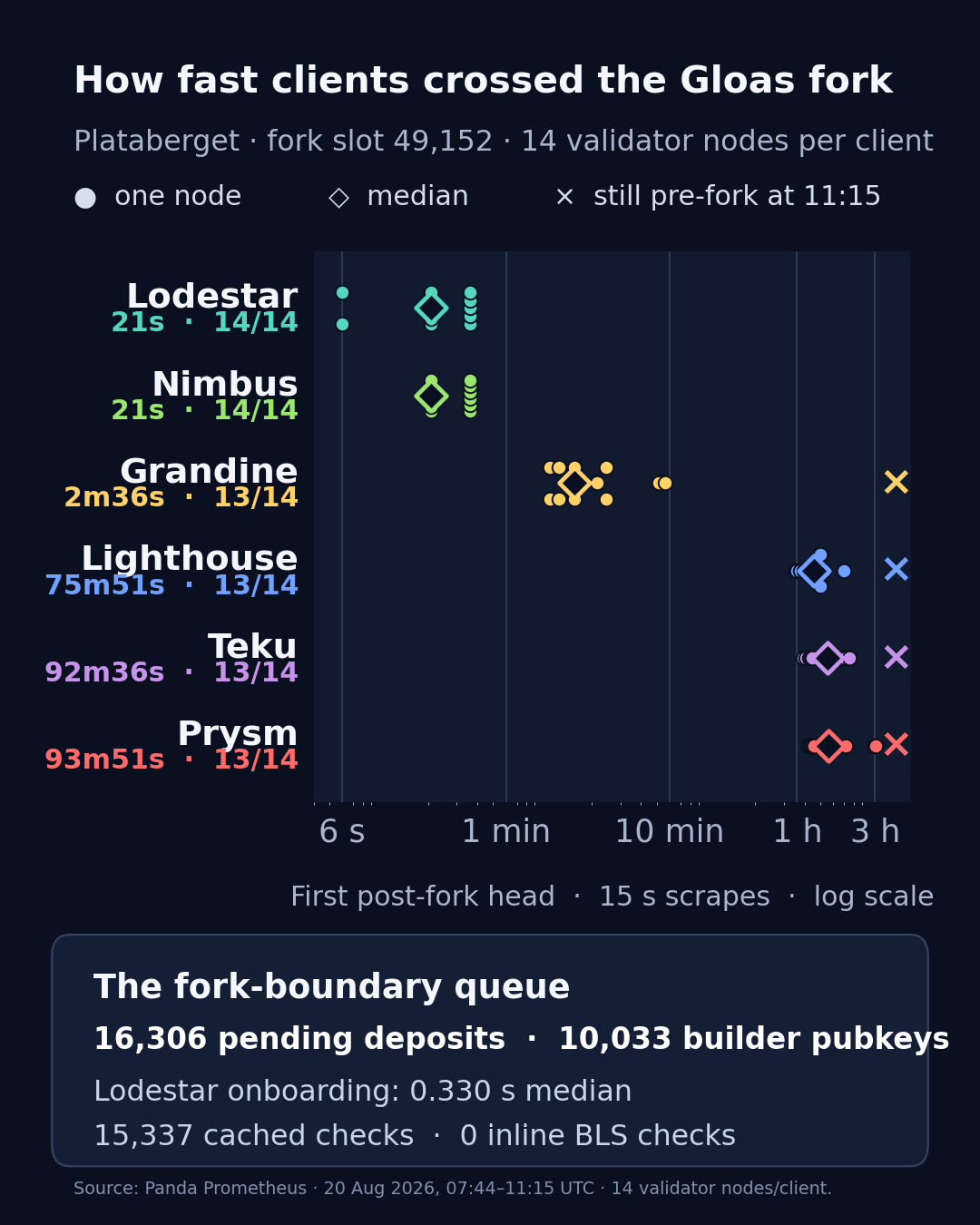
The split
The fork activated at epoch 1,536, slot 49,152, at 07:50:24 UTC on August 20. Plataberget's public inventory had 84 validator-carrying beacon nodes in the comparison: six consensus clients, seven execution-client pairings, and two nodes per pairing. I filtered out bootnodes, buildoor nodes, and execution exporters before touching the numbers.
This is the executed Panda reduction. The row grain is one Prometheus series per beacon-node instance, not one scrape and not one validator:
from ethpandaops import prometheus
from statistics import median

fork_ts = 1787212224
fork_slot = 49_152

raw = prometheus.query_range(
    "devnets",
    'beacon_head_slot{'
    'network="glamsterdam-devnet-8",'
    'job="consensus_node",supernode="True"}',
    step="15s",
    start="2026-08-20T07:44:00Z",
    end="2026-08-20T11:15:00Z",
)

by_client = {}
for series in raw["result"]:
    client = series["metric"]["consensus_client"]
    values = [(float(t), float(v)) for t, v in series["values"]]
    delay = next(
        (t - fork_ts for t, v in values if t >= fork_ts and v >= fork_slot),
        None,
    )
    by_client.setdefault(client, []).append(delay)

summary = {
    client: {
        "median_seconds": median(x for x in delays if x is not None),
        "crossed": sum(x is not None for x in delays),
        "nodes": len(delays),
    }
    for client, delays in by_client.items()
}
| Client | Median first post-fork head | Crossed by 11:15 |
|---|---|---|
| Lodestar | 21 s | 14 / 14 |
| Nimbus | 21 s | 14 / 14 |
| Grandine | 2m 36s | 13 / 14 |
| Lighthouse | 75m 51s | 13 / 14 |
| Teku | 92m 36s | 13 / 14 |
| Prysm | 93m 51s | 13 / 14 |
The 15-second scrape interval means these are first-observed delays, not nanosecond timings for the upgrade function. They still separate cleanly. Every Lodestar and Nimbus node crossed within 36 seconds, every observed Grandine crossing happened within 9 minutes 21 seconds, and no Prysm or Teku node crossed in the first hour.
This was not missing telemetry dressed up as a stall. All 84 head series had samples before and after the fork. For Prysm, 13 of 14 process_start_time_seconds series did not change through the window, so those nodes stayed up while their reported head remained below slot 49,152.
The queue hiding inside the fork
Gloas starts with an empty builder registry. At the fork boundary, the spec's builder-onboarding function walks the existing deposit queue, decides which deposits belong to validators or builders, checks signatures, and constructs the registry. The spec note is unusually direct: implementations should validate pending-deposit signatures before the fork and cache the answers because the queue might be large.
Plataberget made "might be large" concrete. Lodestar's pre-fork gauges agreed on all 14 validator nodes:
- 16,306 pending deposits, all 16,306 scanned and cached;
- 10,033 distinct builder pubkeys tracked;
- 15,337 signature checks served from cache during onboarding;
- zero BLS checks run inline on the fork transition's critical path.
I queried the gauges and transition metrics separately rather than adding Prometheus scrapes together:
metric_names = [
    "lodestar_builder_deposit_preverify_pending_deposits",
    "lodestar_builder_deposit_preverify_scanned_deposits",
    "lodestar_builder_deposit_preverify_cached_deposits",
    "lodestar_builder_deposit_preverify_builder_pubkeys",
    "lodestar_stfn_gloas_onboard_builders_signature_checks",
]

for name in metric_names:
    result = prometheus.query(
        "devnets",
        f'{name}{{network="glamsterdam-devnet-8",'
        'job="consensus_node",supernode="True"}',
    )
The first increment in Lodestar's onboard_builders_seconds_sum ranged from 0.226 to 0.458 seconds, with a 0.330-second median across the 14 nodes. That number covers the deposit-onboarding phase, not the whole fork upgrade or the wait for a head block. It does show that preverification and Lodestar's append-only builder-registry path kept the ugly loop off the critical path.
There is a second check outside the metric family. Tracoor fetched 14 slot-49,152 states from Lodestar and Nimbus at about 07:50:30 UTC. All 14 had the same state root, 0x6f6205ae...d6d025, and the same content hash. The two clients that crossed first were not merely incrementing a local head counter; they agreed on the post-fork state bytes.
Prysm found the quadratic path
All 14 Prysm nodes reported v7.1.8 commit d790f667 immediately before the fork. In that code, each builder candidate could call IsPendingValidator over earlier deposits with the same pubkey and verify those signatures again. A queue shape with repeated pubkeys turns the fork-boundary scan into far more work than the row count suggests.
Prysm maintainers opened PR #17387 during the incident. Its reproduction says Devnet-8 triggered millions of redundant checks and stalled Prysm at the Gloas fork. The patch caches pending-validator status by pubkey, remembers deposit verification by hash-tree root, and makes each pending deposit hit BLS verification at most once. The code change matches the failure visible in the head series; the PR was still open at the end of this measurement window.
I do not have the same code-level attribution for Teku or Lighthouse. Their head delays are measured, but this post does not claim they hit Prysm's exact bug. It also is not a general client benchmark: this is one purpose-built devnet, one large synthetic queue, and a delay that includes the state transition, catch-up, and head selection.
Why finality stopped
The inventory assigned 1,000 validator keys to each of the 84 validator nodes. Lodestar and Nimbus therefore put about one-third of the configured validator set across the fork in the first minute. Grandine raised that to 41 of 84 nodes within ten minutes, still short of the two-thirds effective-balance threshold needed for finality.
The finality metrics fit that arithmetic. beacon_finalized_epoch reached 1,534 and stayed there through 11:15 UTC while the fastest heads reached slot 50,109, in epoch 1,565. That is a 31-epoch gap. Node counts are only a proxy for effective balance, but the keys were deliberately distributed evenly here, and the proxy is not close to the threshold.
This is what a useful devnet failure looks like. The spec said the queue could be slow; Plataberget supplied 16,306 deposits and turned "slow" into an hour and a half. Caching was not a micro-optimization. It was the fork.