Ethereum's identity precompile is weirdly busy

A Hegotá proposal would remove a precompile that contracts called an observed 4.07 million times in twelve days. That sounds reckless until you look at the bill: a first-touch upper-bound backcast of Draft EIP-7666 adds up to 0.44% to the gas used by the affected transactions.
Address 0x04 is the identity precompile. Give it bytes and it returns the same bytes, an old EVM trick for copying memory before MCOPY existed. EIP-7666 would remove that special client path and install seven bytes of ordinary EVM code at the address instead: CALLDATASIZE PUSH0 PUSH0 CALLDATACOPY CALLDATASIZE PUSH0 RETURN.
At ACDE 242, core developers put EIP-7666 forward for inclusion alongside the Hegotá EVMification work, then moved it from Stagnant back to Draft on August 11. Proposed for Inclusion starts client review; it is not final fork scope or a mainnet activation. This is a backcast against current calls, not a fork result.
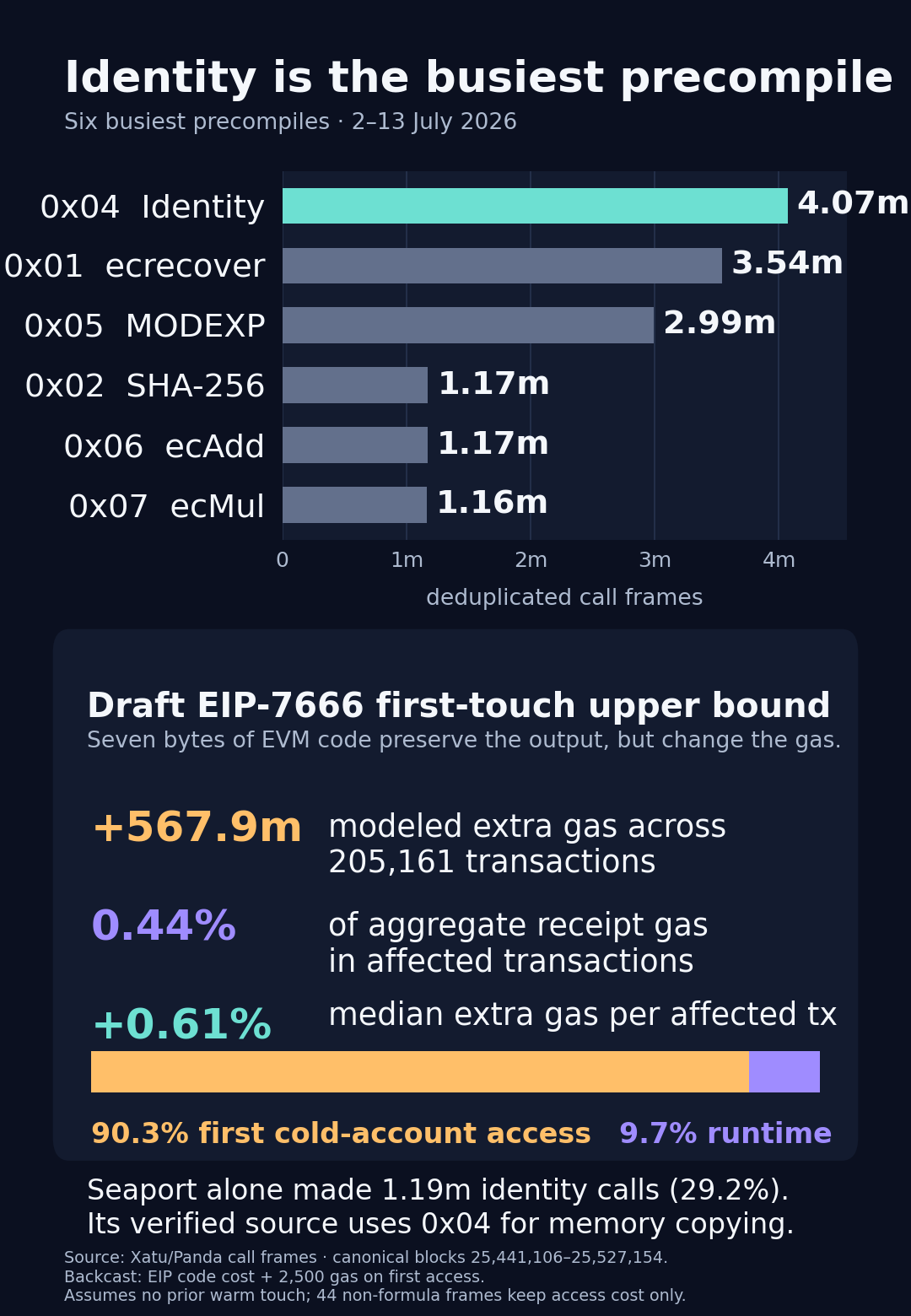
The busiest precompile, by call count
I froze canonical blocks 25,441,106 through 25,527,154, covering July 2–13 as twelve complete UTC days. Refined beacon blocks and raw execution blocks agreed on all 86,049 canonical block numbers and both timestamp edges.
One row in mainnet.int_transaction_call_frame is one execution call frame. I checked its intended key, (block_number, transaction_hash, call_frame_id), before counting; all 4,068,918 identity rows were unique at that grain. The comparison query was:
precompiles = ",".join(
    f"'0x{i:040x}'" for i in range(1, 18)
)

sql = f"""
SELECT
  lowerUTF8(ifNull(target_address, '')) AS precompile_address,
  count() AS frames,
  uniqExact(transaction_hash) AS transactions,
  sum(gas) AS self_gas
FROM mainnet.int_transaction_call_frame FINAL
WHERE block_number BETWEEN 25441106 AND 25527154
  AND lowerUTF8(ifNull(target_address, '')) IN ({precompiles})
GROUP BY precompile_address
ORDER BY frames DESC
"""
Identity came first with 4,068,918 frames in 205,161 transactions, or 28.70% of calls to mainnet precompile addresses 0x01 through 0x11. ECRECOVER followed at 3.54 million frames and MODEXP at 2.99 million; the two observed BLS precompiles had 96 calls each and did not change the ranking. This is call count, not gas consumption: identity used only 123.5 million gas inside the precompile, while the expensive cryptographic precompiles burned far more per call.
The call-frame model had 29,698,032 root frames against 29,700,412 canonical transactions in the same blocks, 99.992% root-transaction coverage. With that gap, I report 4.07 million as the observed count rather than an exact total; the missing 2,380 roots may still contain identity calls.
There is another useful trap here. canonical_execution_transaction found zero top-level transactions sent to 0x04, and the lower-level canonical_execution_traces table also returned zero frames whose action_to was the identity address. A top-level destination query says nobody uses identity. The dedicated call-frame model says the opposite because every observed use was nested.
Seaport still uses the old memory-copy trick
The loudest immediate parent was Seaport 1.6, which made 1,189,056 identity calls, 29.22% of the whole 0x04 pile. Its fulfillAvailableAdvancedOrders path alone produced 932,152 of them.
This is not address-label guesswork. The source used for the deployed contract defines IdentityPrecompileAddress = 0x4, then implements MemoryPointerLib.copy() with a staticcall that copies size bytes from one memory pointer to another. In one exact Seaport transaction, the call-frame model found 30 depth-one static calls to identity while filling five advanced orders.
MCOPY exists now, but deployed contracts do not rewrite themselves. EIP-7666 can remove the client-side precompile without removing the address-level behavior those contracts expect.
The repricing is mostly one cold address
The current identity runtime costs 15 + 3 × words, where words = ceil(input_bytes / 32). EIP-7666's fresh call memory makes the seven-byte replacement cost 13 + 6 × words + floor(words² / 512): 13 gas of fixed opcodes, three gas per copied word, and the standard linear-plus-quadratic memory expansion.
I recovered words from each observed self-gas value, then calculated the runtime delta at transaction grain. The exact aggregate expression was:
SELECT
  transaction_hash,
  count() AS calls_in_tx,
  sumIf(
    toInt64(
      13
      + 6 * intDiv(gas - 15, 3)
      + intDiv(
          intDiv(gas - 15, 3) * intDiv(gas - 15, 3),
          512
        )
    ) - toInt64(gas),
    gas >= 15 AND modulo(gas - 15, 3) = 0
  ) AS runtime_extra_gas
FROM mainnet.int_transaction_call_frame FINAL
WHERE block_number BETWEEN 25441106 AND 25527154
  AND lowerUTF8(ifNull(target_address, '')) =
      '0x0000000000000000000000000000000000000004'
GROUP BY transaction_hash;
That runtime change adds 54,950,438 gas. The bigger piece comes from EIP-2929: precompiles start warm today, while ordinary code at 0x04 would normally pay the 2,600-gas cold account access cost on its first touch instead of the 100-gas warm cost. Adding 2,500 gas once per affected transaction contributes another 512,902,500 gas.
Together, the first-touch upper bound adds 567,852,938 gas across the window, and the 2,500-gas cold first touch accounts for 90.3% of it. Against 129,186,166,761 gas in the containing transaction receipts, that is 0.4396%. The median affected transaction rises 0.6128% and the 95th percentile rises 1.5754%. Direct Seaport entry transactions move a little more: 0.63% in aggregate and 1.12% at the median.
The 2,500-gas access term is an upper bound because an access list or an earlier account touch may already have warmed 0x04; the transaction model exposes neither access lists nor opcode-level touches. The runtime calculation excludes 44 three-gas frames whose input length cannot be recovered from the current formula, though I still include each transaction's first-touch charge. I did not replay gas limits, so this backcast cannot identify tight calls that would fail after repricing. It also uses today's opcode schedule rather than a final Hegotá gas table.
Busy does not mean expensive
The identity precompile is not dead code. It is the busiest precompile by observed internal call count, and one immutable marketplace explains almost a third of the traffic. Those calls are why EIP-7666 preserves the behavior at 0x04 even while removing the precompile.
Millions of calls do not add up to much transaction gas because each one is a cheap memory copy. EIP-7666's phrase "gas costs are slightly different" hides a model that raises identity-related gas to 5.6× today's tiny self-gas bill, but not a 5.6× increase in transaction cost. Most affected transactions land below 2%. The unresolved part is the cold touch: access-list and opcode-level replay should show how often the extra 2,500 gas actually applies.