The 2,020 ETH Slash — and Why It Only Cost 5 ETH

On September 10, 2025, a single Ethereum validator holding 2,020 ETH double-signed an attestation. By any historical measure, the damage should have been severe. Under the rules in place before Pectra, an initial slashing penalty of that scale would have wiped out tens of ETH in one epoch.
Instead, the validator lost roughly 5.53 ETH total — about 0.27% of its stake — and withdrew 2,015 ETH on October 28, intact. The new Electra slashing formula had been tested in the wild, and it worked exactly as designed.
How a 32 ETH Validator Became a 2,020 ETH Validator
Validator #1,073,521 was unremarkable for almost two years. Activated in December 2023 with 32 ETH, it sat at the old beacon chain cap, quietly accumulating rewards — earning, losing nothing unusual.
That changed on May 8, 2025, the day after Pectra went live.
Within hours of Electra activation, the validator received 62 consolidations. Its effective balance jumped from 32 ETH to 1,920 ETH in a single epoch — a near-instantaneous 60× amplification enabled by EIP-7251's MaxEB. Over the following months, compounding rewards pushed it further, reaching a peak of 2,020.5 ETH by early September.
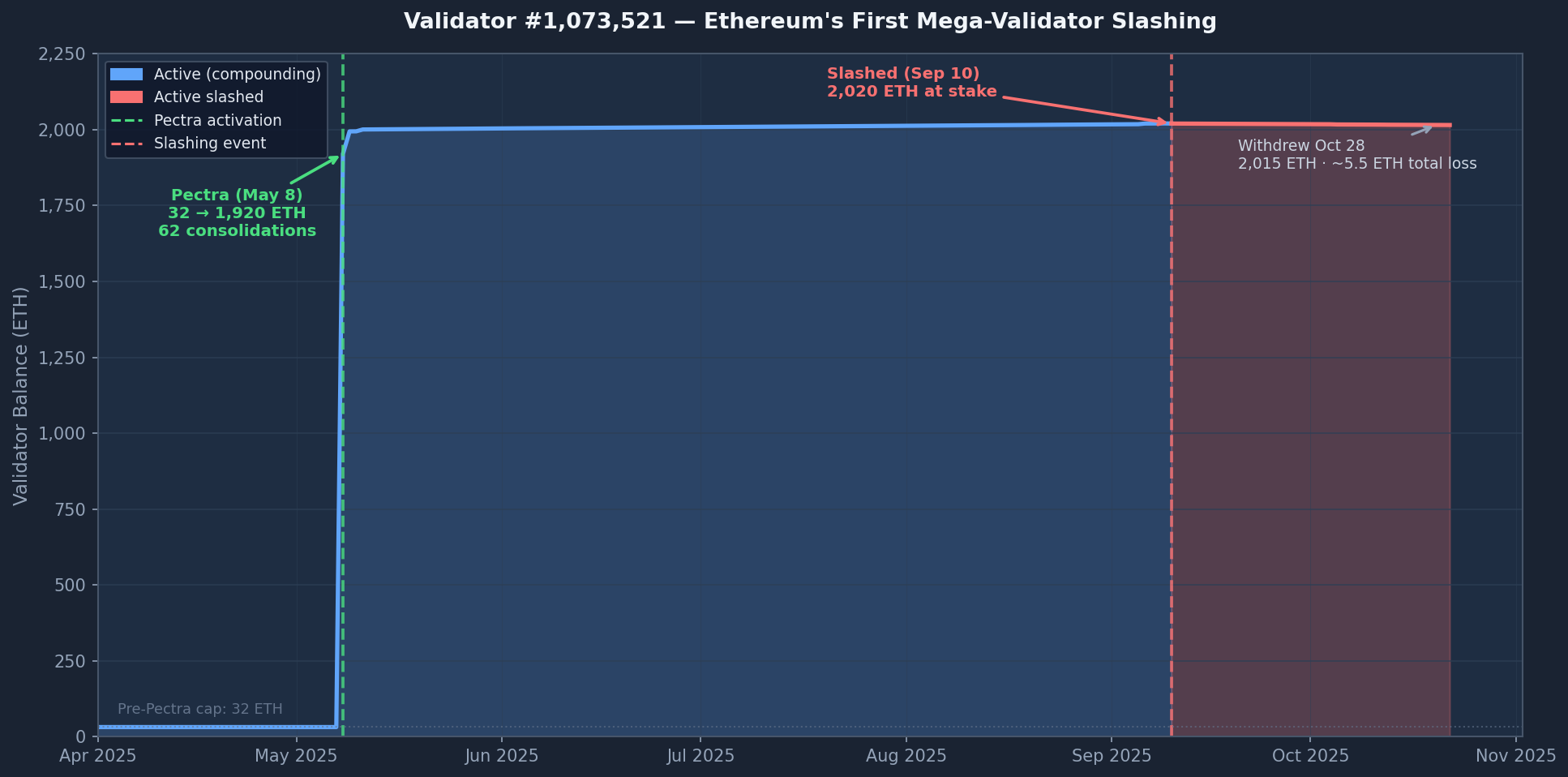
This was the first mega-validator in Ethereum's history to be slashed. Nothing in the network's past had combined that level of ETH concentration with a double-signing event — until September.
The SSV Incident
The slashing originated from an SSV Network cluster. SSV is a distributed validator technology (DVT) protocol that splits signing keys across multiple operators to prevent single points of failure. On paper, it should make slashing harder, not easier.
But the Sep 10 event traced back to operator-side failures, not protocol compromise. One cluster involved routine maintenance by Ankr that left a secondary signing instance running. A second cluster had migrated from Allnodes two months earlier and left a ghost validator still active on the old infrastructure.
The result: 40 unique validators double-voted on September 10, followed by 7 more on September 12 (including a sequential batch of 6 — validators 975,016 through 975,021 — almost certainly from the same operator migration). A handful more were slashed later in September.
In total, 49 unique validators across September 2025 were slashed, carrying a combined effective balance of 3,556 ETH — the second-largest total at-stake in any single month since Ethereum's beacon chain launched.
For comparison: November 2023's mass slashing event (Ethereum's current all-time worst month, at 106 unique validators) involved validators all at the 32 ETH cap, totalling around 3,392 ETH. September 2025's event had fewer validators but more ETH at risk, entirely because of one mega-validator.
Why the Penalty Was So Small
The Ethereum slashing mechanism has two components. First, an immediate penalty applied at the slashing epoch: a fixed fraction of the validator's effective balance. Second, a correlation penalty applied later, proportional to the total slashed stake relative to the entire active stake.
What changed in Electra was the divisor used for the initial penalty. Before Electra, a slashing would take a larger fraction of the validator's balance. After EIP-7251 introduced MIN_SLASHING_PENALTY_QUOTIENT_ELECTRA = 4096 (compared to 32 in early Ethereum, later 64–128), the initial hit shrank dramatically per unit of stake.
For validator #1,073,521:
- Immediate penalty: ~0.49 ETH (2,020 ÷ 4,096)
- Correlation penalty: tiny — 3,556 ETH slashed / ~32,000,000 ETH total stake ≈ 0.011% of network stake
- Ongoing inactivity losses during 42 days of
active_slashedstatus: ~4 ETH - Total loss: 5.53 ETH
The observable balance drop from September 9 to September 10 was 0.4 ETH — matching the formula almost exactly. Under the pre-Electra divisor of 32, the same validator would have faced an initial penalty of ~63 ETH, before any correlation multipliers.
This is intentional design. With a million validators and effective balances now potentially reaching 2,048 ETH, applying the old formula at scale would make key-management mistakes catastrophically expensive for large operators. The new formula keeps the penalty proportional to the harm done to the network — which, when only 0.01% of stake double-votes, is genuinely small.
The Pattern Holding Across All of 2025
Looking at the full post-Pectra slashing record:
| Month | Unique slashed | Mega-validator? |
|---|---|---|
| Sep 2025 | 49 | Yes — val #1,073,521 at 2,020 ETH |
| Nov 2025 | 11 | No (all 32 ETH) |
| Dec 2025 | 14 | Yes — val #2,016,786 at 71 ETH |
| Feb 2026 | 3 | No |
Only two validators with effective balances above 64 ETH have been slashed since Pectra. Both were penalized proportionally small amounts. The correlation penalty structure ensured that the network, holding 32 million ETH, absorbed the shock without blinking.
The slashing system has been live for over five years. Fewer than 600 validators have ever been slashed, across more than one million that have participated in the protocol. Almost every incident traces back to operational errors — migration bugs, maintenance windows, leftover signing instances.
MaxEB concentrated more ETH per validator but did not change that fundamental pattern. What it did change — deliberately — was the cost of getting it wrong when you're running a 2,000 ETH validator instead of a 32 ETH one. Ethereum's slashing rules scaled with it.
Data sourced from Xatu (EthPandaOps). Validator balance data from fct_validator_balance_daily (xatu-cbt). Slashing event data from canonical_beacon_block_attester_slashing. Sep 10 slashing context: CoinDesk reporting, beaconcha.in.