USDC eats 80% of EIP-8374's backcast

EIP-8374 looks like bookkeeping: stop deleting warm-access entries when an inner call reverts. Across 14 complete mainnet days, that one rule would have turned at least 169,495 later account accesses from cold to warm. The funny part is where they landed. 136,127 of them, or 80.3%, were calls into the same USDC FiatTokenV2_2 implementation.
This is not a chain-wide gas miracle. The verified address-only saving is 423,737,500 gas, just 0.0139% of the gas used in the window. It does expose a real execution shape hiding behind proxy calls: an inner frame touches an implementation and reverts, then a surviving frame reaches the same implementation and pays the cold surcharge again.
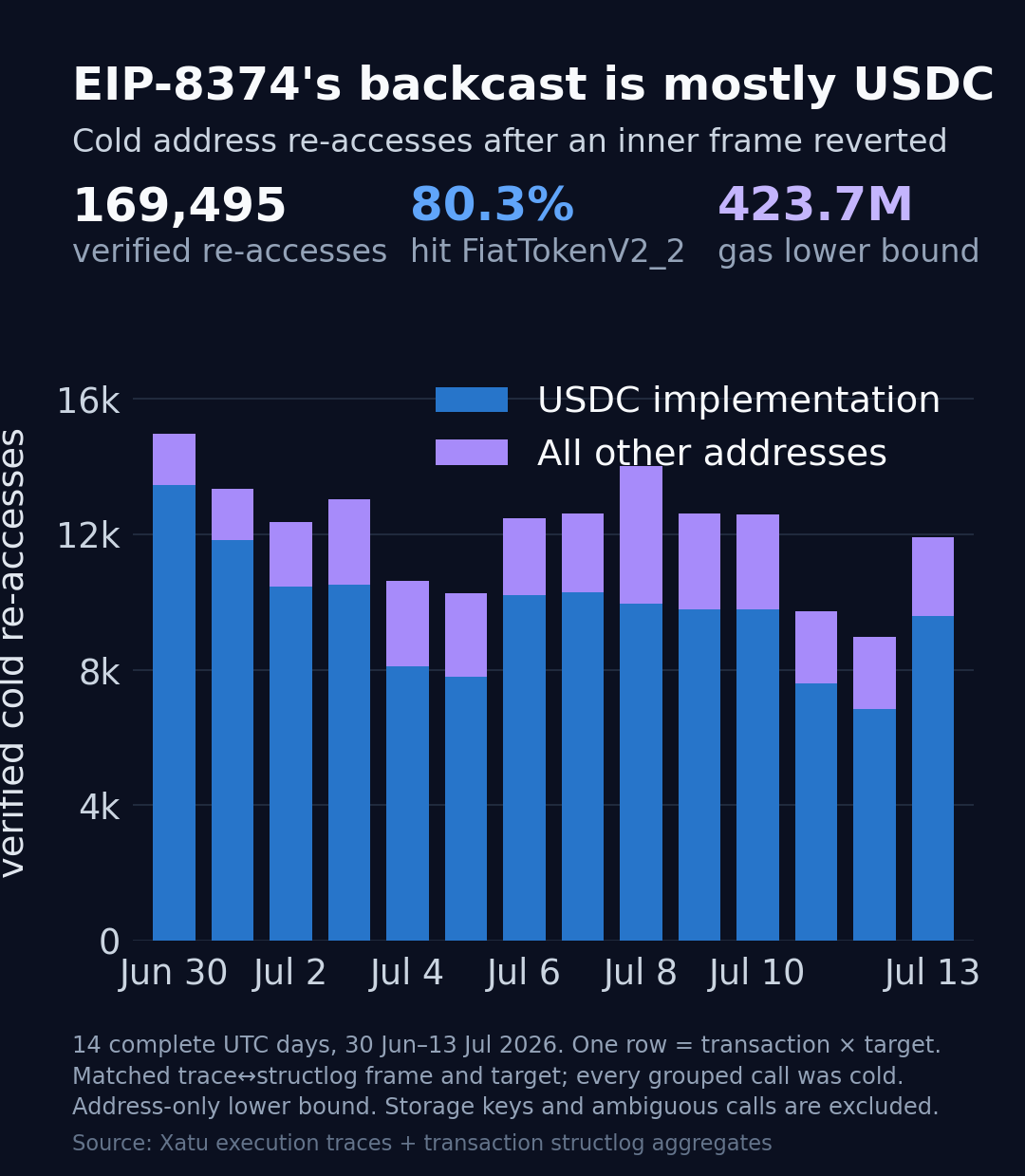
The rule is stranger than it sounds
EIP-2929 charges 2,600 gas for the first account access in a transaction and 100 gas after the address is warm. It also says the access sets roll back with a failed scope. State changes have to revert, of course, but the client's cache does not forget the bytes it just loaded.
Draft EIP-8374 at commit 6c39b7f makes the two access sets append-only for the transaction. Once a reverted child has loaded an address or storage key, a later access stays warm. The proposal PR is open; this is not merged, scheduled, or live on mainnet.
There is one easy counting trap here. If frame A calls frame B and B reverts, B's address was accessed by A before B's failed scope began. That address remains warm today. Only addresses touched inside B, including B's subcalls, lose their warmth when B rolls back.
I handled that boundary from the trace path rather than treating every errored row as discarded. A target counted as reverted only when a strict ancestor path had an error. A later access had to sit outside every errored ancestor, and the target could not have appeared earlier in a surviving scope.
The trace reduction
The structlog aggregate was complete through July 13, so I froze 14 complete UTC days from June 30 through July 13. That window contains 100,388 canonical blocks and 34,076,118 transactions. I ran the reduction one day at a time over canonical_execution_traces FINAL and kept one row per transaction and target address:
WITH grouped AS (
  SELECT
    block_number,
    transaction_hash,
    arraySort(x -> x.1, groupArray((
      internal_index,
      ifNull(trace_address, ''),
      lower(ifNull(action_to, '')),
      toUInt8(error IS NOT NULL),
      lower(action_call_type)
    ))) AS events,
    arrayMap(e -> e.2, arrayFilter(e -> e.4 = 1, events)) AS error_paths
  FROM default.canonical_execution_traces FINAL
  WHERE meta_network_name = 'mainnet'
    AND block_number BETWEEN {day_min_block} AND {day_max_block}
  GROUP BY block_number, transaction_hash
  HAVING has(error_paths, '') = 0
     AND length(error_paths) > 0
), targets AS (
  SELECT
    block_number,
    transaction_hash,
    events,
    error_paths,
    arrayDistinct(arrayMap(d -> d.3, arrayFilter(d ->
      d.3 != ''
      AND arrayExists(
        ep -> startsWith(d.2, concat(ep, '_')),
        error_paths
      ),
      events
    ))) AS discarded_targets
  FROM grouped
), expanded AS (
  SELECT block_number, transaction_hash, events, error_paths, target_address
  FROM targets
  ARRAY JOIN discarded_targets AS target_address
), qualified AS (
  SELECT
    block_number,
    transaction_hash,
    target_address,
    arrayMin(arrayMap(d -> if(
      d.3 = target_address
      AND arrayExists(
        ep -> startsWith(d.2, concat(ep, '_')),
        error_paths
      ),
      d.1,
      toUInt32(4294967295)
    ), events)) AS first_discarded_index,
    arrayFirst(p ->
      p.3 = target_address
      AND NOT arrayExists(
        ep -> startsWith(p.2, concat(ep, '_')),
        error_paths
      ),
      events
    ) AS first_persistent_event
  FROM expanded
  WHERE arrayExists(p ->
    p.3 = target_address
    AND NOT arrayExists(
      ep -> startsWith(p.2, concat(ep, '_')),
      error_paths
    ),
    events
  )
)
SELECT
  block_number,
  transaction_hash,
  target_address,
  first_discarded_index,
  first_persistent_event.1 AS later_internal_index,
  first_persistent_event.5 AS later_call_type
FROM qualified
WHERE first_discarded_index < later_internal_index;
That produced 337,319 trace candidates. A trace candidate says the call-tree order is compatible with the EIP, but it does not prove the later opcode paid cold gas. Access lists and earlier non-call opcodes can warm an address without leaving the same trace shape.
For the hard check, I matched the later trace to canonical_execution_transaction_structlog_agg FINAL. The trace's one-based internal_index matched the structlog's zero-based call_frame_id after subtracting one, but I also required the exact target address to match. I then moved to the parent frame and selected its CALL, STATICCALL, DELEGATECALL, or CALLCODE aggregate.
The exact filter inside the executed ClickHouse query was deliberately harsh:
arrayFirst(x ->
  x.1 = c.later_internal_index - 1
  AND x.3 = ''
  AND x.6 = c.target_address,
  a.opcode_events
) AS child_summary,
arrayFirst(x ->
  x.1 = child_summary.2
  AND x.3 = c.later_opcode,
  a.opcode_events
) AS parent_opcode_row

-- Kept in the local reduction only when:
parent_opcode_row.4 > 0
AND parent_opcode_row.5 = parent_opcode_row.4
If a parent executed three DELEGATECALLs and only one was cold, I threw the candidate away because the aggregate could not identify which child paid it. I also discarded exact frame IDs whose target address did not match. The funnel ended with 169,495 verified transaction-target pairs in 157,906 transactions. Another 17,608 matched pairs were definitely warm, 44,269 had mixed call groups, and 105,947 lacked an exact usable frame/target match.
This is why I call 423.7 million gas a lower bound. Each verified cold call would move from 2,600 gas to 100, saving exactly 2,500 gas. The total is 169,495 × 2,500; storage-key savings from SLOAD and SSTORE are absent because this dataset does not expose the keys at the required chronological grain.
One six-frame transaction explains the blue bars
Transaction 0x239e...3697 is the cleanest example I found. Its successful trace has a root plus five child frames:
- A contract makes a
STATICCALLto the USDC proxy. - The proxy uses
DELEGATECALLto reach0x4350...02dd, the verifiedFiatTokenV2_2implementation. - That branch reverts.
- The surviving caller later uses
CALLon the same USDC proxy. - The proxy delegates to
0x4350...02ddagain and succeeds.
The proxy itself is not the counted address. Its first STATICCALL target was warmed in the surviving parent before the reverted scope began. The implementation was reached from inside that failed proxy frame, so current EIP-2929 semantics rolled its warmth back.
The structlog check is blunt: the parent of the later implementation frame executed one DELEGATECALL, its gas entry was 2,600, and cold_access_count was one. Under EIP-8374 that second implementation access would cost 100 gas instead. No contract label or inferred selector is needed to make the accounting work.
That exact proxy pattern repeats a lot. The FiatTokenV2_2 address accounts for 136,127 of 169,495 verified re-accesses and appears in the same number of transactions. The next address has 8,047. Every other address combined contributes 33,368.
Small total, sharp clue
Only 0.46% of transactions in the window contained one of these verified address re-accesses, and 95% of affected transactions had exactly one. Even the full 423.7 million gas lower bound is a rounding error next to 3.046 trillion gas used over the 14 days.
The concentration is still useful. EIP-8374 is framed as a cleaner match between gas accounting and client cache behavior; the backcast says its visible account-level discount is not spread evenly across exotic contracts. In this window it was mostly one mundane proxy implementation getting loaded, forgotten by the access journal, and loaded again. The EIP is tiny at chain scale, but the reason it saves gas is sitting in plain sight.