Ethereum caught the arithmetic panic and kept going

Solidity's Panic(0x11) looks terminal. On mainnet it often isn't: across 14 complete UTC days, 5,333 of 5,772 transactions containing an overflow, underflow, or division-by-zero panic still ended green. Every panic happened in an internal child call.
That is a useful wrinkle for Draft EIP-8219, which proposes four checked-arithmetic opcodes. Its SAFEADD benchmark cuts a Solidity checked addition from roughly 79 gas to 5, but the cheap failure path returns empty bytes. Solidity currently returns the 36-byte Panic(uint256) payload, and the EIP explicitly calls that payload something the new opcodes trade away.
I wanted to know whether those payloads only appear at the end of doomed transactions. They do not.
The green receipt
I froze blocks 25,656,293 through 25,756,720, covering August 1–14. The trace key matters here: one row is one internal frame, not one transaction, so I reduced the raw table before reading the panic code.
-- Step 1: recover each Panic(uint256) frame once.
SELECT
  block_number,
  transaction_hash,
  internal_index,
  trace_address,
  argMax(ifNull(action_to, ''), updated_date_time) AS action_to_address,
  argMax(ifNull(error, ''), updated_date_time) AS error_text,
  argMax(lower(ifNull(result_output, '')), updated_date_time) AS output_hex
FROM default.canonical_execution_traces
WHERE meta_network_name = 'mainnet'
  AND block_number BETWEEN 25656293 AND 25756720
  AND startsWith(lower(ifNull(result_output, '')), '0x4e487b71')
GROUP BY
  block_number,
  transaction_hash,
  internal_index,
  trace_address;
0x4e487b71 is Solidity's Panic(uint256) selector. The final word supplied the panic code: 0x11 for arithmetic overflow or underflow and 0x12 for division or modulo by zero. I then fetched canonical transaction status for the exact returned hashes in literal batches of 1,500; I did not make a distributed join decide whether a missing match meant failure.
-- Step 2: run once per literal hash batch returned by Step 1.
SELECT
  transaction_hash,
  argMax(success, updated_date_time) AS root_success
FROM default.canonical_execution_transaction
WHERE meta_network_name = 'mainnet'
  AND block_number BETWEEN 25656293 AND 25756720
  AND transaction_hash IN (
    /* up to 1,500 literal hashes from Step 1 */
  )
GROUP BY transaction_hash;
The two arithmetic codes produced 8,120 deduplicated child-frame traces in 5,772 transactions. Of those transactions, 5,333 succeeded and 439 failed, a 92.39% success rate. At trace grain, 6,918 of 8,120 panics sat inside successful transactions; the lower 85.20% share reflects transactions that panicked more than once.
The panic surface is tiny, about 0.0167% of 34,598,710 transactions in the window. I used the refined daily counter only for that denominator and checked its block counts against the raw canonical block bounds.
SELECT sum(total_transactions) AS total_transactions
FROM mainnet.fct_execution_transactions_daily FINAL
WHERE day_start_date >= toDate('2026-08-01')
  AND day_start_date <  toDate('2026-08-15');
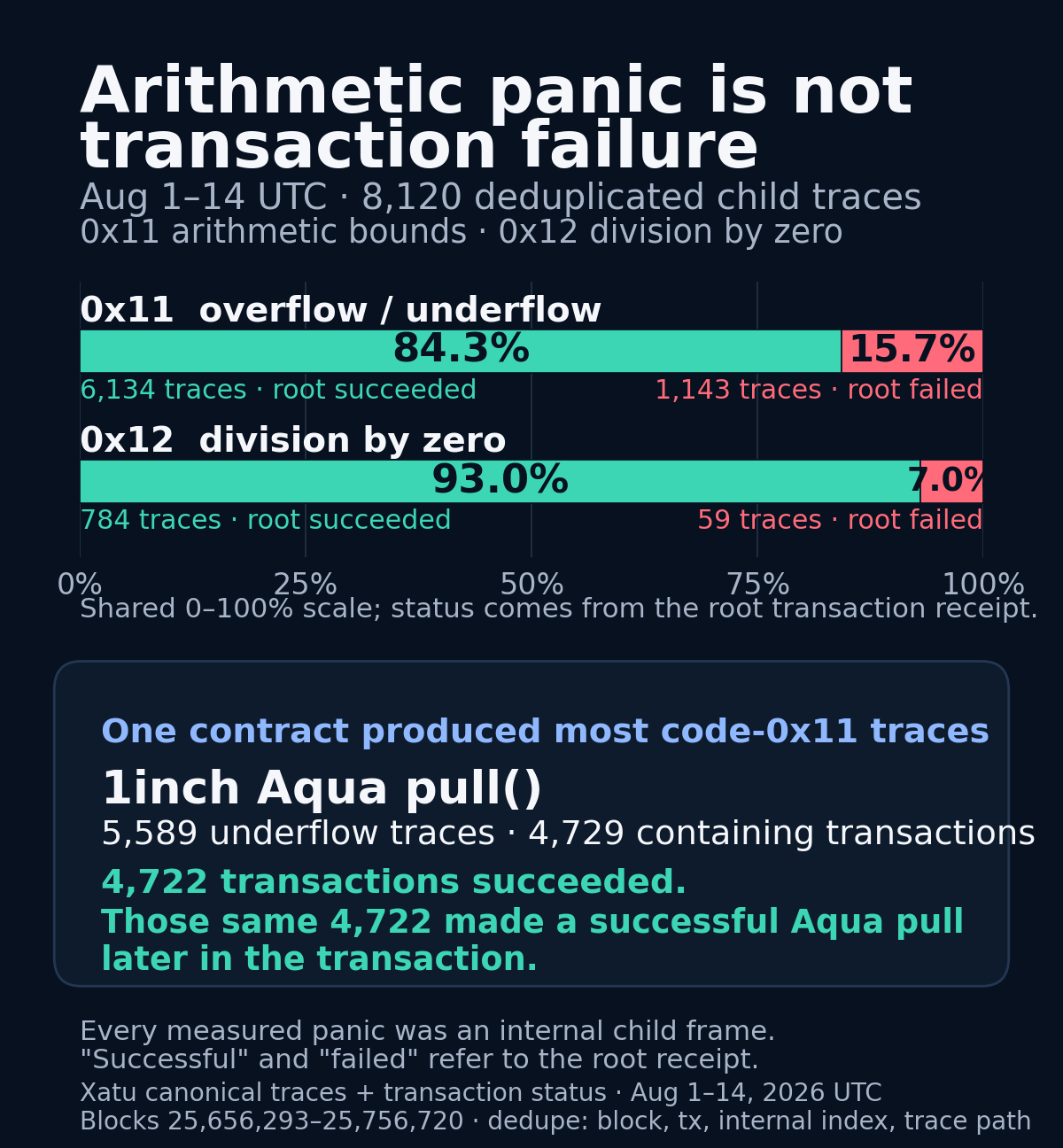
Code 0x11 accounted for 7,277 traces: 6,134 were inside green transactions and 1,143 were inside failed ones. Code 0x12 was smaller and even less terminal, with 784 of 843 traces inside green transactions.
Aqua is the weird part
One contract explains most of the 0x11 pile. The verified 1inch Aqua contract produced 5,589 underflow traces, 76.80% of every 0x11 trace in the window. Every call came from the 1inch SwapVM router and used pull(address,bytes32,address,uint256,address).
The source makes the failure plain. Aqua.pull() loads a packed strategy balance, then executes the checked subtraction below. Asking to pull more than prevBalance produces Solidity panic 0x11 before the token transfer.
(uint248 prevBalance, uint8 tokensCount) = balance.load();
balance.store(prevBalance - amount.toUint248(), tokensCount);
I fetched every Aqua pull() frame for the 4,729 transactions containing one of those underflows. 4,722 transactions succeeded, and those same 4,722 made a successful Aqua pull later in the transaction. This does not prove the later pull was a retry of the same route, but it does rule out the simple story that the underflow ended execution.
One exact trace is unusually readable. Transaction 0x6ba3…f4bf hit an Aqua pull() underflow at internal index 29, made another successful Aqua pull() at index 30, and finished with a successful root receipt in block 25,756,717. A separate public RPC receipt returned status 0x1, matching Xatu's canonical transaction row.
The byte string is part of the boundary
EIP-8219 does not claim to preserve Solidity's panic ABI. It says the opposite: SAFEADD, SAFESUB, SAFEMUL, and SAFEDIV revert with empty returndata, while Solidity currently emits the selector and code. That is how the proposal gets a one-opcode failure path without building a revert payload in memory.
The data does not prove that each caller inspects those 36 bytes. It does show that arithmetic failure frequently lives inside successful outer control flow, with a machine-readable payload present at the call boundary. Compiler and library authors should treat the empty-returndata change as an observable compatibility choice, not merely the removal of a nicer error message.
There is no mainnet SAFEADD traffic to measure because EIP-8219 is still Draft. This is a baseline for the behavior a future compiler target would replace, not an adoption forecast or an argument that the proposal's gas trade is wrong.